Mindfulness facet linked to student well-being in new longitudinal study
This study asks the sharper question behind self-compassion: which of its six parts actually moves student well-being over time.
Why this study stands out
If you have ever told a stressed student to “be kinder to yourself,” this paper asks the next, more useful question: which part of self-compassion is actually doing the work? Yuening Liu, Tiantian Guo, and Feng Kong followed 477 Chinese university students and tracked how self-compassion and subjective well-being moved together over time, instead of treating self-compassion like one flat score.

That is the right move for a campus world that is already overloaded. University life is exactly the kind of setting where broad advice often sounds good and lands weakly, especially during exams, transitions, and emotional pileups. This study is built around the idea that the practice may be more effective when you know whether the pressure point is self-kindness, self-judgment, common humanity, isolation, mindfulness, or overidentification.
The six-part breakdown matters
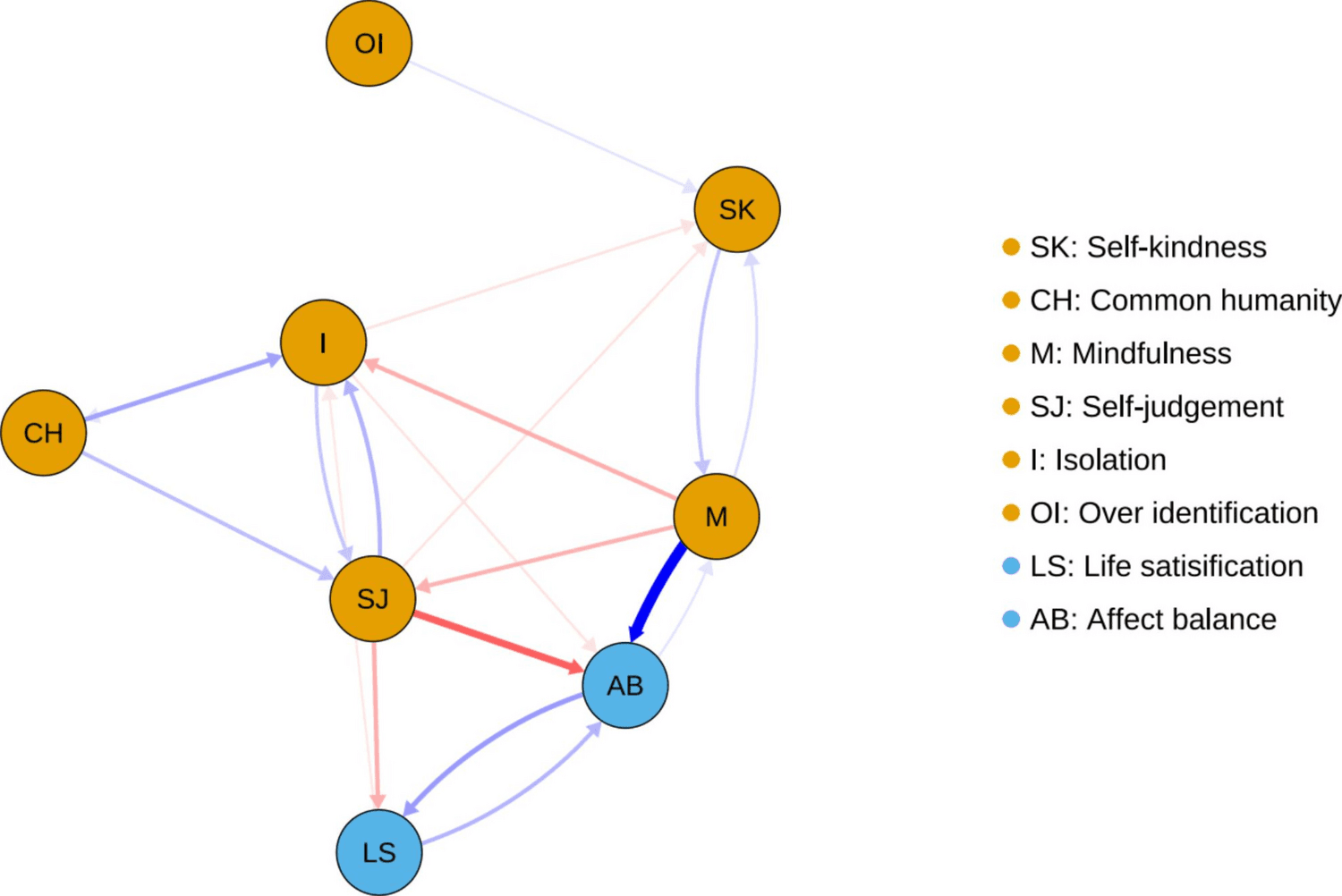
The self-compassion framework is not one ingredient, it is six. In this study, the authors look separately at self-kindness, self-judgment, common humanity, isolation, mindfulness, and overidentification, then examine how those pieces relate to subjective well-being over time.
That detail is the whole point. A student can sound self-compassionate on paper while still being harshly self-critical in the moment, or can understand that other people struggle while still feeling cut off and alone. By separating the facets, the study pushes past the usual black-box version of self-compassion and gets closer to the lived experience of practice, where one skill may be improving while another is still stuck.
Why the method is the story
The paper uses a cross-lagged panel network analysis, which is a fancy way of saying it does more than compare two snapshots. It maps dynamic links across time, letting the researchers examine how earlier levels of one facet relate to later changes in other facets and in subjective well-being.
That matters because mindfulness and self-compassion practices often get taught as if the outcome is immediate and uniform. In real life, though, the mechanism is usually messier. A student might first weaken self-judgment, then feel less isolated, then become more capable of staying present with discomfort. The network approach is built to catch those moving parts instead of flattening them into a single score.
What the study is really asking
The abstract frames self-compassion as a significant resilience factor influencing subjective well-being, but it also points out a gap in the literature: most previous work has focused on overall effects rather than how the six components relate to well-being. That is the important shift here. The study is not just asking whether self-compassion is good, but which ingredient matters most in the chain of change.
For mindfulness teachers and app designers, that question is practical, not academic. If one facet is especially important for students under pressure, a course can lean harder on that piece. Maybe the program needs more self-kindness prompts, or more training in reducing overidentification, or more work on feeling connected to common humanity when isolation is the real problem.
What it means for student support
For campus counselors and wellness teams, this kind of nuance is gold. It suggests that brief, scalable support may work better when it is not presented as a vague promise to “practice self-compassion,” but as a set of teachable components that can be matched to the actual strain students are carrying.
That makes the study especially relevant during periods of emotional overload, when students do not need an abstract lecture on resilience. They need something usable. A targeted intervention can be designed to interrupt self-judgment, reduce the feeling of being alone, or train steadier attention when the mind keeps spiraling into overidentification with stress.
How it fits the larger self-compassion picture
This study does not appear out of nowhere. Broader self-compassion research has already linked the construct with lower psychopathology and higher well-being. Kristin Neff’s work helped establish the field, and experimental findings have lined up with cross-sectional and longitudinal studies using the Self-Compassion Scale.
A 2025 Frontiers study on Chinese university students adds to that same picture by connecting self-compassion with life satisfaction and stress management, alongside psychological capital. Taken together, the newer work suggests that self-compassion is not just a feel-good concept. It keeps showing up where students are trying to handle pressure without falling apart.
The takeaway for practice
The strongest lesson here is not that every self-compassion exercise is interchangeable. It is that the practice may work best when you know what part you are training. If the goal is better student well-being, the field is moving toward precision: less generic encouragement, more component-level design.
That is where this study earns its place. It treats self-compassion not as a slogan, but as a system, and in a high-pressure university setting, that difference is the one that can make a practice actually stick.
This article was produced by Prism’s automated news system from verified source data, official records, and press releases, then run through automated quality and moderation checks before publishing. The system is built and supervised by the people who set the standards it runs under. Read our full AI policy.
Did this article answer your question?