Mindfulness meditation boosts brain network complexity in gaming disorder trial
Mindfulness didn’t just calm cravings in this gaming-disorder trial. It also shifted limbic network complexity, raising the harder question: biomarker or real treatment signal?
Mindfulness is usually sold as a way to feel less stressed. In a gaming-disorder trial, it had to prove something tougher: whether a short, structured practice could cut craving and addiction severity, then move a brain network in step with that change. It did both, which is exactly why this study lands in the awkward space between promising treatment and flashy biomarker story.
Why this trial matters
Internet gaming disorder still sits in a complicated clinical lane. The American Psychiatric Association keeps Internet Gaming Disorder in the DSM-5-TR section for conditions that need more research, while the World Health Organization includes gaming disorder in ICD-11 as a disorder tied to addictive behaviors. That split tells you a lot about the field: the diagnosis is real enough to study, but the treatment playbook is still being built.
The evidence base is unsettled too. A 2024 meta-analysis covering 22 studies found that prevalence estimates swing substantially depending on diagnostic criteria, which is another way of saying the field still argues about where the line belongs. That makes a randomized mindfulness trial more interesting than a standard stress-reduction paper, because it is testing a concrete intervention in a disorder category that still needs sharper tools.
What the trial actually tested
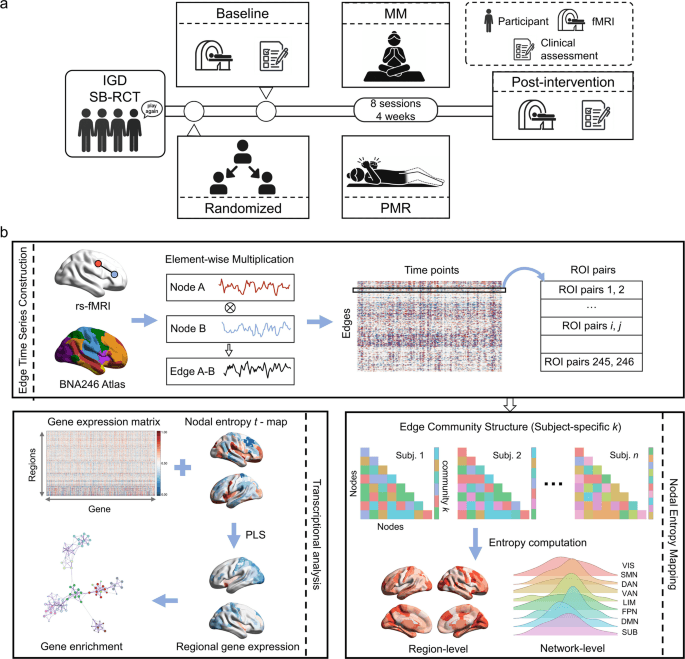
The new study was pre-registered, single-blind, and built as a randomized controlled trial. Sixty-six participants completed the one-month protocol, which included baseline assessment, eight training sessions, and a post-intervention assessment. The researchers compared mindfulness meditation with progressive muscle relaxation, so this was not a weak control or a pass-fail comparison against doing nothing.
That matters. Progressive muscle relaxation is a real intervention, not a placebo in disguise, so mindfulness had to do more than simply make people feel occupied for a few weeks. The trial measured craving and addiction severity, then went a step further and tracked network dynamics in the limbic system. In other words, the study was asking whether mindfulness could reach the compulsive machinery underneath the habit, not just the mood symptoms sitting on top of it.
What changed, and why the brain signal is the real story
The headline result was straightforward: mindfulness meditation beat progressive muscle relaxation in reducing addiction severity and craving. The more intriguing result came from the imaging work. Mindfulness increased normalized entropy within the limbic network, which the authors interpret as a return of dynamic flexibility.
That phrase sounds abstract, but the practical meaning is not. A limbic network that is less rigid may be less likely to snap into cue-driven craving loops, which is exactly the kind of shift that matters when relapse risk is the problem. The paper also says this entropy change significantly moderated the therapeutic effect on craving attenuation, which is the strongest argument in the study that the brain signal was not just a decorative afterthought.
The exploratory transcriptomic work pushes the story one layer deeper. The observed entropy changes lined up spatially with gene-expression profiles enriched in RNA metabolism and sensory transport pathways. That does not make the finding ready for clinical use, but it does suggest the signal is not random noise. The real takeaway is narrower and more defensible: the neural change tracked the symptom change, which is what you want if you are trying to tell a treatment story instead of a nice neuroscience story.
How this fits with the group’s earlier work
This trial did not appear out of nowhere. The same research line has been building a mechanistic case across several randomized studies, including work involving Haosen Ni, Huabin Wang, Xuefeng Ma, Xuefeng Xu, Xiaolan Song, Guang-Heng Dong, Chang Liu, Marc N. Potenza and Xin Luo. The pattern is getting clearer with each step: less symptom severity, then more specific circuit changes, then a better shot at explaining how mindfulness may help compulsive gaming.
In a 2024 randomized clinical trial published in JAMA Network Open, 64 adults with internet gaming disorder took part in an 8-session mindfulness meditation program or progressive muscle relaxation. That study ran from October 1 to November 30, 2023, at Hangzhou Normal University in Hangzhou, China, and enrolled adults who met at least six of the nine DSM-5-TR proposed IGD criteria. Mindfulness reduced IGD severity and craving, and it was linked to decreased activation in the bilateral lentiform nuclei, insula, and medial frontal gyrus.
The next step came in 2025, when another randomized trial in 80 patients found that mindfulness enhanced connectivity within the executive control network and frontostriatal pathways. That is a different part of the story, but it points in the same direction: stronger top-down control over gaming urge, not just a temporary dip in discomfort. A separate 2025 trial in 59 completers with comorbid IGD and depression found that mindfulness reduced both gaming severity and depression severity, which is important because compulsion rarely shows up alone.
What to make of the biomarker question
This is where the study earns its keep. If mindfulness only lowered self-reported stress, it would be easy to file under “nice, but soft.” Instead, the intervention moved both symptoms and a limbic network measure that the authors tie to flexibility. That does not prove the biomarker is a clinical endpoint, but it does make the signal more than a lab curiosity.
The caution is simple: neural complexity is only useful if it helps explain better behavior. Here, the relationship to craving attenuation makes the result look more like treatment progress than a shiny imaging demo. For this corner of mindfulness research, that is the bar worth caring about.
The practical lesson is not that every meditation practice should be treated as a neurological intervention. It is that, in a compulsive-behavior setting, the strongest evidence comes from a defined dose, a real comparator, and a symptom change that shows up alongside the brain change. That is the difference between a soothing claim and a protocol you can actually trust.
This article was produced by Prism’s automated news system from verified source data, official records, and press releases, then run through automated quality and moderation checks before publishing. The system is built and supervised by the people who set the standards it runs under. Read our full AI policy.
Know something we missed? Have a correction or additional information?
Submit a Tip