Outdoor Nature‑Based Activities Trial Protocol Tests Group Meditation and Walking for Mental Vitality in Older Women
Fatemeh Mehriyan's team enrolled 111 women aged 60-plus in Iran to test whether group meditation or social walking delivers stronger gains in mental vitality.
Fatemeh Mehriyan, Afsaneh Bakhtiari, and Razieh Zahedi published a three-arm randomized controlled trial protocol in the journal Trials on March 27, 2026, setting up what may become one of the few head-to-head comparisons of group nature meditation and social walking in an older, non-Western female population. How much of a mindfulness practice's cognitive benefit comes from the inward attentional work itself, versus simply moving outdoors with other people, remains an open question; this trial was designed specifically to answer it.
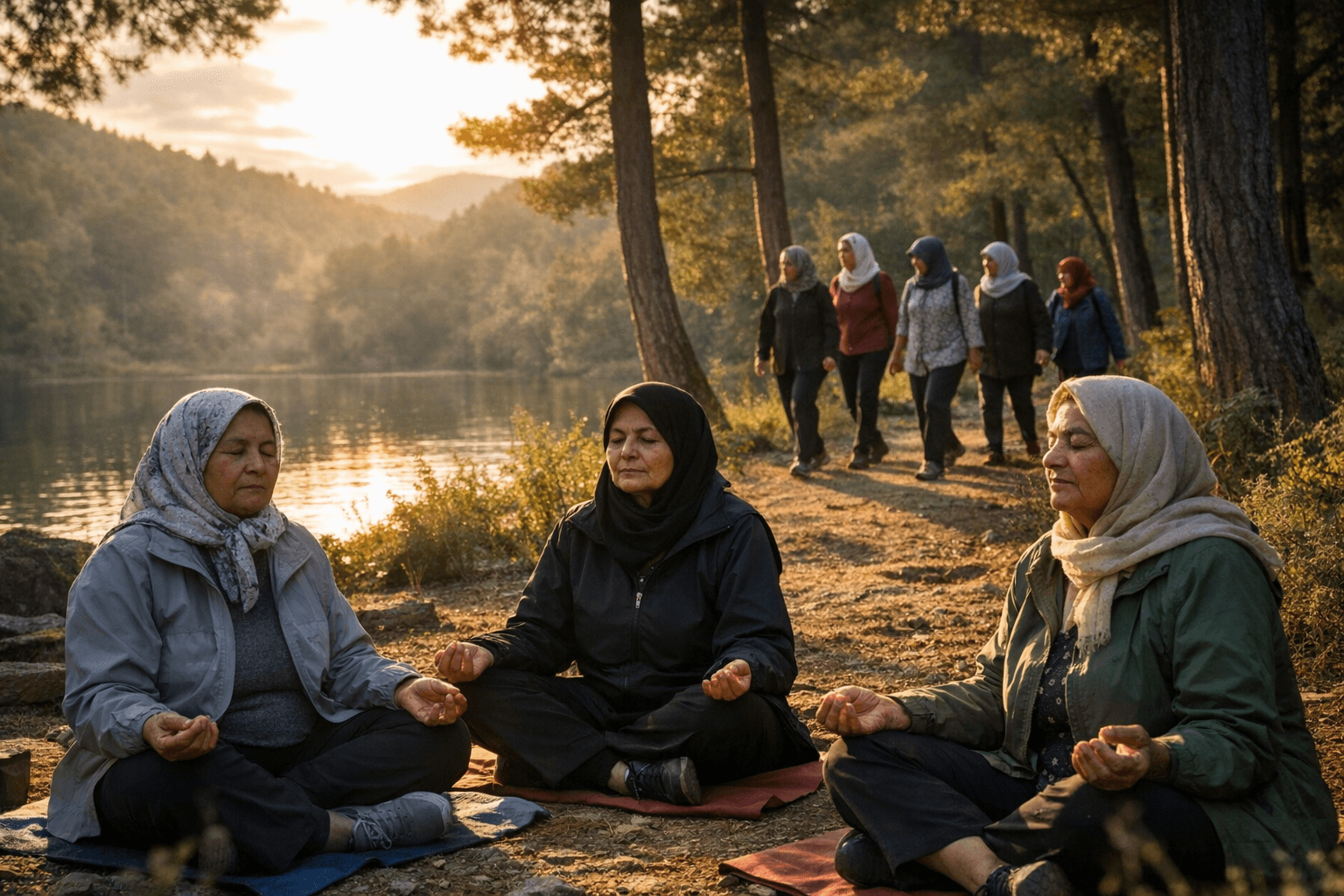
The protocol enrolls 111 women aged 60 and older from nine urban and rural health centers in Khafr County, Iran. Participants are randomized into one of three arms: walking with meaningful conversation, group meditation in nature, or a no-intervention control. Each active arm runs for eight sessions of two hours apiece, delivered once a week over eight weeks. Mental vitality and cognitive empowerment are assessed at baseline, immediately after the final session, and again at a three-month follow-up, giving researchers a window into whether any gains hold once the structured program ends. The team will apply generalized estimating equations to track change across all three time points.
The design choices are deliberate and worth examining closely. Group format means participants are not practicing in isolation; the social architecture of the intervention is itself a variable. The outdoor, nature-based setting adds a sensory context that indoor lab studies routinely strip away. The two active comparators are not arbitrary, either: Mehriyan's team hypothesizes that the walking arm will produce larger gains in mental vitality, while group meditation in nature will more strongly enhance cognitive empowerment. That split prediction reflects the different demands each practice places on the brain, physical activation and social conversation on one side, sustained inward attention on the other.
Older women in rural and semi-urban Iran represent a demographic that experimental mindfulness trials have historically overlooked. The nine-site recruitment across Khafr County's urban and rural health centers is a structural attempt to build in geographical breadth rather than drawing from a single academic center. Trial registration number IRCT20241023063481N1 was filed in February 2025, and because this is a protocol paper, no outcome data exist yet.
While results remain pending, the trial's architecture itself offers a practical and replicable blueprint. A reader wanting to explore a low-stakes version of the meditation arm could gather two or three people, find a park or green space, and commit to eight weekly sessions of roughly two hours each: spend the first portion walking and talking, then transition to 20 or 30 minutes of seated or standing group meditation focused on breath and ambient natural sound. Keeping a brief post-session journal note rating energy and mental clarity on a simple 1-to-10 scale mirrors the validated-questionnaire approach Mehriyan's team is using, without requiring clinical infrastructure. Whether it replicates the trial's anticipated effects is precisely what the RCT was built to determine.
This article was produced by Prism’s automated news system from verified source data, official records, and press releases, then run through automated quality and moderation checks before publishing. The system is built and supervised by the people who set the standards it runs under. Read our full AI policy.
Did this article answer your question?