School-Based Mindfulness Interventions Examined in New Umbrella Review of Meta-Analyses
A new umbrella review of 6 meta-analyses covering 28,910 children found school-based mindfulness shows small but real gains in wellbeing and anxiety, but zero effect on depression.

Six meta-analyses covering 110 primary studies and 28,910 participants form the backbone of a new umbrella review that offers the clearest consolidated picture yet of what school-based mindfulness-based interventions (MBIs) actually deliver for children and adolescents.
The review, published in the journal *Mindfulness* in March 2026, was authored by Annie O'Dowd, Sinead Grennan, Conal Twomey, Alan Carr, and Martin O'Connor. Its aim was to synthesise evidence from existing meta-analyses of school-based MBIs to evaluate effects on wellbeing, mindfulness, depression, and anxiety in children and adolescents.
The results offer a nuanced signal for practitioners. MBIs showed small but statistically significant effects for wellbeing (g = 0.13), mindfulness (g = 0.11), and anxiety (g = 0.11), but no effect for depression (g = 0.05). Those effect sizes are modest, but they are consistent across a dataset large enough to take seriously.
The methodology was rigorous. Searches were conducted in PubMed, PsycINFO, CINAHL, ERIC, and Cochrane databases, with the timeframe covering 2000 to end 2024. Eligibility criteria included controlled trials of school-based MBIs for children and adolescents aged 5 to 18 years, with peer-reviewed publication required. Data extraction followed PRISMA guidelines, with AMSTAR-2 and GRADE used to measure quality. The review protocol was pre-registered with PROSPERO.
The honest accounting of limitations is where the review earns particular credibility within the evidence-based mindfulness community. Quality of the included reviews ranged from critically low to moderate on AMSTAR-2, and GRADE assessments indicated very low certainty of evidence across all outcomes, primarily due to risk of bias, inconsistency, and imprecision.
Results were further limited by the small number of meta-analyses included (k = 6), variation in methodological quality of primary studies, and lack of follow-up data in some meta-analyses. The authors concluded that school-based MBIs are associated with very small improvements in wellbeing, mindfulness, and anxiety, but not depression, for children and adolescents in the general school population, while noting that the evidence remains limited and inconsistent, with a need for further high-quality RCTs in this field.
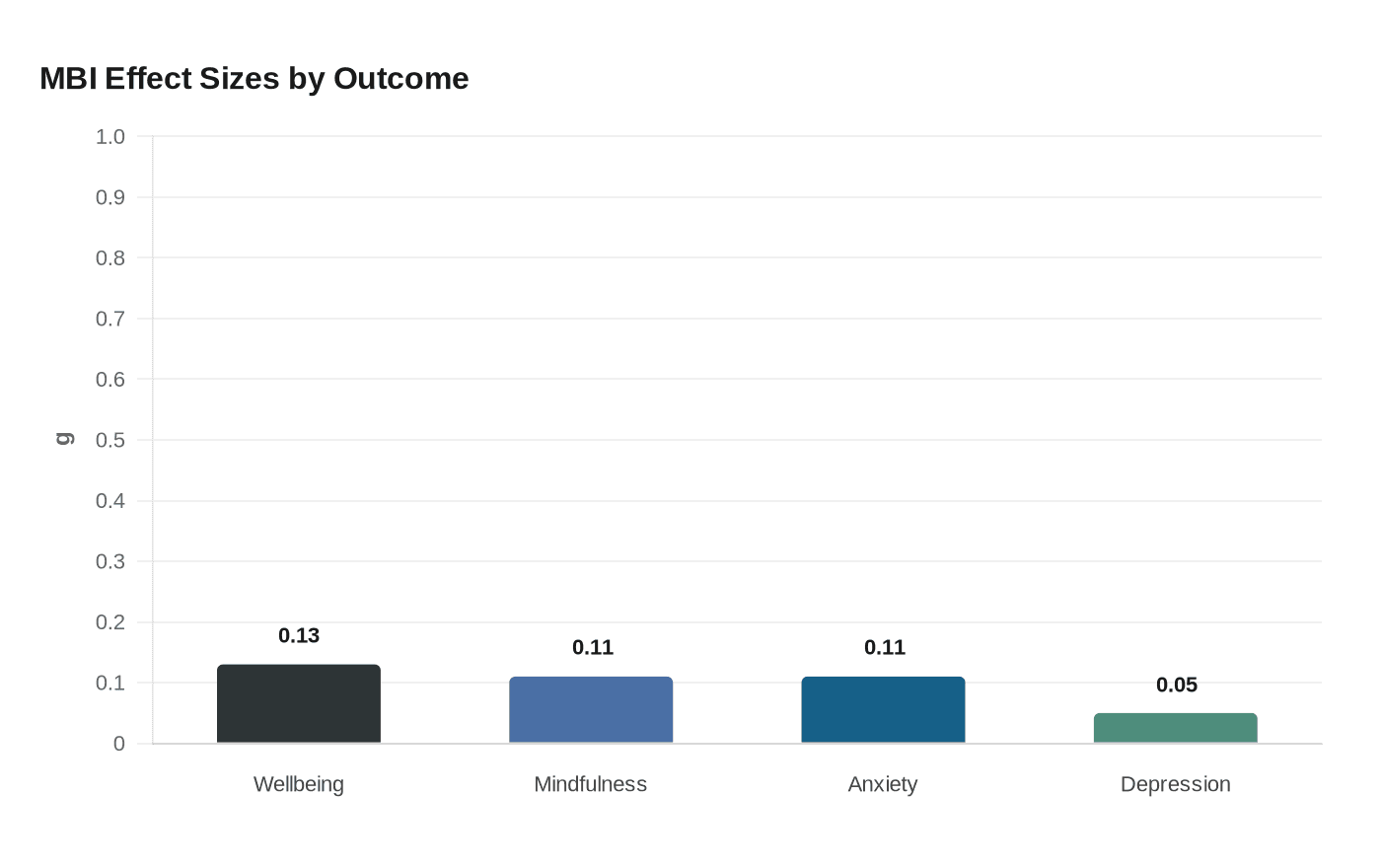
For those of us who follow this literature closely, the null finding on depression is worth sitting with. The three outcomes that showed movement, wellbeing, mindfulness itself, and anxiety, align with what shorter, universal school-based programs are arguably designed to do: build foundational attentional and regulatory capacity, not treat clinical conditions. The depression finding suggests that expecting MBIs to move the needle on more entrenched symptom clusters, in a universal school-population context, may be placing more weight on the intervention than the format can bear.
What this umbrella review gives the field is a sober, well-structured reference point as schools continue to adopt and expand these programs. The call for high-quality RCTs with proper follow-up data is not new, but seeing it restated at the level of an umbrella review, rather than a single study, sharpens the obligation on funders and researchers to finally answer it.
This article was produced by Prism’s automated news system from verified source data, official records, and press releases, then run through automated quality and moderation checks before publishing. The system is built and supervised by the people who set the standards it runs under. Read our full AI policy.
Did this article answer your question?