UCSF Expert Leads 6-Minute Guided Meditation to Calm Uncertainty
UCSF psychologist Elissa Epel released a six-minute guided meditation to help calm the nervous system and sit with uncertainty, offering a quick, research-based micro-practice for times of stress.

Psychologist and stress expert Elissa Epel of the University of California, San Francisco released a roughly six-minute guided meditation on January 22, 2026, designed specifically to help listeners regulate their nervous systems and sit with uncertainty. The episode is framed as a micro-practice intended for immediate calming when anxiety or unpredictable situations arise.
The practice opens with simple settling cues: find a quiet comfortable place, close your eyes or soften your gaze, and breathe slowly. Epel then guides a compact body scan that moves attention from head to toes, inviting practitioners to notice tension with curiosity rather than judgment. Listeners are encouraged to breathe into tight areas and soften them on the exhale, a technique rooted in breath-based regulation.
Rather than offering cognitive fixes, the meditation directs attention to uncertainty itself. The practice asks listeners to name thoughts and feelings about what feels uncertain without trying to change them, and to pose reflective questions such as what is on the mind, whether worry is about past or future, and what expectations are being held. That reflective segment is designed to shift habitual reactivity into mindful inquiry.
Epel includes explicit directions to practice letting go of attempts to control outcomes, and to remember that uncertainty is part of life. The guided steps close by inviting practitioners to relax the shoulders, rest in the present moment, and use an anchoring phrase to stabilize attention: "Things are exactly as they are right now." The episode page supplies practical cues and short lines to repeat, plus links to related episodes and resources and a full transcript for anyone who wants to follow the text.
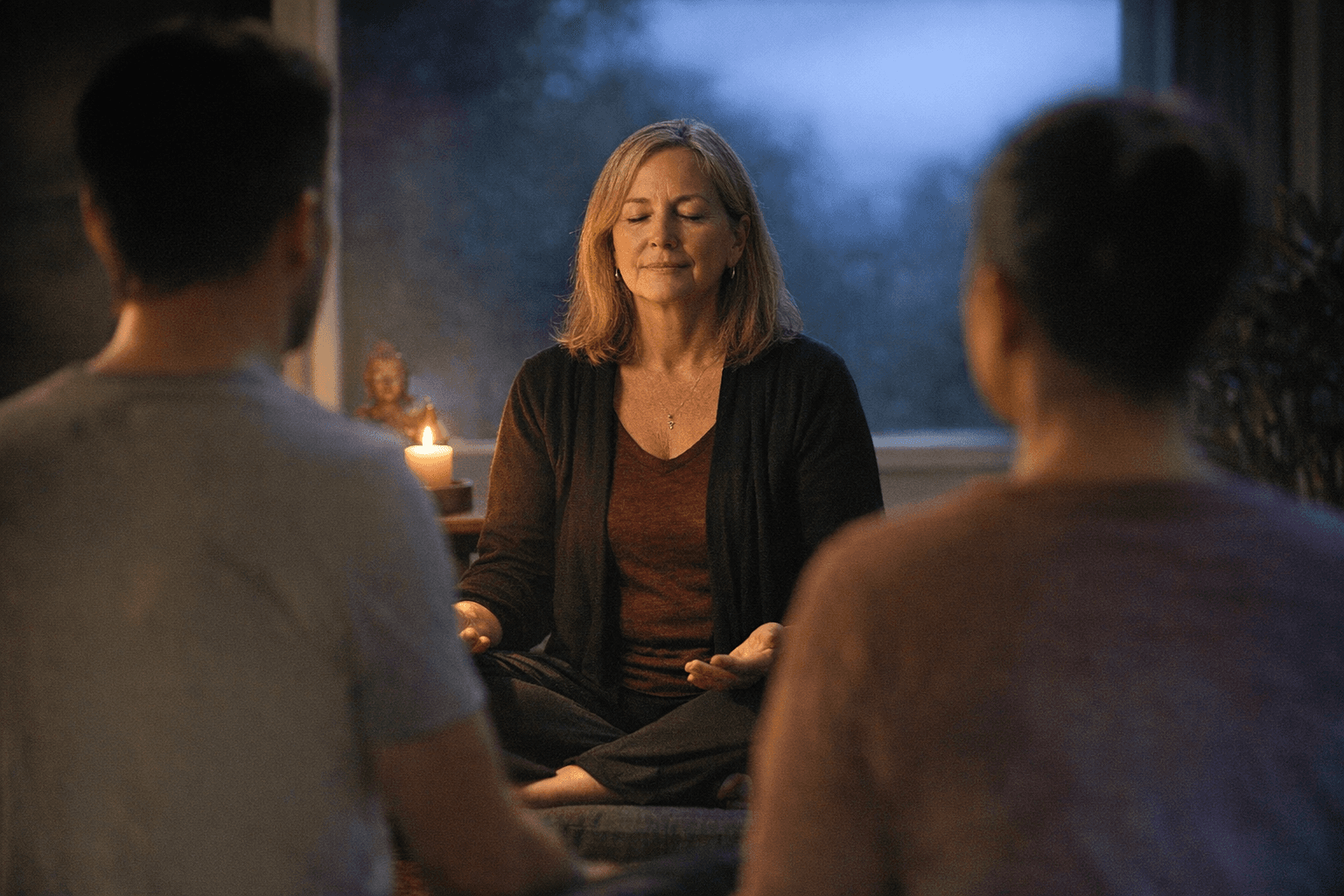
This short format has clear practical value for a community that favors accessible, regular practice. Six minutes fits into commute waits, pre-meeting jitters, or moments between parenting tasks, and the focus on naming emotions and releasing control targets common pain points for people learning to tolerate uncertainty. The body-scan-to-anchor sequence gives a repeatable structure that can be practiced alone or taught in group sessions.
For meditators building a toolkit for real-world stress, Elissa Epel’s micro-practice offers an evidence-informed, portable exercise to regulate physiology and reorient attention. Try it in a single session when uncertainty spikes, weave the steps into a morning routine, or bring the sequence into community classes to practice tolerance of not-knowing together.
This article was produced by Prism’s automated news system from verified source data, official records, and press releases, then run through automated quality and moderation checks before publishing. The system is built and supervised by the people who set the standards it runs under. Read our full AI policy.
Did this article answer your question?