Welligama’s ‘Breathe to Unlock’ Debuts — a Mindfulness Gatekeeper for Social Apps
Welligama gates social apps behind three guided breaths and re-prompts every 15 minutes, turning compulsive scrolling into repeated micro-mindfulness practice.

Three breaths. That is now the price of entry to any social app or website you flag as a distraction, according to Impulse Inc., which launched Welligama: Breathe to Unlock on March 30, 2026. The Wilmington, Delaware company built a patent-pending gating system that intercepts the tap-to-open reflex and replaces it with a short interactive breathing exercise delivered through audio, visual, and tactile cues before granting access.
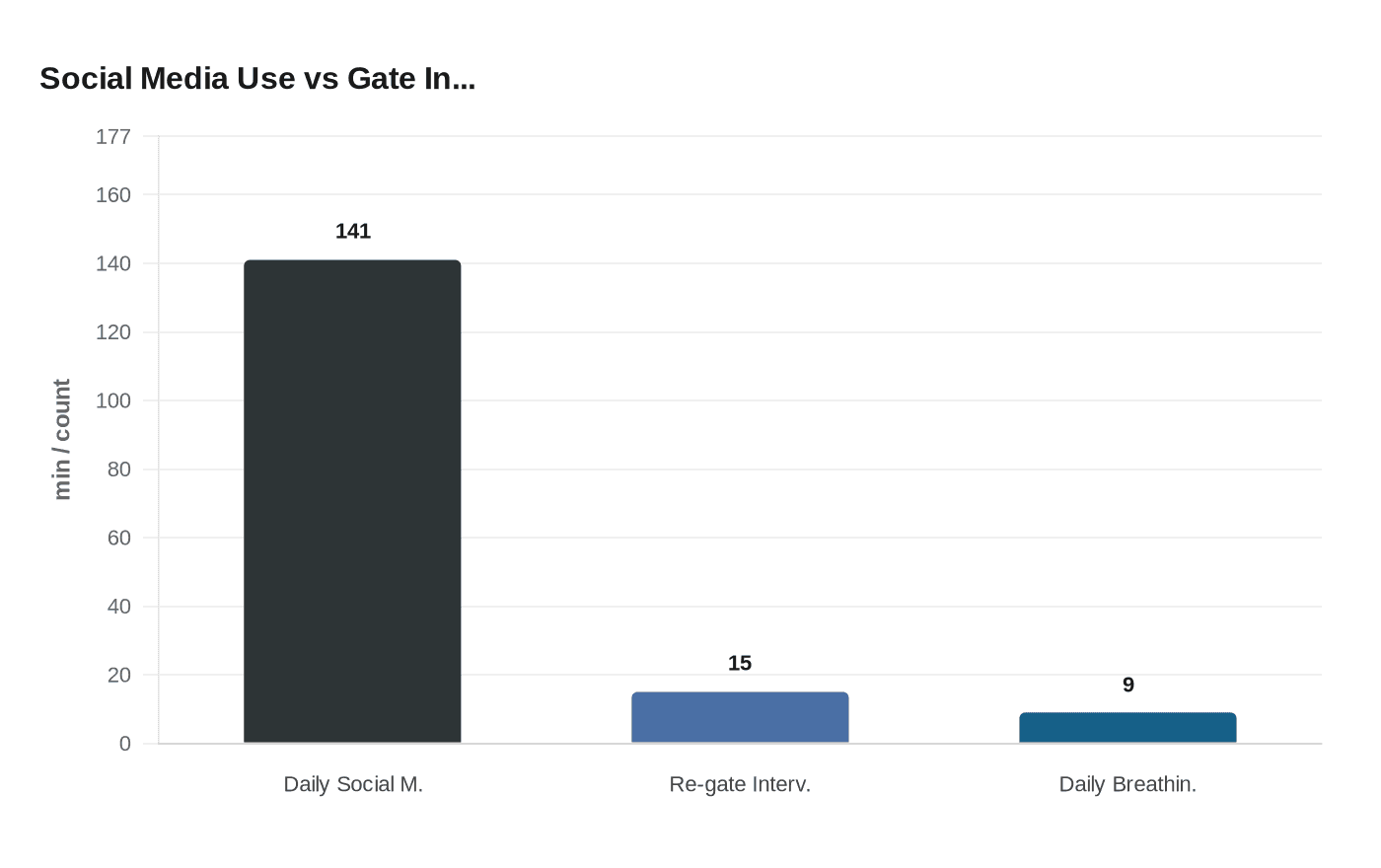
The scale of that intervention becomes clear when you do the arithmetic. Global daily social media use averaged 141 minutes in 2025, according to Statista. At the product's example re-gate cadence of every 15 minutes, a single average user would encounter roughly nine breathing prompts per day from social apps alone, turning an invisible autopilot behavior into nearly a dozen discrete moments of intentional awareness, without ever opening a meditation app.
The mechanics are deliberately minimal. Users designate which apps or sites to gate, and upon tapping in, Welligama presents a three-breath slider. Completing the sequence unlocks access for a user-defined interval; when that window closes, the prompt reappears. The product integrates with Screen Time on Apple and optionally extends into check-ins, meditations, and journaling that users can access once through the gate.
Founder and CEO Praveen Dayananda framed the tool as rooted in "a simple but transformative practice: taking a moment to pause and return to the breath," and the product's explicit design philosophy holds that "it is okay to scroll." That distinction matters: Welligama does not cap daily usage or cut access after a threshold. It introduces friction without punishment, which puts it closer to urge-surfing mechanics than to the blunt screen-time limits most platforms already offer and most users quietly ignore.
The real stress test for practitioners is whether three breaths before opening an app constitutes actual training or is simply performative interruption. Adding friction to a compulsive loop can erode the loop; it can also generate avoidance, frustration, or a workaround reflex, particularly among users who gate their apps without prior mindfulness context. The 15-minute re-prompt cadence means a sustained scroll session triggers repeated gates, which will feel disciplinary rather than contemplative to anyone not already practicing with breath. Schools and employers considering deployment will also face questions about cross-platform compatibility beyond Apple's ecosystem and about what behavioral data, if any, flows through the platform API integration.
For the mindfulness community, the most structurally interesting thing about Welligama is not the product but the design template it represents: a named micro-practice, three breaths, anchored to an existing high-frequency behavioral trigger, repeating at a measurable cadence. That is habit-stacking applied to device use, and its effectiveness will ultimately depend on whether users arrive at the gate with the intention Dayananda built it to cultivate.
This article was produced by Prism’s automated news system from verified source data, official records, and press releases, then run through automated quality and moderation checks before publishing. The system is built and supervised by the people who set the standards it runs under. Read our full AI policy.
Did this article answer your question?