Antarctic ice reveals supernova debris drifting through our Solar System
Antarctic ice held a radioactive breadcrumb: iron-60, a supernova isotope that maps how the Solar System is moving through nearby interstellar debris.
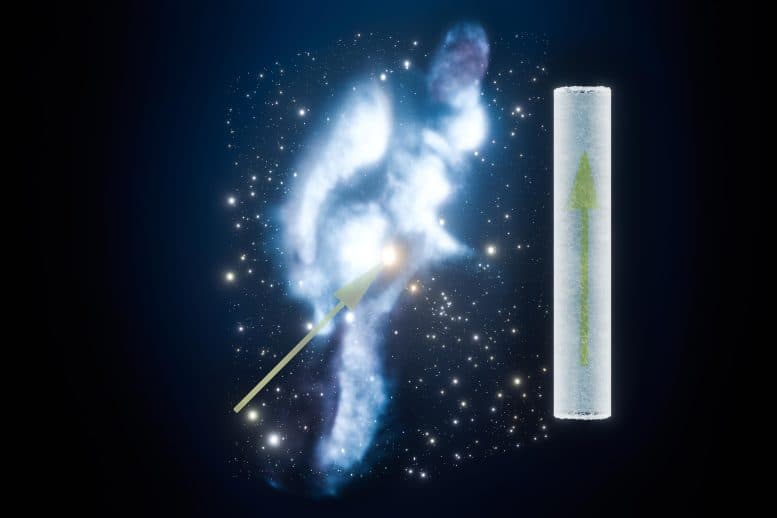
A few hundred kilograms of Antarctic ice turned into a cosmic crime scene. Buried in 295 kg of EPICA Dronning Maud Land core material, researchers found minuscule traces of iron-60, the rare radioactive isotope forged in massive stellar explosions and left behind as a fingerprint of nearby supernova activity.
The work, published May 13, 2026 in Physical Review Letters, focused on ice spanning 40,000 to 81,000 years ago. That matters because Antarctic ice is a brutally good archive: cold, stable, and isolated enough to preserve tiny signals that would be erased almost anywhere else. Here, the signal was not a full-blown spike in radiation, but a whisper of interstellar 60Fe embedded in the snow record.

Iron-60 is the kind of isotope that earns its reputation. It is not a routine terrestrial contaminant. Earlier studies had already turned up the same nuclide in Antarctic surface snow and in deep-sea sediments as old as 30,000 years, and geological archives have pointed to two separate iron-60 hits from supernovae millions of years ago. That history made the new Antarctic core especially valuable: it extends the timeline far enough back to test whether Earth has been moving through a debris-rich patch of space, rather than just catching stray fallout from a distant blast.
That is the story the team led by Helmholtz-Zentrum Dresden-Rossendorf set out to test. Dominik Koll said the original idea was that the Local Interstellar Cloud itself might hold iron-60, but the case became convincing only after additional Antarctic and sediment samples strengthened the time profile. The researchers now link that profile to a changing local interstellar environment over the last 80,000 years.
The setting is the Solar neighborhood itself. Our Solar System is currently crossing the Local Interstellar Cloud, one of roughly 15 cloudlets in the Complex of Local Interstellar Clouds. HZDR says the Solar System entered this cloud several tens of thousands of years ago and will leave it again in a few thousand years, which gives the result a moving target: Earth is not sitting still in empty space, but drifting through a chemically distinct region that may carry the residue of an ancient supernova.
The article’s value is not just that it found old stardust in ice. It is that 60Fe can now be used as a tracer for nearby stellar explosions and for the structure of the local interstellar medium. It can show that our Solar System is passing through a debris field left by a long-dead star. It cannot, by itself, name the star or reconstruct every detail of the blast. But in Antarctic ice, the isotope still does something rare: it makes an invisible interstellar boundary measurable, and it shows that the Solar System is still collecting fallout as it moves.
This article was produced by Prism’s automated news system from verified source data, official records, and press releases, then run through automated quality and moderation checks before publishing. The system is built and supervised by the people who set the standards it runs under. Read our full AI policy.
Did this article answer your question?