Brookhaven physicists use near-miss gold collisions to probe nuclear structure
Near-miss gold ions at RHIC let STAR use J/psi spin interference to map nuclear gluons, turning almost-collisions into a sharper look at the nucleus.
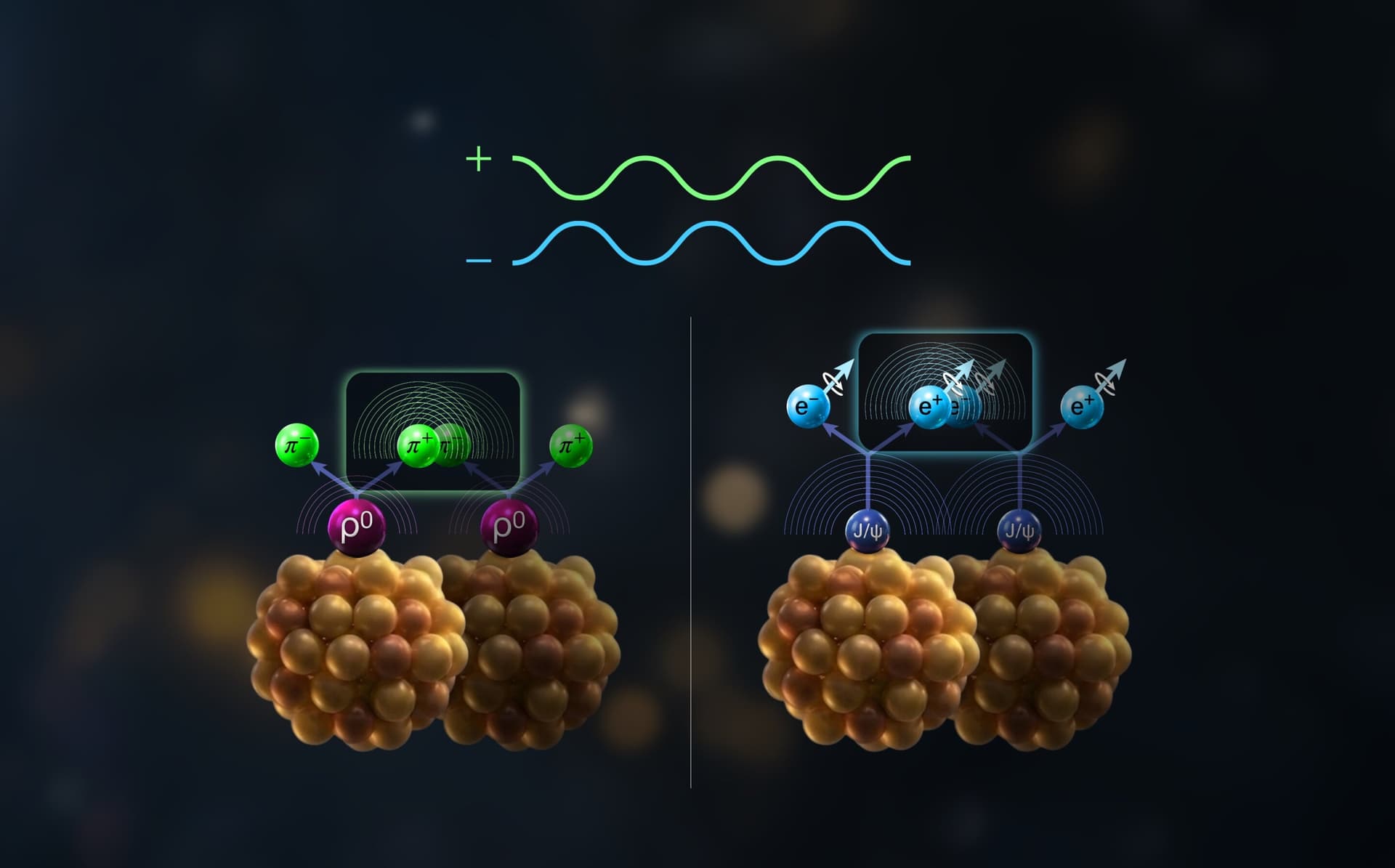
A head-on smash is no longer the only way to study what holds a nucleus together. At Brookhaven National Laboratory, the STAR Collaboration has used near-miss gold-ion collisions at the Relativistic Heavy Ion Collider to read out gluons, the particles that bind quarks and carry the strong force inside matter.
The trick is ultraperipheral physics. When two gold nuclei pass close by on RHIC’s 2.4-mile racetrack without physically hitting, their electromagnetic fields still overlap, and those fields carry photons. STAR used those photons to probe gluons inside the passing ion, with J/psi particles and their spin providing the signal that maps where the gluons are concentrated.

That makes the collision geometry do some of the work. Instead of sorting through the debris from a violent head-on event, physicists can use the quantum interference encoded in a near-miss, which gives a cleaner handle on nuclear structure. Brookhaven says the STAR detector, a 1,200-ton instrument about the size of a house, tracked the particles emerging from these events.
The new paper, published June 17, 2026 in Physical Review Letters, includes Brookhaven physicists Prithwish Tribedy and Ashik Ikbal, along with the broader STAR team. Brookhaven described the result as pushing RHIC toward a new frontier in nuclear physics, one focused not only on the aftermath of collisions but also on the information hidden in the collisions that almost happened. RHIC operated from 2000 to 2026, and this work adds a new imaging mode to a machine best known for quark-gluon plasma studies.
The result also fits into a run of earlier STAR work. Brookhaven reported the first-ever observation of quantum interference between dissimilar elementary particles in a 2023 nucleus-mapping study, and STAR later reported evidence of spin interference in exclusive J/psi to e+e- photoproduction in ultraperipheral Au+Au and isobar collisions at 200 GeV. That study found a negative cos(2) modulation for transverse momentum below 100 MeV/c and argued that compact J/psi states probe gluon distributions at perturbative scales.
The payoff is a sharper view of the inner glue. A DOE Office of Science highlight on related work said J/psi production in near-miss gold-nucleus collisions showed that gluon density in nucleons bound inside a heavy nucleus appears lower than in free nucleons, with gluon saturation and nuclear shadowing both possible explanations. That is exactly the kind of question the planned Electron-Ion Collider is meant to answer with greater precision, and it is why these almost-collisions matter: they turn a miss into a map.
This article was produced by Prism’s automated news system from verified source data, official records, and press releases, then run through automated quality and moderation checks before publishing. The system is built and supervised by the people who set the standards it runs under. Read our full AI policy.
Did this article answer your question?


