Chile, Argentina renew nuclear cooperation on research and safety
Chile and Argentina signed a nuclear cooperation pact that points to reactors, isotopes and safety work, not a new power plant. The real test is whether RA-10, RECH-1 and La Reina show visible movement.
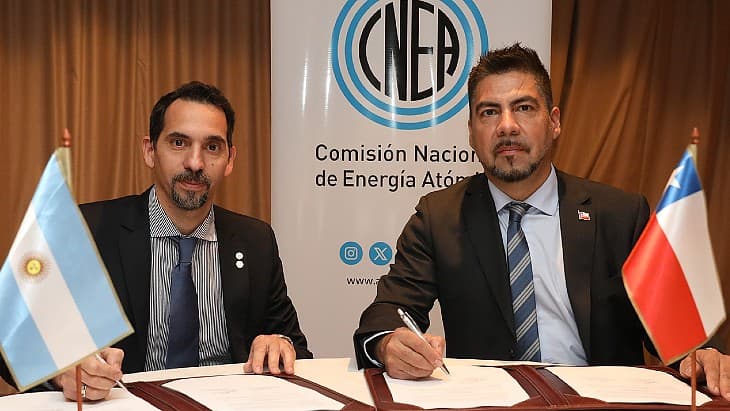
Chile and Argentina have put their long-running nuclear partnership back on a practical footing, but the real story is not diplomacy. It is whether this renewed agreement turns into measurable work at the reactor and isotope level, where the region already has named facilities, operating hardware and unfinished projects.
The two countries signed a Marco de Colaboración on June 4, 2026, through the Comisión Nacional de Energía Atómica in Argentina and the Comisión Chilena de Energía Nuclear in Chile. The agreement covers research reactors, radiopharmaceuticals, nuclear applications in health, agriculture, industry and mining, along with nuclear and radiological safety, training, used-fuel management, modernization, aging management and technical assistance in nuclear power.

That scope matters because the pair are not starting from zero. Argentina and Chile have cooperated on peaceful nuclear uses since 1976, and the first accord was ratified in 1983. Argentina’s nuclear system is still anchored by three operable power reactors, which provide about 7 percent of the country’s electricity, and by a research reactor program that has already produced one of the region’s most important current builds: RA-10. The IAEA describes RA-10 as a 30 MW thermal multipurpose research reactor under construction, aimed at high-performance neutron production, radioisotope production and neutron beam research. Construction began in 2014 after a license was obtained, following earlier project work that dates to 2010.
Chile brings a different set of assets to the table. RECH-1 at the La Reina Nuclear Centre in Santiago first went critical in October 1974 and operates at 5 MW. CCHEN says the reactor is used mainly for radioisotope production, especially for medical purposes, as well as sample irradiation and analytical work. The same site also houses a cyclotron, radioisotope and radiopharmaceutical facilities, and laboratories for radiation measurement and radio-medicine, which gives the agreement a clear link to isotope supply and medical applications rather than to grid power.
The industrial and strategic backdrop is equally concrete. Argentina’s first commercial nuclear power reactor began operating in 1974, and the country has also pushed the CAREM 25 small modular reactor concept, even though that work has been halted under the current government. IAEA material describes CAREM 25 as a prototype of about 27 MW electrical output with passive safety features, while World Nuclear Association lists CAREM25 as under construction with a 25 MWe design net capacity and a construction start date of August 25, 2015. Argentina’s nuclear sector has tied itself to exports, energy security, technological capacity and regional leadership, so a cooperation deal with Chile fits into a broader industrial strategy.
For the next 12 months, the headline will not be a treaty signature. It will be whether the agreement produces visible movement in joint research, technical visits, safety work or isotope-related projects at RA-10, RECH-1 and La Reina. That is where this partnership either becomes hardware, training and output, or stays where too many nuclear agreements end up: in polished language and not much more.
This article was produced by Prism’s automated news system from verified source data, official records, and press releases, then run through automated quality and moderation checks before publishing. The system is built and supervised by the people who set the standards it runs under. Read our full AI policy.
Did this article answer your question?