Direct X-ray Detection of Muonic Molecules Boosts Fusion Research
Muons pull nuclei 200 times closer, and a new X-ray fingerprint finally shows the ddµ* resonance state directly. The physics is cleaner, but muon economics still sets the pace.
Muons pull atomic nuclei about 200 times closer than they sit in an ordinary hydrogen molecule, which is why muon-catalyzed fusion has always sounded like the shortest path to room-temperature fusion. The new result from Toshiyuki Azuma’s international team at WPI-QUP is the kind of milestone that cuts through the hype: the first direct observation of X-rays emitted from resonant states of muonic molecules, specifically the muonic deuterium state ddµ*. For a field that has spent decades inferring these states indirectly from fusion products, that is a real step forward.
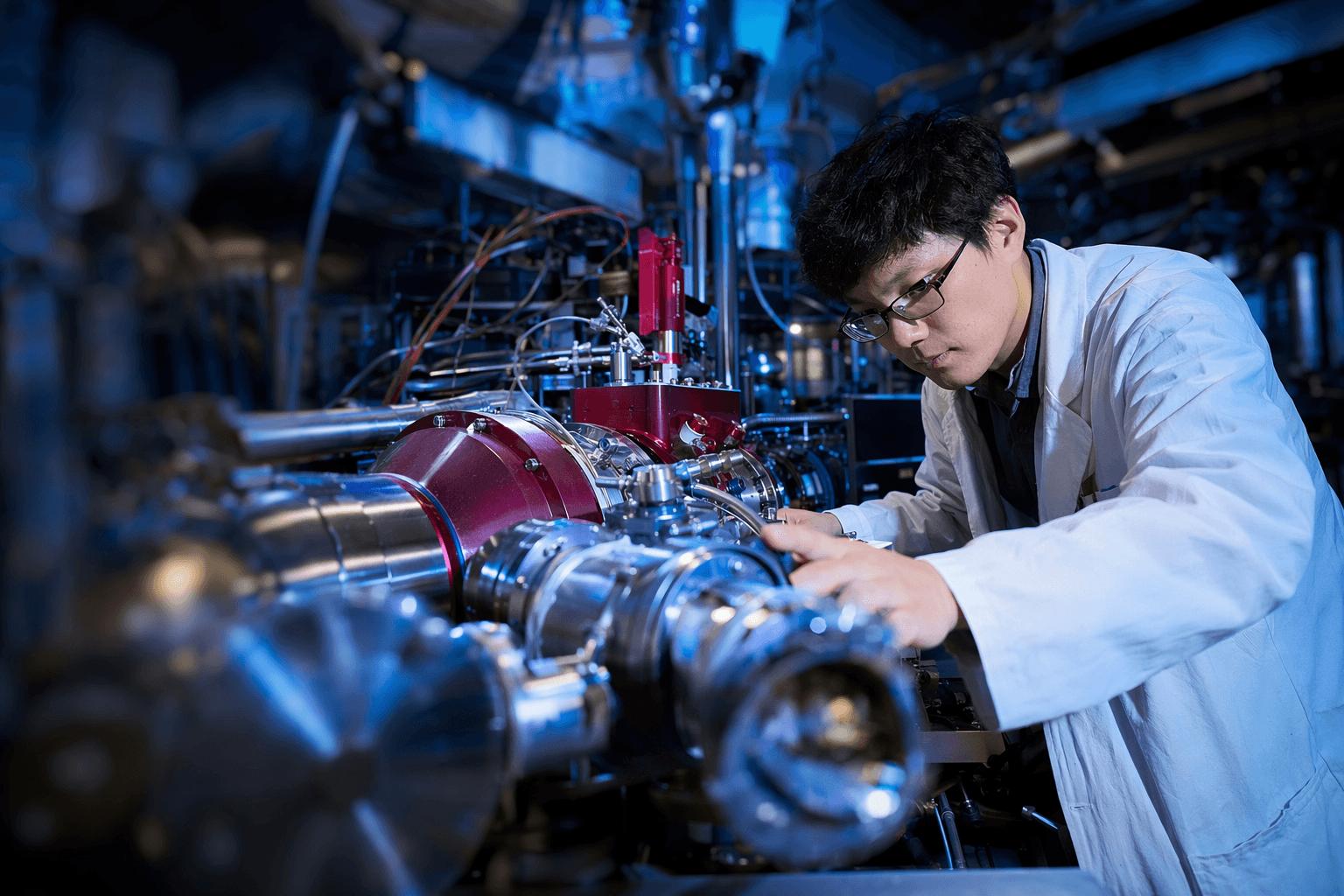
The team used a high-resolution microcalorimeter built around superconducting transition-edge sensors, and the spectrum matched high-precision calculations closely. In plain terms, the detector finally caught the internal fingerprint of the molecule as it broke apart, instead of forcing physicists to reconstruct it from downstream debris. The paper, published in Science Advances on April 16, 2026, lists 39 authors and names collaborators including Tadayuki Takahashi, Yuichi Toyama, Shinji Okada, Takuma Yamashita and Yasushi Kino. The collaboration says the resonance-state pathway is not a side note anymore, but a dominant part of muon-catalyzed fusion.
That matters because the central question has never been whether muons can help nuclei fuse. It is whether the process can ever beat the cost of making the muons in the first place. The new data closes a longstanding gap in the molecular physics, and it strengthens the case that the resonance route is the one worth modeling, measuring and, eventually, engineering around. But it does not repeal the basic economics. If you still need a lot of energy to manufacture each muon, then the clean little reaction in the molecule can be a triumph of nuclear chemistry and still be a lousy power business.
That is the real stress test for the room-temperature fusion dream. The researchers describe muon-catalyzed fusion as plasma-free and, in principle, possible at room temperature, with fuel that could come from seawater and no carbon dioxide emissions. Those are exactly the kinds of claims that grab attention. They also sit on top of a stubborn bottleneck: muons do the elegant part, but muon production is still the expensive part. Until that changes, this remains a beautiful physics milestone, not a compact fusion concept ready for hobbyist bench space.
The deeper value here is clarity. Muon-catalyzed fusion has been discussed since before 1950, from early theoretical proposals by Andrei Sakharov, F. C. Frank and later Yakov Zel’dovich, to experimental evidence in Luis W. Alvarez’s 1956 work. What Azuma’s team has done is put a direct X-ray signature on the molecular state at the heart of the process. That does not make a tabletop reactor any less distant, but it does make the path through the molecule far less mysterious.
This article was produced by Prism’s automated news system from verified source data, official records, and press releases, then run through automated quality and moderation checks before publishing. The system is built and supervised by the people who set the standards it runs under. Read our full AI policy.
Did this article answer your question?