Dry Ice Locks Hydrogen Spin States, Opening Paths to Quantum Storage
Dry ice turns into a spin gate for hydrogen, blocking ortho-para conversion without magnets. That low-tech trick could matter for storage, memory, and comet science.
Dry ice as a quantum gatekeeper
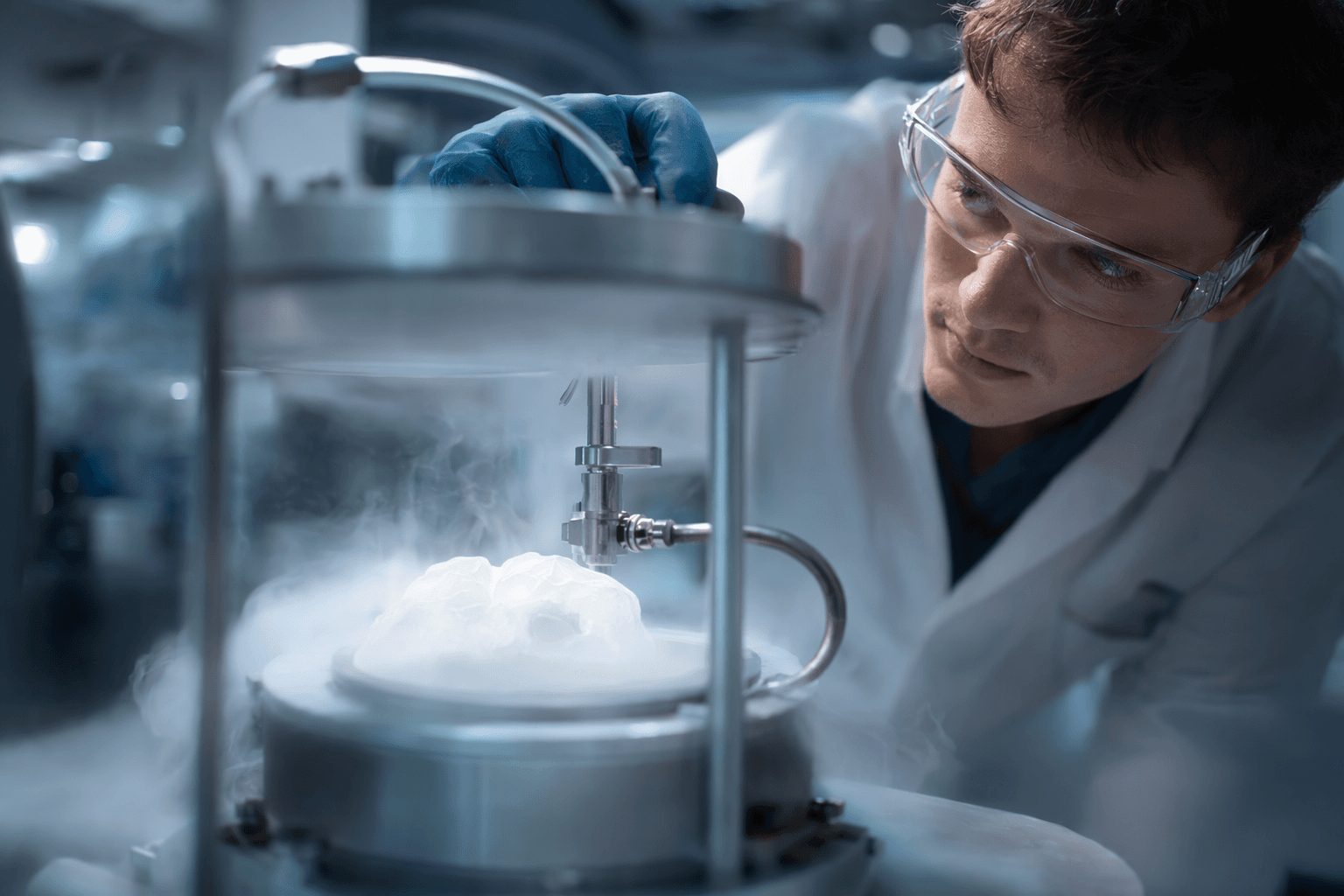
Dry ice looks like the most ordinary piece of cryogenic gear in the world, yet in this work it does something that feels almost mischievous: it locks down hydrogen’s nuclear spin behavior. By freezing molecular hydrogen inside crystalline carbon dioxide, the University of Maryland team showed that a simple solid can decide which spin states are allowed to swap and which stay protected. That matters because hydrogen is not just a fuel molecule here, it is a clean test case for how environment and symmetry can steer quantum dynamics.
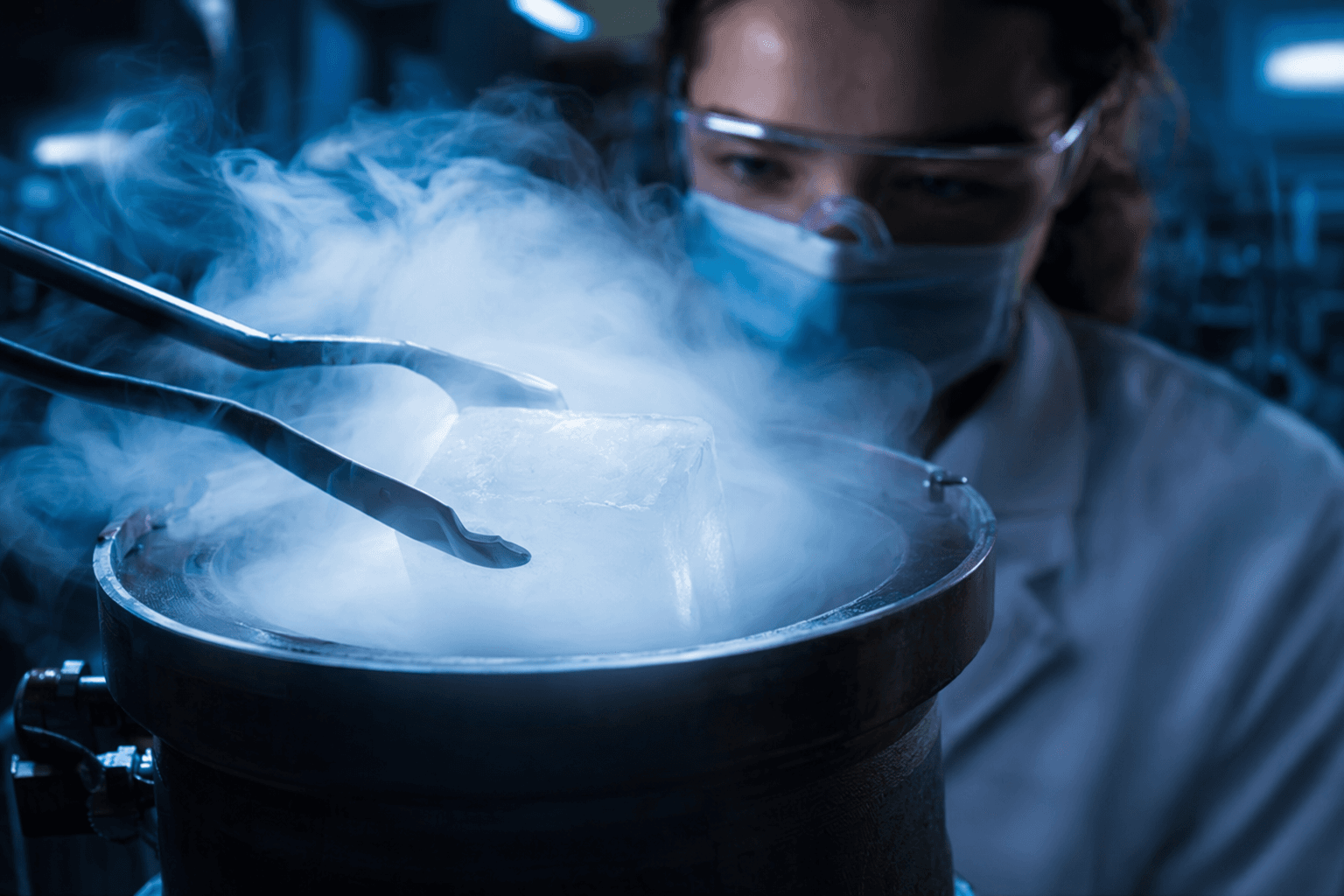
The molecule at the center of the story is the simplest one we have, H2, but it still comes in two nuclear-spin flavors. Para-hydrogen has paired spins that cancel, while ortho-hydrogen has spins that add, producing three substates. In the dry-ice lattice, two of those ortho substates were blocked from converting into para-hydrogen as the sample cooled, while the third retained the ability to move. That is the surprise: an ultra-cold, low-tech confinement scheme altered a genuinely quantum property without relying on the usual blunt instruments of strong magnetic fields or chemical catalysts.
What the crystal is actually doing
The mechanism is not magic, it is symmetry. The paper, “Environment-Imposed Selection Rules for Nuclear-Spin Conversion of H2 in Molecular Crystals,” shows that the surrounding crystal imposes selection rules that govern nuclear-spin conversion. In plain terms, the dry-ice lattice acts like a gatekeeper, and the crystal-field tensor rank controls the spin dynamics without any external fields. When the hydrogen sits in that structured environment, the solid does not merely hold it in place, it tells the molecule which quantum pathways are open.
That is why the nitrogen dioxide result matters. When the team added nitrogen dioxide into the crystal lattice, the rigid symmetry rules relaxed and all three ortho-hydrogen substates could convert. So this is not a generic freezing effect, it is a materials-design effect, one where the host lattice itself becomes the control knob. Nathan McLane, the lead author, read the outcome as a clear sign that hydrogen’s quantum behavior is highly sensitive to its surroundings, and Leah G. Dodson’s group has turned that sensitivity into the point of the experiment rather than a nuisance to be eliminated.
The work appears in Physical Review Letters 136, 178002, published April 29, 2026. The journal marked it as an Editors’ Suggestion and featured it in Physics. It was received October 22, 2025, accepted February 20, 2026, and the author list is Nathan McLane, LeAnh Duckett, and Leah G. Dodson. McLane is a chemical physics graduate student in the Institute for Physical Science and Technology, Dodson is an assistant professor in the University of Maryland Department of Chemistry and Biochemistry, and Duckett is a chemistry major. The University of Maryland says the study was funded by the U.S. Department of Energy.
Why hydrogen storage people should pay attention
If you work anywhere near liquid hydrogen, the obvious question is whether this is actually useful or just elegant spectroscopy. The answer is somewhere in the middle. Ortho-to-para conversion is exothermic, so when hydrogen is being liquefied, that spin change dumps heat into the system and makes the cooling problem worse. Liquid hydrogen has to be brought down to around 20 K, and a 2024 review in Renewable Energy says practical liquefaction usually needs a catalyst to make that conversion happen on a useful timescale.
That is why a controllable, lattice-based way to favor or protect specific spin states gets attention fast. In principle, a material that can slow, block, or direct conversion could help manage boiloff and heat load, or even enrich the desired spin population before storage. The catch is that this is still a laboratory control method, not a drop-in industrial fix. The appeal is not that dry ice is ready to replace catalysts, but that it shows a new route for spin control through materials design, which is the kind of idea that often matters before the engineering catches up.
Why quantum memory researchers are watching
The same spin physics that complicates hydrogen storage also makes this story interesting for quantum memory. Nuclear-spin states can be unusually stable, and stability is the whole game when you are trying to store information without letting the environment scramble it. Dodson’s lab is already building a platform to prepare, trap, and optically characterize molecules in specific nuclear-spin isomeric states, which is exactly the sort of infrastructure you need if you want to turn a selection-rule trick into a controllable quantum resource.
That is also why the team’s plan to push the approach beyond H2 and into methane is worth following. If simple confinement can steer spin conversion in more than one molecule, then the method starts to look less like a hydrogen oddity and more like a general strategy for controlling nuclear spin through host materials. In this corner of physical chemistry, that would be a real step forward, because it shifts the control problem from brute-force fields and catalytic surfaces to the geometry and symmetry of the solid itself.
The comet connection is real, but it needs caution
The astrochemistry angle is not decorative, either. NASA technical records note that cometary ortho/para ratios have been used as proxies for nuclear-spin temperature, which then gets used to infer formation conditions. A classic Halley measurement reported an ortho/para ratio of 2.66 plus or minus 0.13, corresponding to a nuclear-spin temperature of about 32 K. ESA’s Rosetta mission sharpened that broader conversation, since it was the first spacecraft to orbit a comet’s nucleus and land a probe on its surface.
Even so, NASA and ESA both warn that comet ortho/para ratios are not a perfect fossil record. Spin conversion can continue after formation, in the coma or on icy surfaces, so the ratio has to be interpreted carefully. That is exactly where a better handle on nuclear-spin conversion in controlled solids could help, because it gives researchers a cleaner way to test how much of a measured spin ratio reflects origin, and how much reflects later processing.
The practical read on this paper is straightforward: it is not yet a production method for hydrogen tanks or a finished quantum-memory architecture. What it does give you is a crisp, low-tech demonstration that symmetry inside a crystal can lock and unlock hydrogen’s nuclear spin states with no external field at all. That is the kind of mechanism that starts as a neat lab result and ends up changing how the field thinks about control.
This article was produced by Prism’s automated news system from verified source data, official records, and press releases, then run through automated quality and moderation checks before publishing. The system is built and supervised by the people who set the standards it runs under. Read our full AI policy.
Did this article answer your question?