Europe's first TES X-ray spectrometer boosts synchrotron sensitivity at BESSY II
A 248-sensor TES array at BESSY II pushed soft X-ray sensitivity far enough to study thin layers and dilute samples in minutes, not hours.
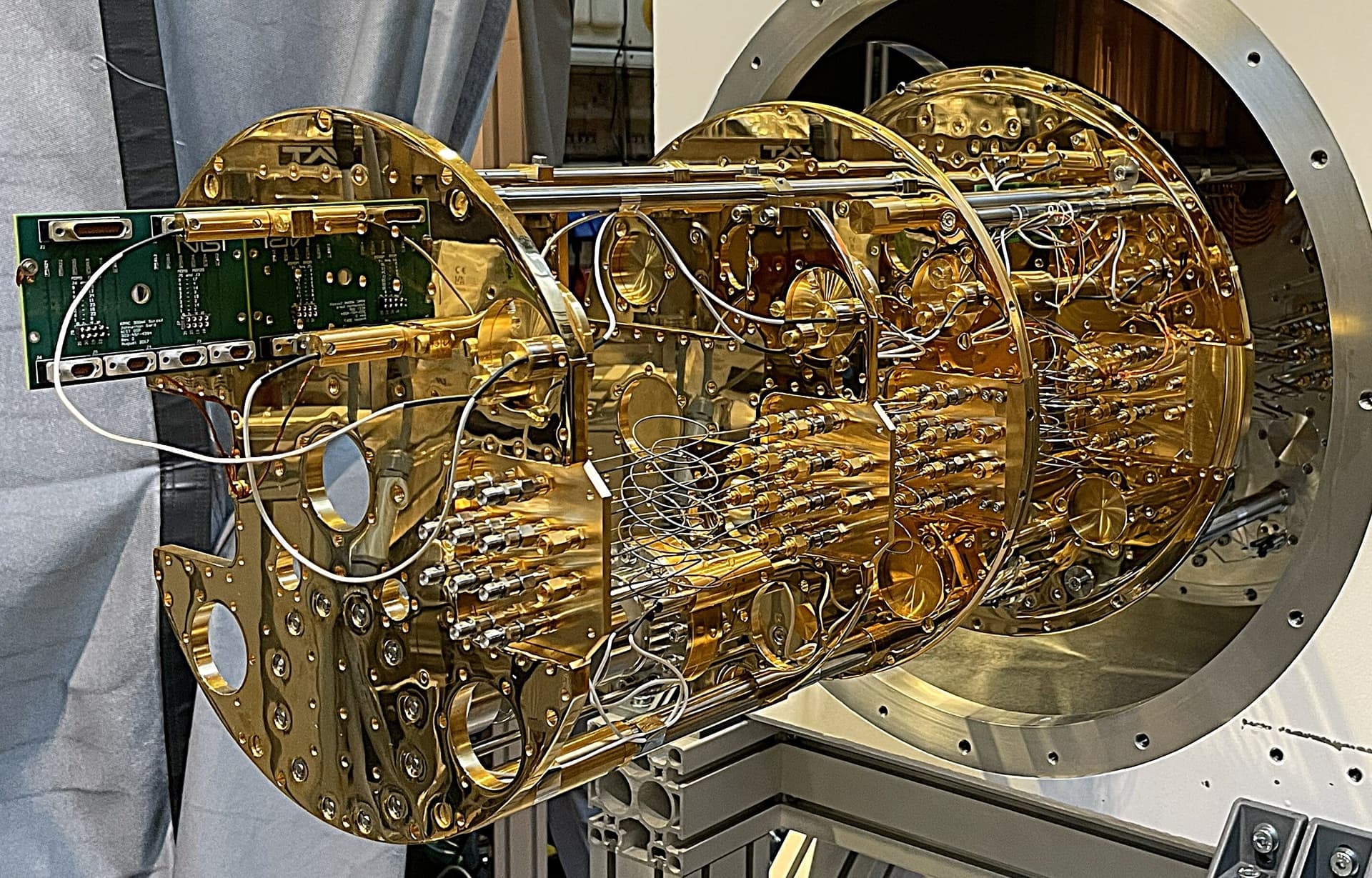
The real advance at BESSY II was not that a new spectrometer came online. It was that a 248-sensor TES array cooled to 25 milli-Kelvin made soft X-ray work sensitive enough to chase impurities, nanostructures and atomically thin layers that used to vanish in the noise. The endstation, AXSYS TES on the UE-52 SGM beamline, became the first and only TES spectrometer at a synchrotron source in Europe, giving Berlin a detector platform that had already been proven at major facilities in the United States and Japan.
That temperature requirement is the whole game. The array sits in a helium-4 and helium-3 dilution refrigerator, where the sensors become superconducting and can register single photons with a reported detection efficiency 100 to 1,000 times higher than conventional wavelength-dispersive X-ray emission spectrometers. For X-ray emission spectroscopy and resonant inelastic X-ray scattering, that is a practical shift, not a cosmetic one. The methods are photon-hungry by nature, and the new detector is meant to cut measurement times from hours to minutes while keeping weak signals alive long enough to analyze them.

HZB says the TES endstation was built for soft X-ray methods including XAS, XES and RIXS, with the beamline listing also naming NEXAFS, XMCD, XMLD and EXAFS across an experimental energy range of roughly 100 to 1500 eV. That range matters because it covers the electronic and chemical fingerprints researchers actually use to sort out thin oxide films, metal nanoparticles on oxides, catalysts under operating conditions and other low-concentration systems. The Fritz Haber Institute’s Interface Science department already has preferred access to BESSY II beamlines, which makes the instrument a natural fit for the kind of work that depends on trace impurities or tiny active sites rather than bulk samples.
The new European installation also lands with a useful track record behind it. NIST has already reported a 240-pixel TES spectrometer at SPring-8, where 220 pixels ran simultaneously and delivered 4 eV energy resolution at 6 keV, with an empirical compromise of about 2,000 counts per second across all pixels at 5 eV resolution. NIST has also reported TES spectrometer work at the Stanford Synchrotron Radiation Lightsource and in the upgraded LCLS-II project. BESSY II, Germany’s only third-generation synchrotron radiation source and home to 46 beamlines, now has the same detector class in its own ecosystem, and that is what changes the experiment list. It turns formerly marginal samples into real targets and makes faint electronic structure something the beamline can actually catch.
This article was produced by Prism’s automated news system from verified source data, official records, and press releases, then run through automated quality and moderation checks before publishing. The system is built and supervised by the people who set the standards it runs under. Read our full AI policy.
Did this article answer your question?