Helium-3 polarization survives laser-plasma acceleration, boosting compact fusion research
Helium-3 kept its spin through laser-plasma acceleration, a key test for compact beams that fusion diagnostics and polarized nuclear studies have been waiting for.
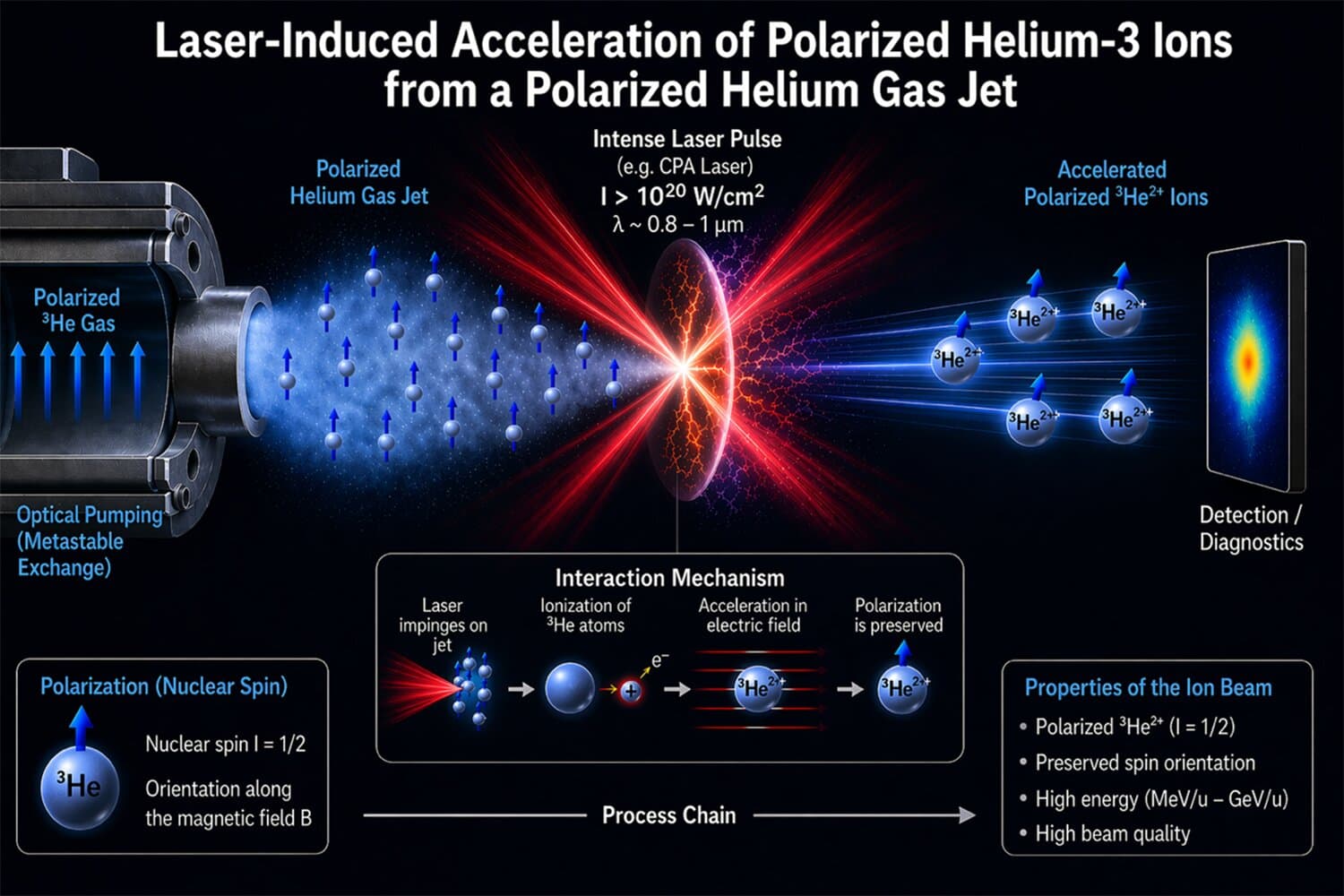
Preserving Helium-3 polarization through a laser-plasma accelerator is the real milestone here. The German-led team showed that a spin-polarized 3He beam can survive acceleration to MeV energies, a result that pushes compact accelerator concepts closer to the one thing they usually struggle with: beam quality that survives the trip.
Markus Büscher’s group at Heinrich Heine University Düsseldorf worked with partners at Forschungszentrum Jülich and GSI Helmholtzzentrum für Schwerionenforschung to move a pre-polarized helium-3 gas from Jülich to Darmstadt, then hit it with GSI’s PHELIX laser. The beam was read out with CR-39 detector plates after acceleration. GSI describes PHELIX as a petawatt-class facility with pulse energies up to about 1 kilojoule and power up to about 500 terawatt, the sort of machine that lets wakefield acceleration do what conventional hardware cannot in a normal lab footprint.
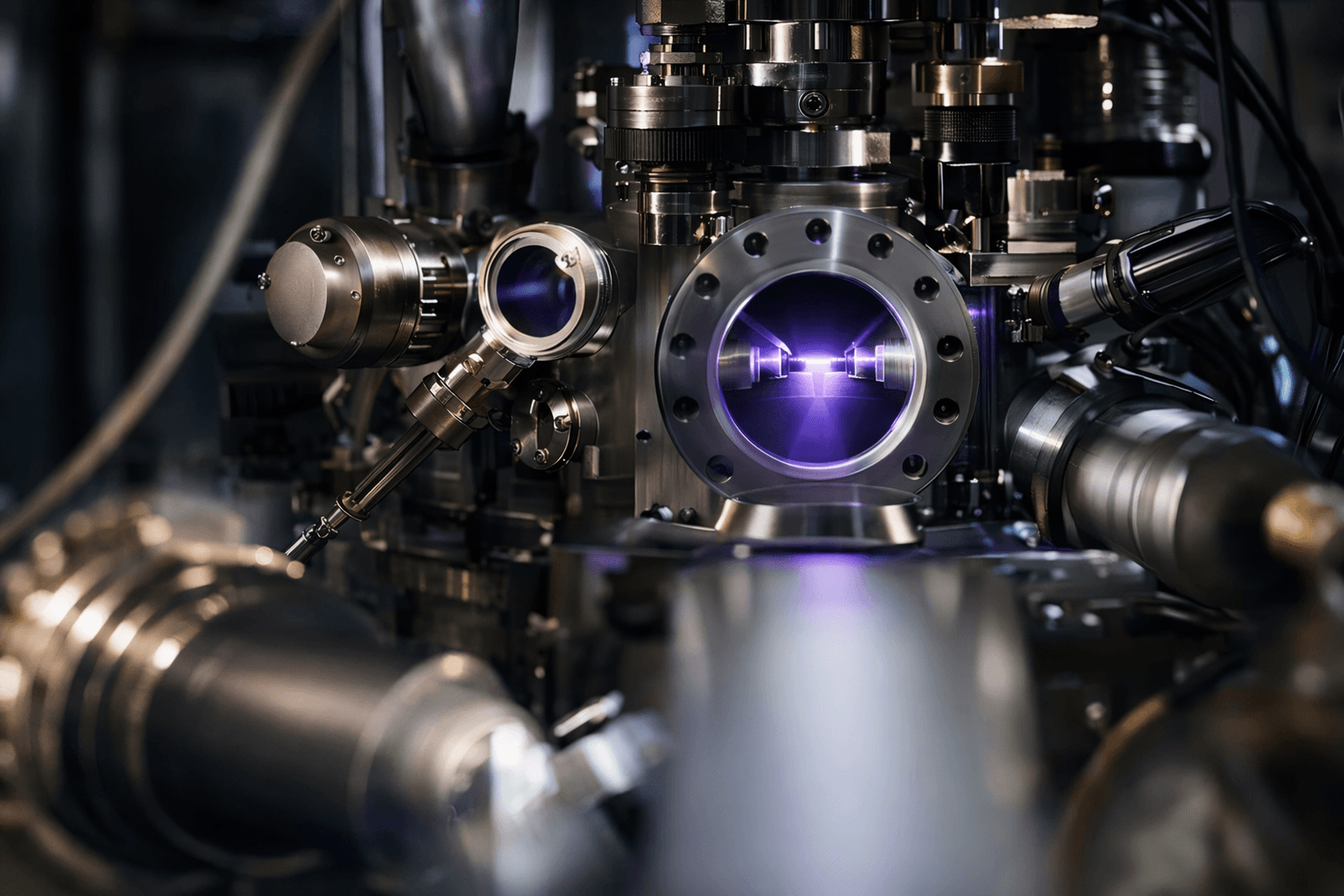
That footprint is the other half of the story. HHU says laser-plasma accelerators can produce accelerating and focusing fields in the 100 GV/m class, about 1,000 times higher than conventional machines. That is why plasma accelerators have drawn so much attention: they promise compact, lower-cost sources for particles at high energy. But high gradient alone has never been enough. If spin alignment falls apart in the plasma, polarized beams are useless for the work that needs them.
This experiment showed that problem is not inevitable. The paper says experimental confirmation of spin-polarization conservation in plasma had not been achieved before, and the new data provide evidence that nuclear polarization persists after acceleration. That matters immediately for fusion research. In controlled nuclear fusion, aligned spins can raise reaction probability and improve the energy yield. Polarized helium-3 could also sharpen diagnostics in experiments that depend on spin-sensitive interactions, especially for future proton and electron beam studies.
Büscher’s role fits a longer arc. HHU said he received a Chinese Academy of Sciences fellowship in January 2026 and gave talks in Shanghai and Lanzhou on plasma acceleration of polarized particle beams. He has also worked for about a decade with the Shanghai Institute of Optics and Fine Mechanics and the Institute of Modern Physics on polarized beam work. Earlier papers in 2019 and 2022 had already framed the technical path, pointing to helium-ion acceleration energies relevant for future 3He spin measurements and to a high-density polarized 3He gas-jet target as a prerequisite for a laser-driven spin-polarized beam source.
This result does not mean plasma accelerators are ready to replace conventional sources of fully polarized beams. It does show that spin survival, the part that usually breaks the promise, can be kept intact. For compact accelerator science and polarized fusion research, that is the breakthrough worth paying attention to.
This article was produced by Prism’s automated news system from verified source data, official records, and press releases, then run through automated quality and moderation checks before publishing. The system is built and supervised by the people who set the standards it runs under. Read our full AI policy.
Did this article answer your question?