Lloyd’s Register and ABS back early nuclear ship designs
Two class societies gave nuclear shipping a visible first step, but only on paper: a molten-salt car carrier and a 16,000-TEU cargo ship.
Nuclear shipping just got a little less imaginary, but not by much. Lloyd’s Register and American Bureau of Shipping have both signed off on early concept designs that put reactors on commercial hulls, a visible milestone that still stops well short of construction approval. The hard problems are still sitting in front of the industry: crew rules, port access, insurance, security, fueling and the question of how a reactor survives inside a moving ship at sea.
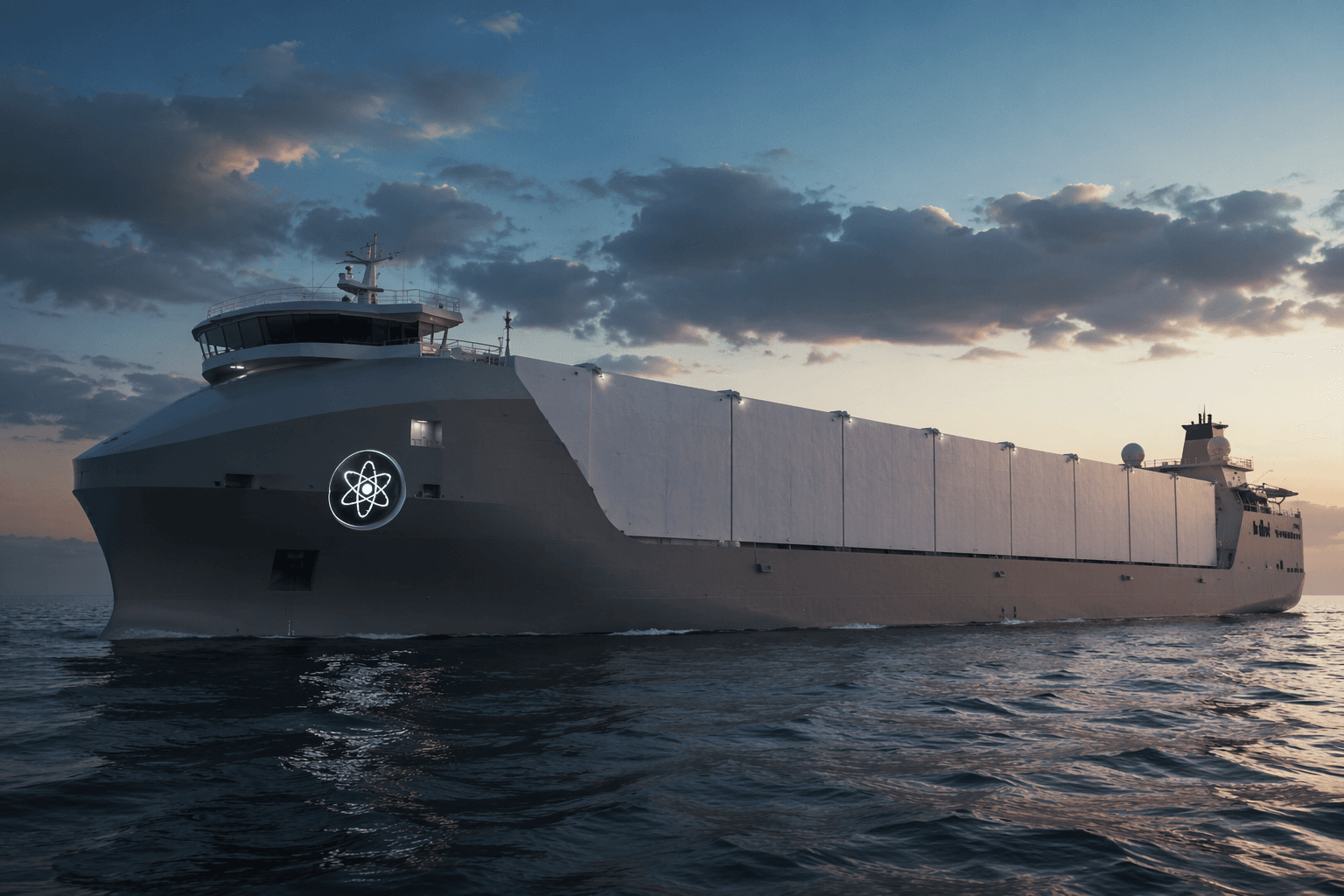
Lloyd’s Register granted approval in principle for a car-carrier concept built around a molten-salt reactor. The project is a joint development effort with Hyundai Heavy Industries, HD Korea Shipbuilding & Offshore Engineering, Hyundai Glovis, G-Marine Service and the Korea Atomic Energy Research Institute, and it is focused on how a molten-salt reactor could be physically and operationally integrated into a large pure car and truck carrier. LR also brought the subject into the room on June 1 at the Athens Olympic Museum, where it held a closed-door nuclear-shipping roundtable at Posidonia 2026 with around 20 senior representatives from shipowners, regulators, reactor developers and industry bodies.

That is the right level of seriousness for this stage. LR has said concept-stage feasibility matters for cargo optimization, vessel stability and integrated safety design, which is exactly where shipboard nuclear power becomes a real engineering problem instead of a glossy idea. A reactor on a PCTC has to fit around cargo flow, damage control, maintenance access and emergency response, all while satisfying class rules that were written for a very different propulsion world.
ABS made a parallel move on the cargo side. On March 9, 2026, ABS, HD Korea Shipbuilding & Offshore Engineering and HD Hyundai Samho Heavy Industries signed a joint development project to assess a nuclear-powered electric propulsion system for a 16,000-TEU container ship. ABS later granted approval in principle for the integration of a nuclear reactor into a cargo vessel propulsion system developed through the MIT Maritime Consortium, the first AIP given to a technology from that consortium. The consortium’s founding members include the Massachusetts Institute of Technology, HD Korea Shipbuilding & Offshore Engineering and Capital Maritime Group, and the concept uses a synthetic heat-transfer fluid with a target reactor thermal output of roughly 10 MW to 20 MW.
Taken together, the approvals do not mean nuclear cargo ships are about to start loading at every major port. They do mean classification societies are now willing to treat nuclear propulsion as a design path worth formal review, and that matters because the first adopters, if they come, will likely be the biggest standardized vessels where zero-carbon propulsion and fewer fuel stops justify the regulatory lift. The reactor is still on the drawing board, but the shipping world has finally started marking where it might fit.
This article was produced by Prism’s automated news system from verified source data, official records, and press releases, then run through automated quality and moderation checks before publishing. The system is built and supervised by the people who set the standards it runs under. Read our full AI policy.
Did this article answer your question?