Netherlands opens molten salt reactor testing facility in Eindhoven
A week in DICE can stand in for a Thorizon reactor core’s lifetime, making Eindhoven’s new salt-test lab a serious bridge from drawings to hardware.
_60353.jpg&w=1920&q=75)
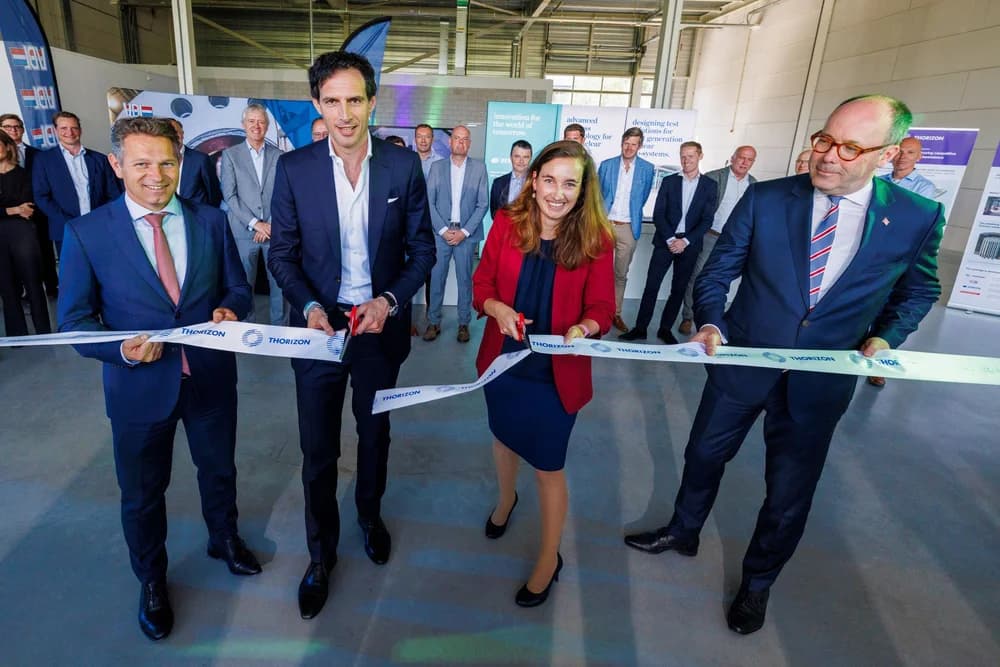
Hot molten salt is where reactor ideas stop being glossy renderings and start getting real, and that is exactly what the new testing facility in Eindhoven is built to expose. At the High Tech Campus Eindhoven, Wopke Hoekstra joined Dutch and provincial officials, industry partners and Thorizon CEO Kiki Lauwers for the June 1, 2026 kickoff of a project meant to push molten salt reactors from concept toward buildable hardware.
The facility sits inside PROMOSA, a EUR8 million program with North Brabant covering half the cost. Its job is narrow but decisive: demonstrate and validate the manufacturability, safety and functionality of critical components and non-nuclear subsystems for molten salt reactors. That means testing parts in high-temperature molten salt without nuclear fuel, a deliberate step that focuses on engineering reality instead of reactor theatrics. For advanced nuclear, that is often where the hard part lives: materials, seals, pumps, heat transfer and durability, all of it under conditions that can make a promising design fail long before the first fissile material is loaded.

DIFFER said it helped build the DICE testing platform with Thorizon and North Brabant, and the materials angle is the whole point. According to DIFFER, one week of testing in DICE corresponds roughly to the full expected lifetime of a Thorizon reactor core. That is a blunt reminder that material behavior, not just core physics, will decide whether molten salt systems can move through licensing and into service. DIFFER’s Beata Tyburska-Pueschel said hot molten salt and radiation strongly affect material lifetime and reactor safety, which is why accelerated testing matters for validating safety models and cutting the time needed to prove a design can survive in the real world.
The political and industrial backing is already stacked behind the project. North Brabant launched its Nuclear Energy for the Future coalition in 2021 to use the province’s manufacturing base and research institutions to accelerate MSR development, and Hoekstra used the Eindhoven event to argue that nuclear energy must be part of Europe’s energy mix. Martijn van Gruijthuijsen, the North Brabant deputy, framed the facility as proof that the province can connect sustainable energy, industrial strength and international cooperation. Thorizon, Demcon, VDL Group and the Dutch Institute for Fundamental Energy Research are all involved, turning the lab into a regional test bench for a supply chain that will need to make molten salt hardware repeatably, not experimentally.
That matters because Thorizon is already talking in deployment milestones. The company says Thorizon One is intended to be a 250 MWt, 100 MWe molten salt reactor, and an April 16, 2026 memorandum with EPZ, NRG PALLAS, Zeeland, Noord-Holland, Impuls Zeeland, ROM InWest and Invest-NL set a non-nuclear demonstrator target for 2030 and a first commercial reactor on the European grid for 2034. Eindhoven is the place where those dates get a lot less abstract, because the path from reactor idea to operating plant runs straight through a facility like DICE, where salt, heat and materials either hold together or give the game away.
This article was produced by Prism’s automated news system from verified source data, official records, and press releases, then run through automated quality and moderation checks before publishing. The system is built and supervised by the people who set the standards it runs under. Read our full AI policy.
Did this article answer your question?