BirdVenue Guide Teaches Parrot Owners to Train Talking With Patience
Context beats repetition every time: a few well-timed daily cues, a high-value treat, and welfare guardrails are all it takes to teach a parrot real speech.
An African grey parrot that says "want a bath?" on cue didn't learn it from a word drill. It learned it because someone said those exact three words, at normal conversational volume, every single time before the misting bottle came out. That is how parrot speech training actually works, and it is a world away from the looping recordings and marathon repetition sessions most new owners default to.
The BirdVenue guide "How To Train Your Parrot To Talk: A Practical Guide" cuts through the noise with a welfare-first framework rooted in bonding, context-based cuing, and incremental reinforcement. It's aimed squarely at companion-parrot owners who want results without sacrificing the trust they've built with their birds. Here's how to put its principles into a concrete daily practice.
Start With the Bond, Not the Words
Every credible avian trainer says the same thing, and the BirdVenue guide opens with it for good reason: a parrot will not willingly communicate with someone it doesn't trust. Before a single target word is introduced, spend whatever time it takes simply existing calmly near your bird. Talk to it in your normal voice, let it approach you on its own schedule, and keep early interactions brief and entirely pressure-free.
African grey parrots learn best through immersion and context, often picking up phrases you didn't consciously "teach." That means the bonding phase is not dead time; it is the first stage of vocabulary building. A bird that associates your presence with safety and positive outcomes is already primed to mimic your speech, before you've formally started training at all.
The Daily Training Plan: What to Say, When, and How to Reinforce
The BirdVenue framework centers on short, frequent sessions rather than long, intensive ones. The target is two to three sessions of five to ten minutes each, spaced through the day and timed to when your bird is naturally alert. Most parrots are most receptive shortly after the morning cage cover comes off, in the mid-afternoon, and in early evening before things quiet down.
Each session follows the same structure:
1. Choose one target word per session. Start with single-syllable or two-syllable words with hard consonants: "up," "hello," and "food" all work because they have natural, repeatable context in daily life.
2. Say the word clearly and at your normal conversational volume, paired with the relevant action or moment. Say "step up" every time you invite the bird onto your hand. Say "good morning" every morning when you lift the cage cover. Say "want a bath?" before every misting. The word and the moment must be inseparable.
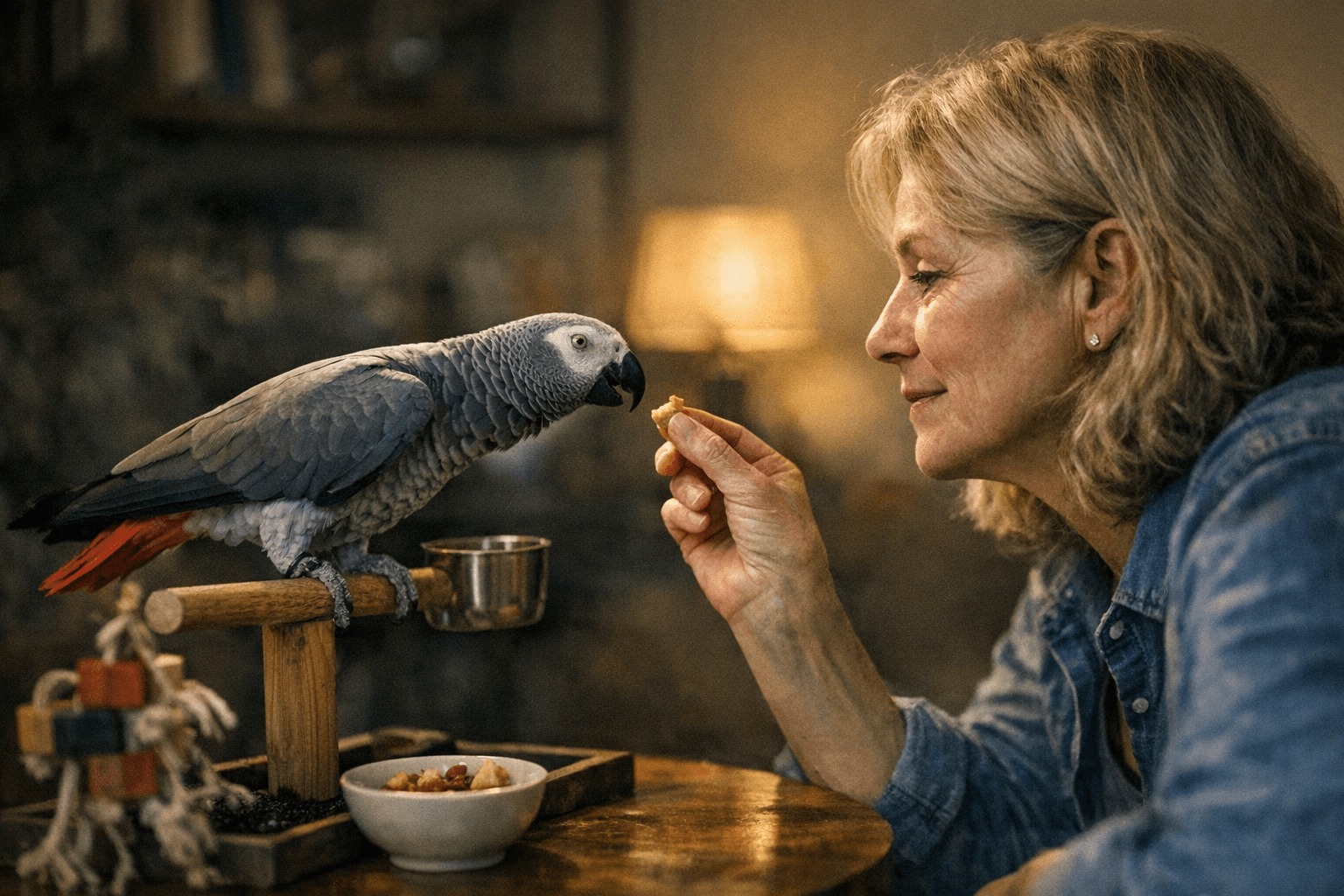
3. The instant your bird produces any approximation of the target sound, even a garbled attempt, deliver a high-value reward immediately. A small piece of favored fruit, enthusiastic verbal praise, or a brief favorite interaction all work. Timing is the variable that most owners get wrong: a reward delivered three seconds late is reinforcing whatever the bird did in those three seconds, not the vocalization you wanted.
4. End the session while the bird is still engaged and before its attention drifts. Stopping on a successful note, however small, builds momentum for the next session.
Keep sessions short, upbeat, and end on success. Never scold or show frustration; this discourages communication. That is not a soft preference; it is a structural rule. Frustration in your voice teaches your bird to associate training with your frustrated tone, and parrots mimic tone as readily as they mimic words.
Choosing Rewards That Actually Reinforce
Not all rewards land equally. Positive reinforcement, especially praise, should gradually replace food rewards for lasting results. Start with food, because it delivers the clearest "yes, that's right" signal in early training, then layer in verbal praise as the behavior solidifies. Clicker or marker-based training, where a precise click marks the exact moment of correct behavior before the treat appears, sharpens the signal considerably and is the method the BirdVenue guide recommends for shaping vocal behavior.
Whatever you use as a food reward, keep it safe. The guide is explicit: do not reward a parrot with human foods that are toxic to birds. Small pieces of preferred vegetables, fruit, or species-appropriate pellets are the reliable options.
Species and Age: Calibrate Before You Train
African Greys might speak within weeks. Budgies might take months. Some parrots may never talk, but they'll still bond, whistle, or mimic other sounds. The BirdVenue guide addresses this honestly: African greys and Amazon parrots sit at the top of the speech-learning hierarchy among companion birds. These birds don't just copy sounds; they often use words with apparent understanding and context. This intelligence means owning one is a serious commitment.
Macaws are capable but variable. Their gift tends to be presence and volume rather than vocabulary breadth. Conures and smaller species require a recalibrated goal entirely. Many conures will happily master whistled phrases or melodic patterns before, or instead of, producing clear human speech, and a finely whistled tune counts as a genuine training success.
Age shapes the trajectory too. Younger birds in their first year or two tend to absorb new vocalizations more readily, but older parrots can absolutely learn. The pace simply demands more patience and more consistent cuing.
Welfare Boundaries: Recognizing When Training Becomes Pressure
Training is enrichment. The moment your bird stops experiencing it that way, the session has become something else. These are the behavioral signals to watch for:
- Feather plucking or excessive preening during or after sessions
- Avoidance: the bird moves away when you approach, turns its back, or refuses to step up
- Fluffed posture or drooping wings at training time
- Vocalizations shifting from exploratory and curious to alarm calls or distress screams
Feather plucking is a primary indicator of stress in parrots. The behavior can be linked to boredom, anxiety, or underlying medical issues. If you see it increasing around training time, the sessions are too long, too loud, or too frequent. End immediately, give the bird space, and reduce the ask before trying again.
The BirdVenue guide is also clear on volume: vocal prompts should never exceed your normal conversational voice. Repeating a word louder and louder does not accelerate learning; it overstimulates or frightens the bird. If your bird is not responding, the answer is better timing and higher-value reinforcement, not more decibels.
If your bird stops eating, shows sustained feather destruction, or displays other physical changes, do not attempt to train through it. Seek an avian veterinarian. Sudden behavioral regression or a previously social bird withdrawing from interaction can be an early indicator of illness, not a training plateau.
Multi-Bird Households
For owners with more than one parrot, individual sessions are non-negotiable. Group training typically results in one dominant bird controlling the interaction while others become passive or competitive. Five focused minutes per bird, one at a time, produces faster vocabulary gains and better welfare outcomes than any shared session.
Troubleshooting: The Most Common Failure Points
*Inconsistent cues.* If "step up" sometimes sounds like "come on, step up" and sometimes like a gesture or a whistle, your bird cannot build a reliable association. Pick one exact cue word and use it identically every time, without variation.
*Background noise.* Running a training session with the television on or household noise competing in the background muddies the acoustic signal your bird is trying to isolate. Find a genuinely quiet ten minutes. Link key phrases to specific cues and repeat them in context to avoid boredom.
*Environmental stress.* A moved cage, a new pet, a change in schedule, or an unfamiliar person in the home can temporarily shut down a parrot's willingness to vocalize or engage. This is a normal adaptive response, not a training failure. Resume sessions only once the bird has returned to relaxed baseline behavior.
*Wrong expectations by species or age.* A conure that never produces a clear word but whistles enthusiastically and steps up reliably is a trained, enriched, well-bonded bird. Measure success by the quality of the relationship and the bird's visible engagement, not by vocabulary count.
*Reward timing errors.* If the treat arrives two to three seconds after the vocalization, you are likely reinforcing whatever behavior followed the sound. Work on your own delivery speed as consciously as you work on the bird's response. A clicker resolves this problem almost entirely, because the mark is instant even when the treat is not.
A parrot that has learned to say "up" and actually uses it when it wants to be lifted has achieved something that goes well beyond mimicry: a genuine two-way communicative exchange across species. That is the goal the welfare-first approach is aimed at. Not a performing bird. A bird that trusts you enough to tell you what it needs, in your own language, on its own terms.
This article was produced by Prism’s automated news system from verified source data, official records, and press releases, then run through automated quality and moderation checks before publishing. The system is built and supervised by the people who set the standards it runs under. Read our full AI policy.
Did this article answer your question?