New Study Explores Bird Agency and Owner Relationships Among Chinese Bird Keepers
A new study found that the longer someone keeps a bird, the deeper their perception of its vitality becomes, revealing a temporal progression in the owner-bird bond.
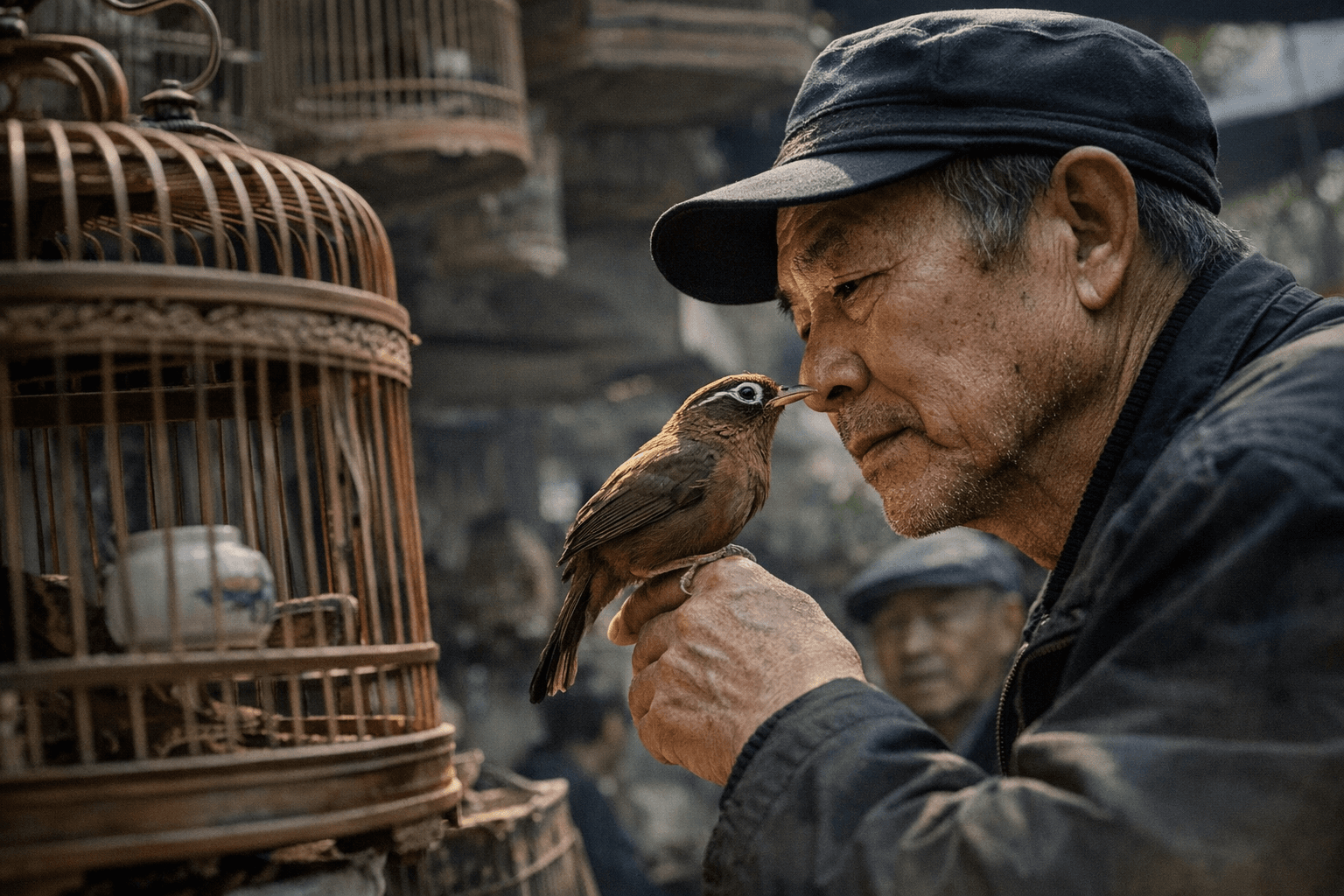
A qualitative study published in Frontiers in Communication on March 5 mapped the relationship between bird owners and their birds across eight basic dimensions, producing a structural model that treats the bond as a dynamic network shaped by material, emotional, and social forces.
Researcher Ziyi Wong, whose paper carries the title "Hail to thee, blithe spirit! A critical study of bird agency among bird owners in China," built the study around in-depth interviews rather than the surveys and statistical methods that dominate most bird-related research. The decision was deliberate. As Wong wrote in the paper, "quantitative research methods are not conducive to exploring the connection between the two from the perspective of micro-relationships," making in-depth interviews the necessary tool for capturing what actually happens between a keeper and a bird at the individual level.
The theoretical backbone is vital materialism, a framework that treats the world as a dynamically generated network of relationships and pays close attention to how material, emotional, and social forces flow through it. Wong argued that pairing this lens with qualitative interviewing is "not only appropriate but also highly promising as a research path," because the combination allows micro-level personal histories to reveal how broader forces, including technology, institutions, and social norms, get internalized and translated into new keeping practices.
From the interview data, Wong constructed a structural model of the owner-bird relationship formed by three layers of aggregation built from eight basic dimensions. The model is visualized in a network diagram that focuses on "the flow and effects of material, emotional, and social forces." The specific names of those eight dimensions and three layers are detailed in the paper itself, which is available as an open-access PDF through Frontiers' website.
One of the study's clearest findings concerns time. Wong found that "the perception and influence of the owner on the vitality of the bird gradually deepened as the duration of keeping the bird increased, resulting in a temporal progression among the three themes." In practical terms, that means the bond between keeper and bird is not static at the moment of acquisition. It evolves, and the study's model is designed to capture that evolution as a structured phenomenon rather than a vague emotional attachment.
Wong positioned the work against a backdrop of prior scholarship that has approached birds either through large-scale quantitative lenses or through concepts like "citizenship in bird research" developed by researchers including Keck in 2020 and Mollentze and Streicker in 2020. By taking the micro-narrative as an entry point, the study aims to surface the generative mechanisms that those broader approaches tend to obscure. For anyone who has watched their parrot's personality seem to sharpen and respond over months and years of keeping, this paper offers a framework for understanding why that deepening is real and not just projection.
Know something we missed? Have a correction or additional information?
Submit a Tip