Red-headed lovebird captivates with rarity, striking colors, and demanding care
Its red mask grabs attention, but the real story is scarcity: this is a lovebird that punishes sloppy setups and rewards careful, steady care.
A lovebird that looks familiar until you actually try to find one
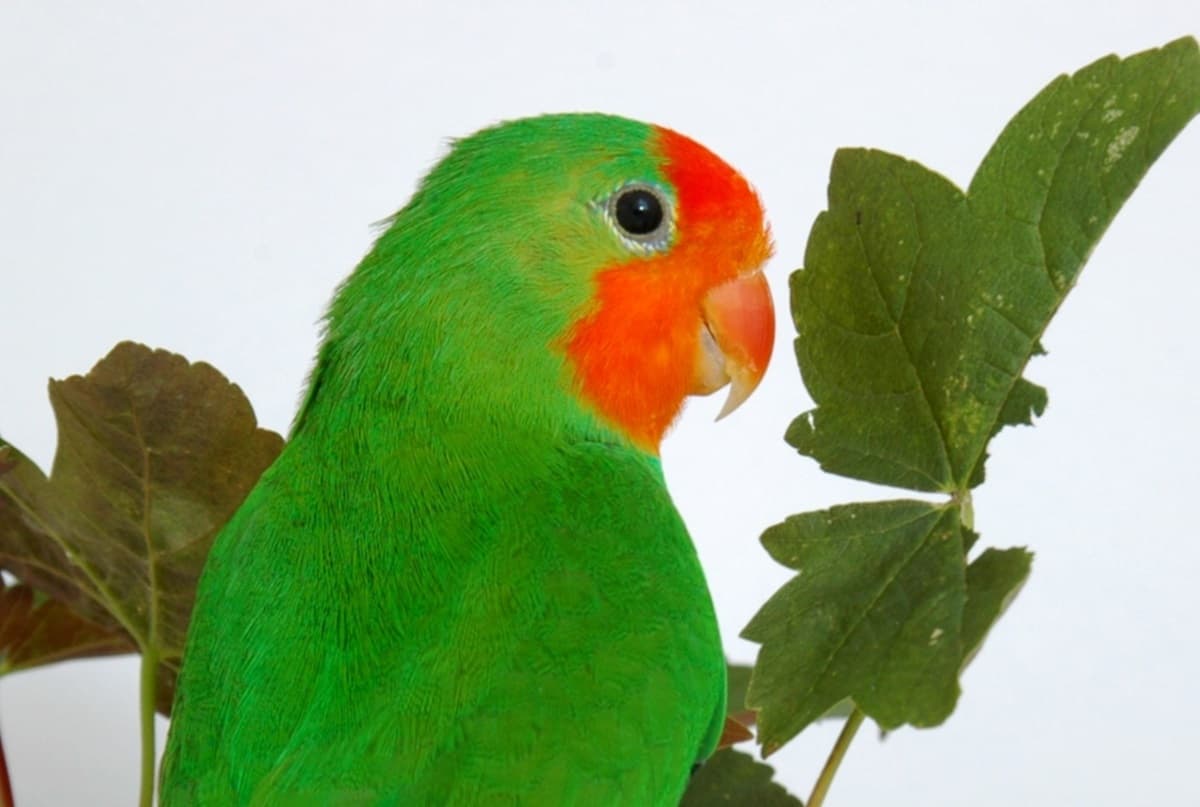
The red-headed lovebird, Agapornis pullarius, is one of those birds that stops you in your tracks. It has the classic lovebird body plan, a vivid green base color, and a red facial mask that makes the species instantly recognizable, but it is far less common in aviculture than the lovebirds most people know. That gap between beauty and availability is the real story here: this is not just a pretty small parrot, it is a species that asks for precision, calm, and consistency.
It also has the kind of pedigree bird people notice. Carl Linnaeus first described it in 1758, and it remains a distinct member of the genus Agapornis, a group of nine extant species whose name comes from the Greek for “love” and “bird.” That lineage matters, because the red-headed lovebird is not some generic mini parrot with a flashy face. It is a true lovebird through and through, social, pair-bonded, and built for a very specific kind of life.
What sets it apart from the lovebirds people already know
The easiest way to think about this species is as a short-tailed, mostly green miniature parrot with a few high-impact details that change everything. Males show a red patch on the face and black on the underwing. Females have an orange face instead, and juveniles are entirely green-headed, which makes young birds easy to misread if you are expecting the adult look on day one.
That visual split is part of the appeal, but the common name can be misleading if you let the looks do all the work. You may also see it called the red-faced lovebird, and in the field it is usually found in small groups, not as lone showpieces. The sound and behavior fit the bird too: a quick, high-pitched, silvery call often carries in flight, which is a reminder that this is an African parrot shaped by open-country movement and tight social contact, not a decorator pet.
A wide range, but not a common bird
BirdLife International lists the red-headed lovebird as Least Concern, yet that does not translate into easy access or a booming captive population. The species has a huge extent of occurrence, 8,360,000 km², and its range stretches across much of Africa, including Angola, Benin, Burundi, Cameroon, the Central African Republic, Chad, Congo, the Democratic Republic of the Congo, Côte d’Ivoire, Equatorial Guinea, Ethiopia, Gabon, Ghana, Guinea, Kenya, Mali, Niger, Nigeria, Rwanda, Sierra Leone, South Sudan, Sudan, São Tomé and Príncipe, Tanzania, Togo, and Uganda, with Liberia listed as introduced.
Even with that spread, BirdLife says it is generally rather uncommon and never reported as abundant except locally in Ethiopia. The global population size has not been quantified, the number of mature individuals is unknown, and the population trend is decreasing. That combination is exactly why the bird feels rarer in aviculture than its range map suggests. A species can be widespread and still be hard to find, hard to source, and hard to keep well.
Why rarity in captivity is part biology and part husbandry
The reason this bird stays uncommon in captivity is not mystery, it is management. The red-headed lovebird appears more stress-prone than many standard pet birds, and that changes the whole ownership equation. If you treat it like a routine small parrot, you are setting yourself up for problems.
What this species seems to demand is a stable, low-drama environment. Environmental upheaval, sudden changes in routine, and sloppy housing are the kinds of things that can turn an eye-catching bird into a difficult one. That is the practical reality behind the rarity: the bird is beautiful, but it is also less forgiving of casual care.
A useful way to think about it is this: the bird’s appeal gets people in the door, but its sensitivity determines whether it thrives. That is why this species belongs in the category of “specialized companion bird,” not “starter lovebird.”
What the wild bird is telling you about care
The natural habitat tells you a lot. eBird places the species in lush savanna, secondary forest, gallery forest, and cultivation, which is a useful clue that it is not adapted to chaos. It lives around vegetation structure, food availability, and seasonal rhythms, and that should push captive care toward environmental consistency rather than improvisation.
The wild diet adds another layer. Sources describe grass seeds, fruit, some cultivated crops, and insect larvae as part of the mix, which is a reminder that the bird is not a seed-only machine. Feeding and management should reflect that broader ecology, with attention to balance rather than the old habit of assuming all small parrots can live on a generic small-bird menu.
Breeding is where the species gets even more specific
Breeding behavior underlines how specialized this bird can be. It breeds during the rainy season when food is abundant, and it is a cavity nester that often uses arboreal termite or ant nests, though tree hollows made by woodpeckers can also be used. That is not a random nesting preference. It is a clue that the species is adapted to a narrow set of breeding conditions, shelter styles, and timing cues.
Captive breeding can therefore require special nest setups. One practical approach described in avicultural references is a nest box filled with sheets of cork so the female can excavate a tunnel to the nest chamber. That detail matters because it shows how easily generic equipment can miss the mark. If you want a serious breeding attempt, you need to think like the bird, not like a catalog.
Common misconceptions that cause trouble
The biggest misconception is that a smaller parrot is automatically an easier parrot. The red-headed lovebird is a clean example of why that assumption fails. Size has nothing to do with how much stability a bird needs, and in this case the species’ rarity in captivity is itself a warning label.
Another mistake is to assume all lovebirds behave the same. They share the genus, the social nature, and the pair-bonded reputation, but that does not erase species-level differences in temperament and management. The red-headed lovebird’s strong identity, striking sexual dimorphism, and stress sensitivity make it different enough that careful owners notice the contrast immediately.
Bird trade data reinforces the point. BirdLife says the species has shown up in three of seven datasets evaluated in a 2024 review, which suggests presence in trade without turning it into a routine captive bird. It is available enough to be noticed, but not common enough to be truly normalized.
The reality check that matters
The red-headed lovebird earns its fascination honestly. It is visually striking, scientifically well-established, and biologically distinct, but it is also a bird that demands more from the keeper than its size might suggest. Wide range, unknown population size, decreasing trend, and a long history in science do not make it easy in captivity.
That is the real value of this species in a companion-bird conversation. It reminds you that beautiful parrots are not necessarily straightforward parrots, and that rarity often reflects husbandry difficulty as much as market demand. If you respect the bird’s need for stability, social structure, and precise environmental management, the reward is one of the most distinctive lovebirds in the world.
This article was produced by Prism’s automated news system from verified source data, official records, and press releases, then run through automated quality and moderation checks before publishing. The system is built and supervised by the people who set the standards it runs under. Read our full AI policy.
Did this article answer your question?