San Francisco’s Free-Flying Parrots Are Hybrid Red-Masked, Mitred Species
San Francisco’s famous parrots are not a single species at all. The flock is a hybrid mix, and that changes how you read every green flash over the city.
The flock is more complicated than it looks
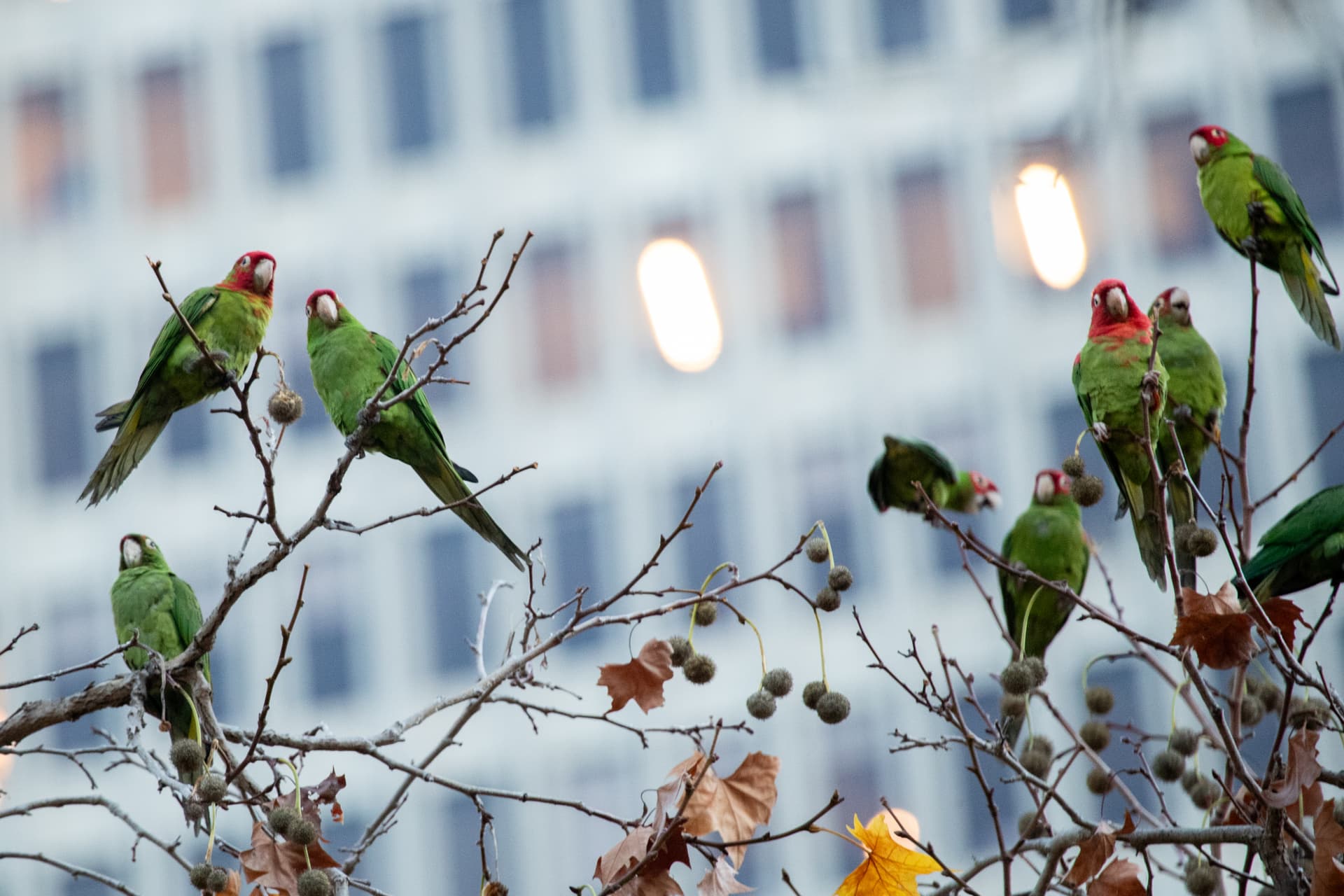
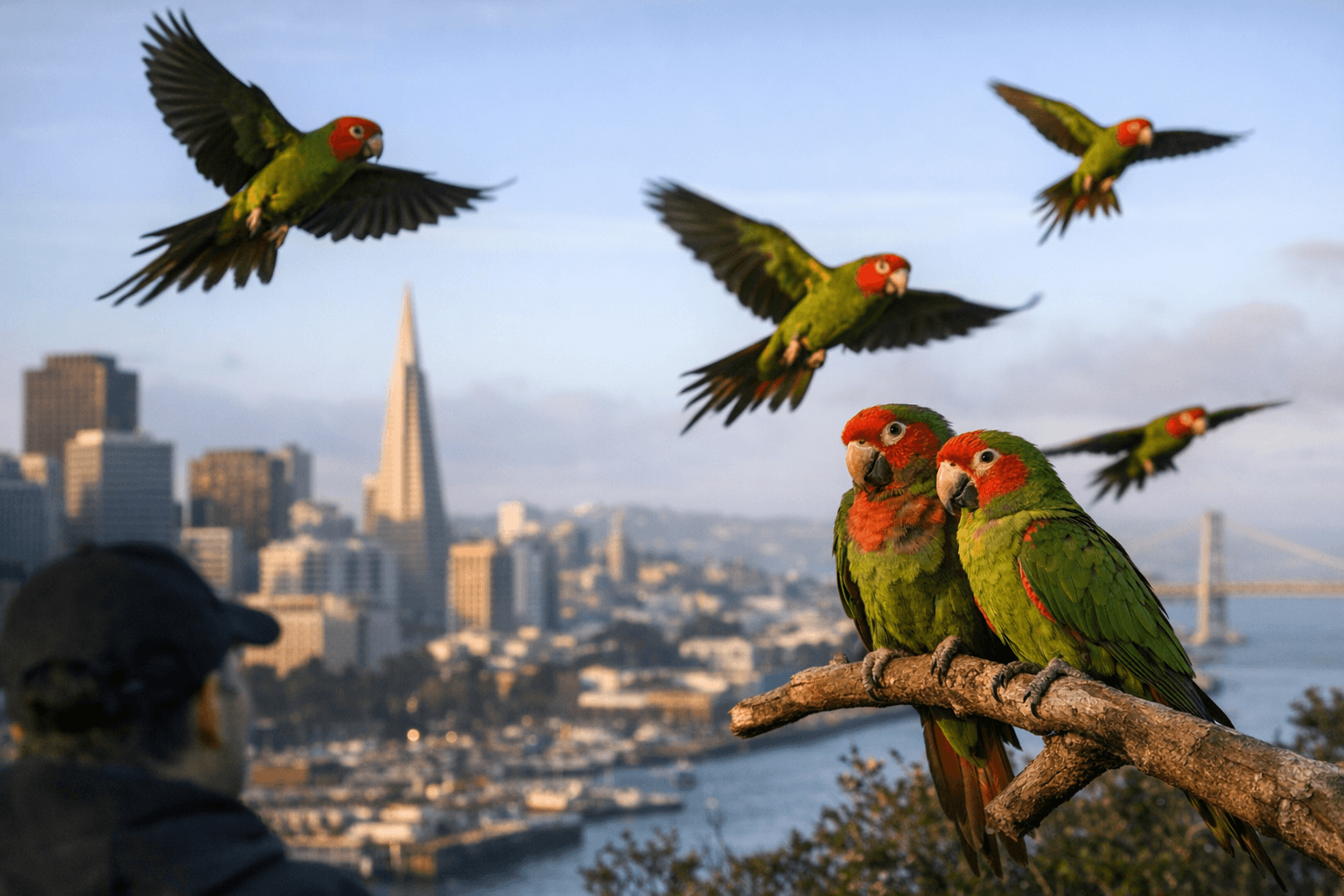
San Francisco’s parrots have always looked like one of those city legends that somehow turned real: loud, green, impossible to miss, and somehow at home on Telegraph Hill. The surprise is that they are not just a straightforward red-masked parakeet story. Bay Nature reports that the birds are hybrids of red-masked and mitred parakeets, which means the flock is not a single escaped-pet spillover but a breeding population with its own mixed genetic identity.
That distinction matters more than it sounds like it should. Once you realize the flock is hybridized, every flyover becomes part birdwatching, part local history, and part urban ecology. These are not just parrots passing through San Francisco. They are birds that have settled, reproduced, and adapted well enough in the city to blur the line between imported curiosity and established urban wildlife.
Why the species ID debate finally matters
For years, birders, residents, and conservation observers have argued over what the San Francisco parrots actually are. A lot of people knew them under the common name cherry-headed conures, which maps to the red-masked parakeet, but that shorthand never told the whole story. Audubon notes that red-masked parakeets have feral populations in California cities, including San Francisco, and that they are often seen in mixed flocks with the similar mitred parakeet.
KQED had already described the flock as starting with cherry-headed, or red-masked, birds and later absorbing at least one mitred conure that bred with them. The result, as that reporting put it, was a flock dotted with hybrids. Bay Nature’s newer reporting makes that older picture look even more important: the city’s parrots are not only mixed in appearance, they are mixed in origin.
That is not a small taxonomic footnote. If you are trying to identify the birds overhead, understanding the hybrid makeup helps explain why some individuals do not look exactly like the field guide photo you remember. If you care about local bird history, it explains why the flock has stayed such a stubbornly debated presence for so long. And if you love San Francisco’s parrots for the same reason many people do, because they feel like a living piece of the city, then the hybrid story makes them even more interesting.
How the flock became a city fixture
The deeper backstory starts far from San Francisco. KQED described the red-masked, or cherry-headed, birds as coming from a small territory spanning Ecuador and Peru, while the mitred parakeet comes from a different part of South America. That geographic separation is part of what makes the hybrid finding so striking. In nature, these birds are not supposed to be meeting up and forming a stable mixed flock on a Pacific coast city block.
But San Francisco changes the rules. Escaped cagebirds established feral populations around the Bay Area, and over time the city’s parrots became a recognizable urban population rather than a novelty sighting. Bay Nature’s framing suggests they are not just surviving in a city environment, but reproducing there successfully enough to keep the flock going as a hybrid group.
That history also explains why the birds have become part of the city’s folklore. The 2003 documentary The Wild Parrots of Telegraph Hill, centered on Mark Bittner and the flock, helped make them famous far beyond birding circles. Judy Irving’s film gave the birds a face, a home range, and a human witness who understood their daily rhythms. Bittner later remained the name most people associated with the flock, and his death on March 1, 2026, at age 74, closed a chapter in that story without ending the birds’ own.
What you are actually seeing in the city
The flock’s visibility is part of why people keep revisiting the species question. In 2023, more than 27,000 people voted in the San Francisco Chronicle’s poll for the city’s official animal, and wild parrots beat sea lions by a slim margin. Reporting at the time said there were reportedly 200 to 300 wild parrots living in San Francisco, which is enough birds to feel local without being overwhelming.
Their range is still shifting too. SFist reported in December 2024 that some of the parrots were regularly gathering in the redwood grove next to the Transamerica Pyramid, a detail that says a lot about how embedded the flock has become in the downtown landscape. These are not birds confined to one nostalgic postcard corner of the city. They move through new pockets of green, settle where the urban canopy works for them, and keep rewriting the map people think they know.
- Expect mixed features, not a single clean field-guide look.
- Remember that red-masked and mitred birds can overlap in mixed flocks.
- Watch for behavior and flock structure as much as color, because a hybrid urban population can be less tidy than a textbook species account.
If you are trying to spot or identify them, the practical takeaway is simple:
Why bird lovers should care about the hybrid story
The appeal here is not just that the parrots are famous. It is that they show how introduced birds can become something new in place. That raises a real question for anyone who watches urban wildlife: when does a flock stop being a collection of escaped birds and become a city population with its own identity? San Francisco’s parrots sit right in that gray area, and the hybrid finding makes the answer more interesting, not less.
There is also a conservation angle that keeps this from being just a fun bird story. BirdNote has noted that San Francisco’s wild cherry-headed conures have been affected by rodent poison, which is a reminder that even the city’s most beloved avian residents are exposed to urban hazards. A flock can be iconic and vulnerable at the same time.
That broader pattern shows up elsewhere in the Bay Area too. Berkeley researchers reported in 2024 that coastal Savannah sparrows around the region have lost some salt-marsh-adapted genetic diversity as tidal marshes have declined. Different bird, different habitat, same lesson: urban and human-altered landscapes do not just host birds, they reshape them. San Francisco’s parrots are a vivid, highly visible example of that process working in real time.
The city’s green parrots are therefore more than a mascot with wings. They are a hybrid population with a traceable history, a stubborn presence in the urban landscape, and a reminder that the birds overhead are often carrying a longer, messier story than the one people first assume.
This article was produced by Prism’s automated news system from verified source data, official records, and press releases, then run through automated quality and moderation checks before publishing. The system is built and supervised by the people who set the standards it runs under. Read our full AI policy.
Did this article answer your question?