Pathfinder 2e Crafting powers knowledge, logistics, and item creation
Crafting pays off when your party needs control, repairs, and consumables on demand. Buying gear is still smarter for rare items, high-level upgrades, and anything your formula list can’t reach.
In Pathfinder 2e, Crafting matters the moment the party runs out of rope, arrows, potions, or time. The skill lets you identify item value, understand unusual materials, and keep equipment alive when the party is deep in the field and the nearest market is days away. The question is when Crafting beats cash, vendors, and a short walk to the shop.
Crafting is a logistics skill before it is a workshop skill
The strongest thing Crafting does is widen what the party can do between fights. Even untrained characters can use it to Recall Knowledge about alchemical reactions, the value of items, engineering, unusual materials, and alchemical or mechanical creatures, which means the skill has real use before anyone spends a week at the bench. Once the party does invest, Crafting becomes a tool for supply management: consumables can be crafted in batches of up to four with one check, and non-magical ammunition can be produced in the quantities listed on the weapons table.
One successful check can cover multiple consumables. If your group leans on oils, talismans, alchemical tools, or arrows, Crafting can turn downtime into a supply chain instead of a shopping trip.
Formulas are the real gatekeeper
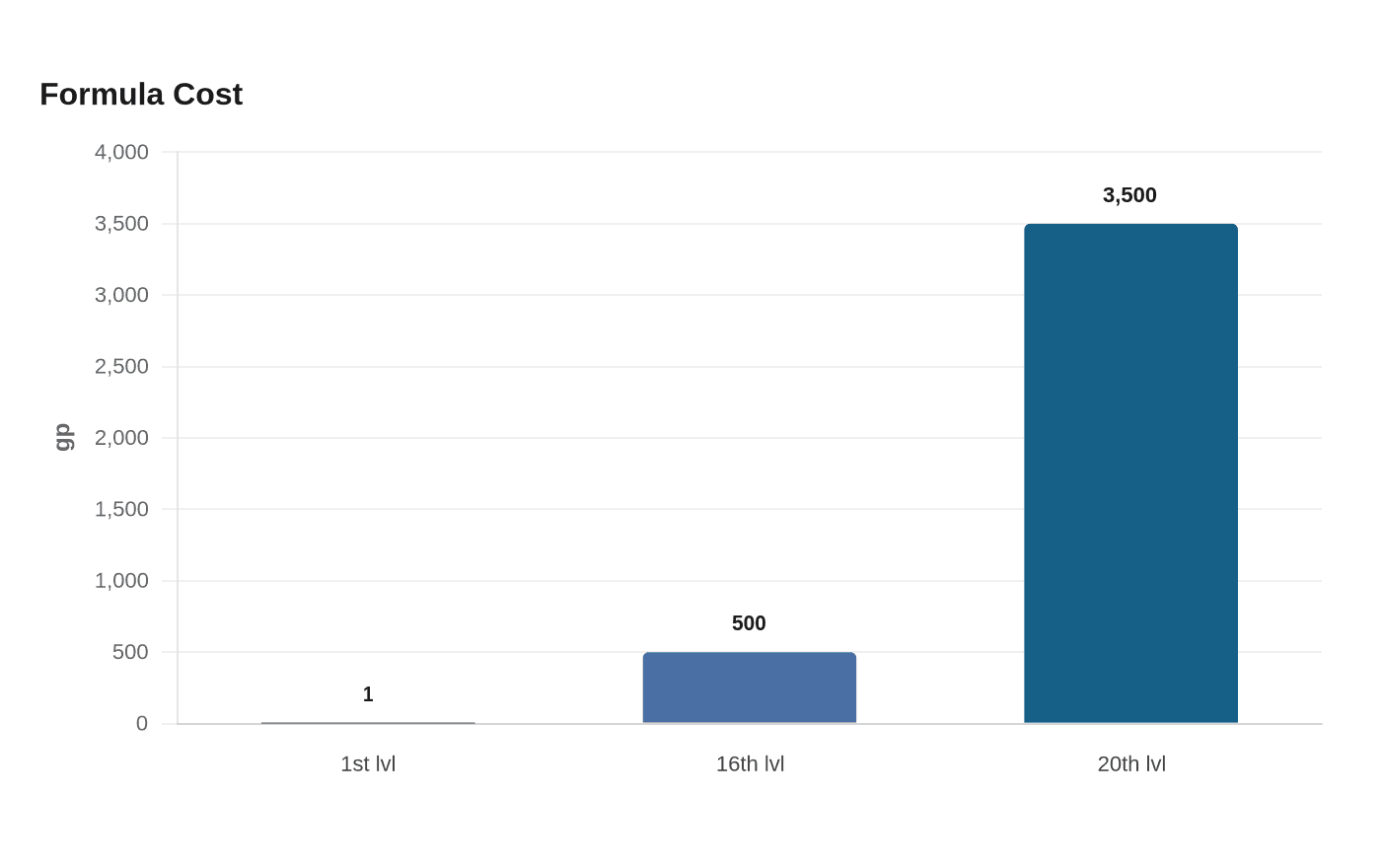
The item economy in PF2e is not simply about having the feat and the gold. You need the formula first, and formulas have their own price ladder: a 0-level common formula costs 5 sp, a 1st-level formula costs 1 gp, a 16th-level formula costs 500 gp, and a 20th-level formula costs 3,500 gp. A basic crafter’s book can bundle formulas for all 0-level common items from the chapter and give a party a cheap launch point.
Formulas are the formal instructions that define what you can reliably produce, and without them Crafting becomes narrow, slow, and dependent on whatever the local market stocks. Common formulas can be purchased, copied, or reverse-engineered, but uncommon and rarer items stay behind a stricter access wall: you need both the formula and access to the item.
When the party can shop freely, buying still wins for convenience. When the campaign closes that door, formulas become strategic assets. If the table expects long stretches away from civilization, the formula library is often more valuable than the next incremental loot upgrade.
Level gates decide who can make the good stuff
PF2e does not let every crafter make everything. To Craft an item, your level must be equal to or higher than the item’s level, and the system adds hard proficiency breaks on top of that. Items of 9th level or higher require master Crafting, while items of 16th level or higher require legendary Crafting.
Specialized item lines also demand their own feats. Alchemical items require Alchemical Crafting, and magic items require Magical Crafting. Snare Crafting exists for its own niche of battlefield control, which is exactly the kind of rule that tells you Crafting is not one skill with one job. It is a cluster of permissions, each tied to a different part of the item economy.
A low-level character with spare downtime can still support the group with consumables and ammo, but the person who expects to forge high-end gear needs to plan around level, proficiency, and feat selection from the start.
Repair is where Crafting saves sessions, not just gold
Repair is the part of Crafting most tables underrate until somebody’s shield, weapon, or specialty tool is hanging by a thread. With a repair kit, you spend 10 minutes and usually use about the same DC as crafting the item. On a success, you restore 5 Hit Points plus 5 per Crafting proficiency rank; on a critical success, you restore 10 Hit Points plus 10 per rank. A critical failure can actually damage the item, so repair is useful, but not free of risk.
You cannot Repair a destroyed item.
Raw materials, workshops, and why buying still often wins
Crafting is never just “spend time, get item.” The crafter must supply raw materials worth at least half of the item’s Price, and many items also expect a workshop. Those costs and setup requirements are what keep Crafting from replacing shops across the board.
For a one-off upgrade in a settled town, buying is usually cleaner. For a party that wants a reliable source of consumables, ammunition, and repair work, Crafting starts to pay for itself quickly.
The Remaster did not make Crafting obsolete
Paizo’s Remaster Project framed the remastered books as a fresh entry point rather than a new edition, and the Remaster FAQ states that the core system design did not fundamentally change. Pathfinder Player Core 2 arrived in July 2024 as part of that line, and the remaster presentation kept expanding the modern rules set rather than replacing it.
The same requirements still govern the choice: formula, feat, proficiency rank, and time.
This article was produced by Prism’s automated news system from verified source data, official records, and press releases, then run through automated quality and moderation checks before publishing. The system is built and supervised by the people who set the standards it runs under. Read our full AI policy.
Did this article answer your question?