BestChoice 2026 Guide Ranks Top STIGA Ping Pong Paddles for Every Player
Most hobby players blame their technique when their STIGA paddle is the real mismatch. Here's how to fix that by problem, not by price.

Somewhere between "this toy paddle from the sports shop" and a fully custom blade with hand-glued Tenergy 05, there's a tier of STIGA premades doing serious work for serious club players. The problem isn't that these paddles are bad. The problem is that most people pick the wrong one, usually because they grabbed the fastest-sounding name on the shelf rather than the one that actually addresses what breaks down in their game.
Three problems kill hobby players more than any other: they can't lift heavy backspin, their blocks go long or into the net under pressure, and their serves generate so little spin that any intermediate opponent just walks through them. Each of those failures maps to a specific class of STIGA premade, and understanding why changes everything about how you shop.
Problem One: You Can't Lift Backspin
The STIGA Pro Carbon has 7 plies, two of which are carbon fiber, giving the blade significantly more rigidity and greater flex response. That increase in rigidity results in greater speed and power. That stiffness is also the catch. When you're trying to brush upward under a heavily chopped return, rigidity works against you. The ball doesn't linger on the rubber long enough for you to redirect it safely over the net. The Pro Carbon's official performance ratings sit at Speed 99, Spin 100, and Control 80. That Control figure is the one to watch here. An 80 in control means the paddle is less forgiving of the gradual, brushing contact that lifting backspin requires.
The STIGA Evolution is the correct tool for this problem. Its precisely crafted lightweight 6-ply blade unites Ayous, Awan, and Kiri woods with a 2mm sponge for a larger sweet spot and cleaner hits. STIGA's Crystal Technology hardens the blade for increased speed, and its WRB Technology increases blade balance, recovery rate, and ball sensitivity. The Evolution's performance ratings are Speed 96, Spin 94, and Control 90. That ten-point Control advantage over the Pro Carbon is exactly where it matters most for a player learning to topspin against backspin. The Evolution's design places greater weight in the head than the handle, which is ideal for players near the table. Its design allows players to use chops to add backspin, and the sponge allows beginners and defensive players to control and respond to slams.
Problem Two: Your Blocks Are Inconsistent
Unreliable blocking is almost always a feedback problem. When a fast ball strikes your paddle and you can't feel where contact happened, you can't make the micro-adjustments that keep returns low and controlled. The Pro Carbon's stiffness, the same property that delivers explosive speed, punishes off-center hits by sending the ball long. The Pro Carbon has extreme speed and good spin, but it requires some skill to get the best out of it. It suits players with an offensive style who find themselves hitting from a longer distance. In other words, it rewards players who already have technique dialed in, not players who are still building it.
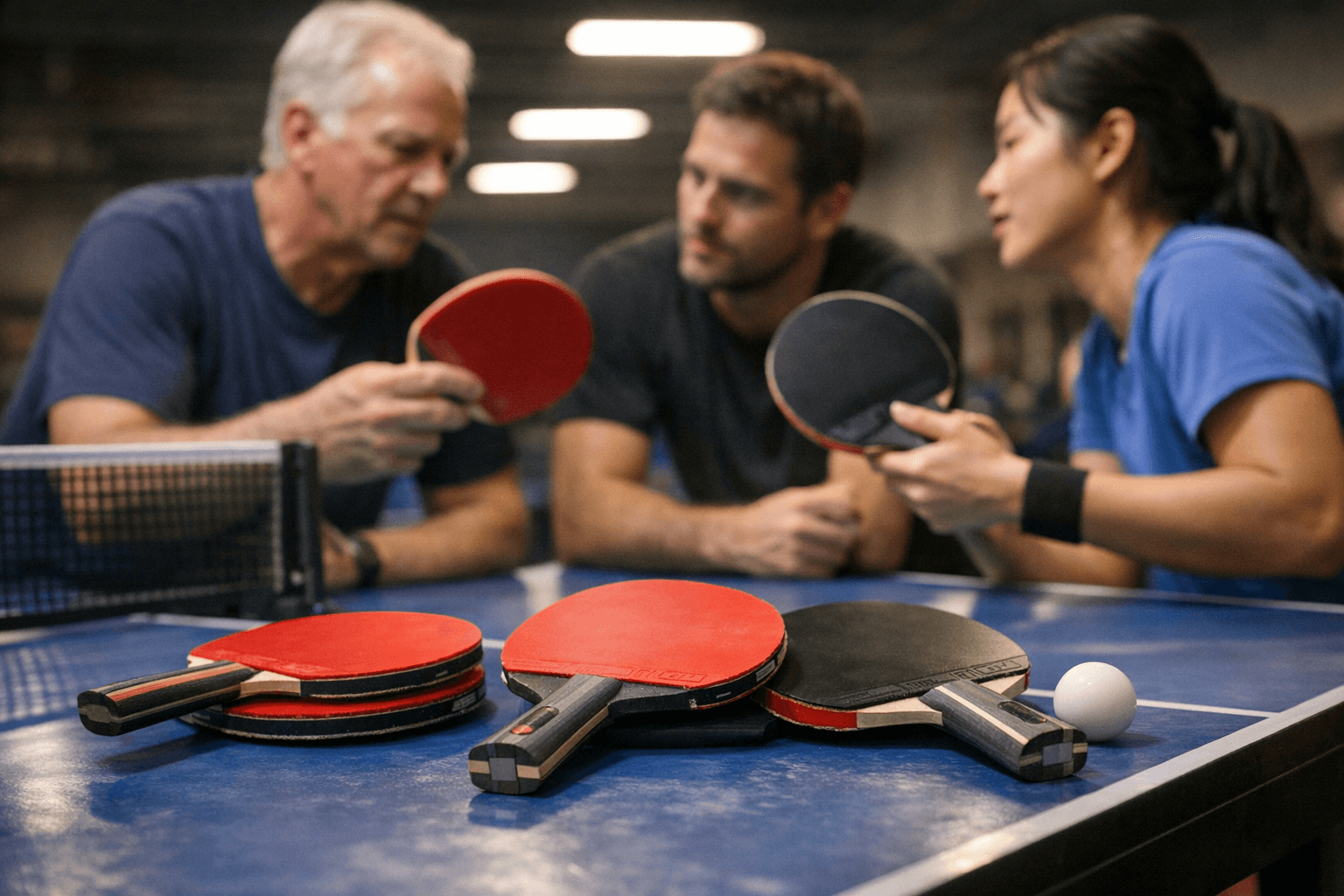
The Evolution addresses this through two technologies working together. The Evolution unites STIGA's Shock Dispersion Tube (SDT) technology with its Crystal and WRB Technologies for a hardened, light blade with faster returns, more power, and extra sensitivity of touch. SDT specifically absorbs vibrations at the handle rather than letting them feedback into your wrist on off-center hits, giving blocks a noticeably cleaner feel in live play. For players earlier in the club journey who are drilling blocks rather than competing with them, STIGA's intermediate rackets are built with extra-light 5-ply blades for precision and 1.5-2mm sponges for balanced control and speed, representing a clear performance upgrade over basic paddles.
Problem Three: Your Serves Generate No Threat
A serve that doesn't worry your opponent is a free third-ball attack for them. Most hobby players with low-spin serves are playing on degraded or low-grip rubber, often a paddle they've been using for a year without realizing how much the rubber has flattened out. Fresh STIGA premade rubbers grip the ball properly, and that alone can transform serve quality overnight.
The Evolution is particularly effective for spin-heavy serving. Because its all-wood construction extends dwell time relative to a stiff carbon blade, you can load more rotational energy into short, deceptive pushes and pendulum serves. One reviewer noted being impressed by the Evolution's serving capability, describing the rubber as grippy and producing strong spin that made the returns difficult for opponents to handle. The lack of speed generation was actually beneficial for serving. That counterintuitive point is worth sitting with: less blade speed means more time on the rubber, which translates directly to more spin.
Players wanting serve options at higher ball velocities, fast, deep serves that exploit reaction time, should look at the Pro Carbon. Its Spin rating of 100 and speed-oriented construction make it easier to deliver fast, spinny serves, but those serves require refined wrist technique and precise contact angles to execute consistently.
The Technologies That Actually Differentiate Models
STIGA's Crystal and WRB technologies appear across nearly the entire lineup, but they aren't filler. The Pro Carbon unites Crystal and WRB Technologies for a hardened, light blade with faster returns, more power, and extra sensitivity of touch. Crystal Technology chemically hardens the blade surface, while WRB shifts balance toward the hitting zone to shorten recovery time between strokes.
What separates models is what sits alongside these technologies. In the Pro Carbon, carbon-fiber plies amplify speed. In the Evolution, the absence of fiber layers lets WRB express itself as control and feel rather than raw pace. Sponge thickness follows the same logic: a 2.0-2.2mm sponge suits players prioritizing spin-oriented topspin play and extended dwell time, while a thinner sponge favors quick short-game exchanges and touch play close to the table.
When to Stop Playing Premade and Go Custom
There is a specific trigger for this, and it isn't hitting a certain rating on a review site. The signal is precision: when you can articulate exactly which aspect of your premade rubber is failing you, not "I need more spin" generically, but "my backhand loop is losing exchanges because my rubber can't grip the ball at speed," you are ready for custom. That specificity means your technique has outgrown the premade's general-purpose rubber, and a targeted sheet of dedicated rubber on one side will register as a real improvement in match play.
The Evolution has been one of the best-selling intermediate paddles for years. At under $40, it delivers the kind of spin and control most players don't experience until they spend three times that amount. The plateau signal is when you're winning consistently at your club, your technique is the ceiling rather than your equipment, and a coach is pointing specifically at your rubber as the limiter. Custom blades and rubbers are precision instruments, not shortcuts. A well-chosen STIGA premade won't hold you back while you're still building the game. The wrong one, however, genuinely will.
Know something we missed? Have a correction or additional information?
Submit a Tip