Liang Geliang Reflects on 55 Years of Ping-Pong Diplomacy's Lasting Impact
Liang Geliang, who won 13 World Championship medals, sits down with CGTN to share first-hand memories of the 1971 bus encounter that thawed Sino-U.S. relations.
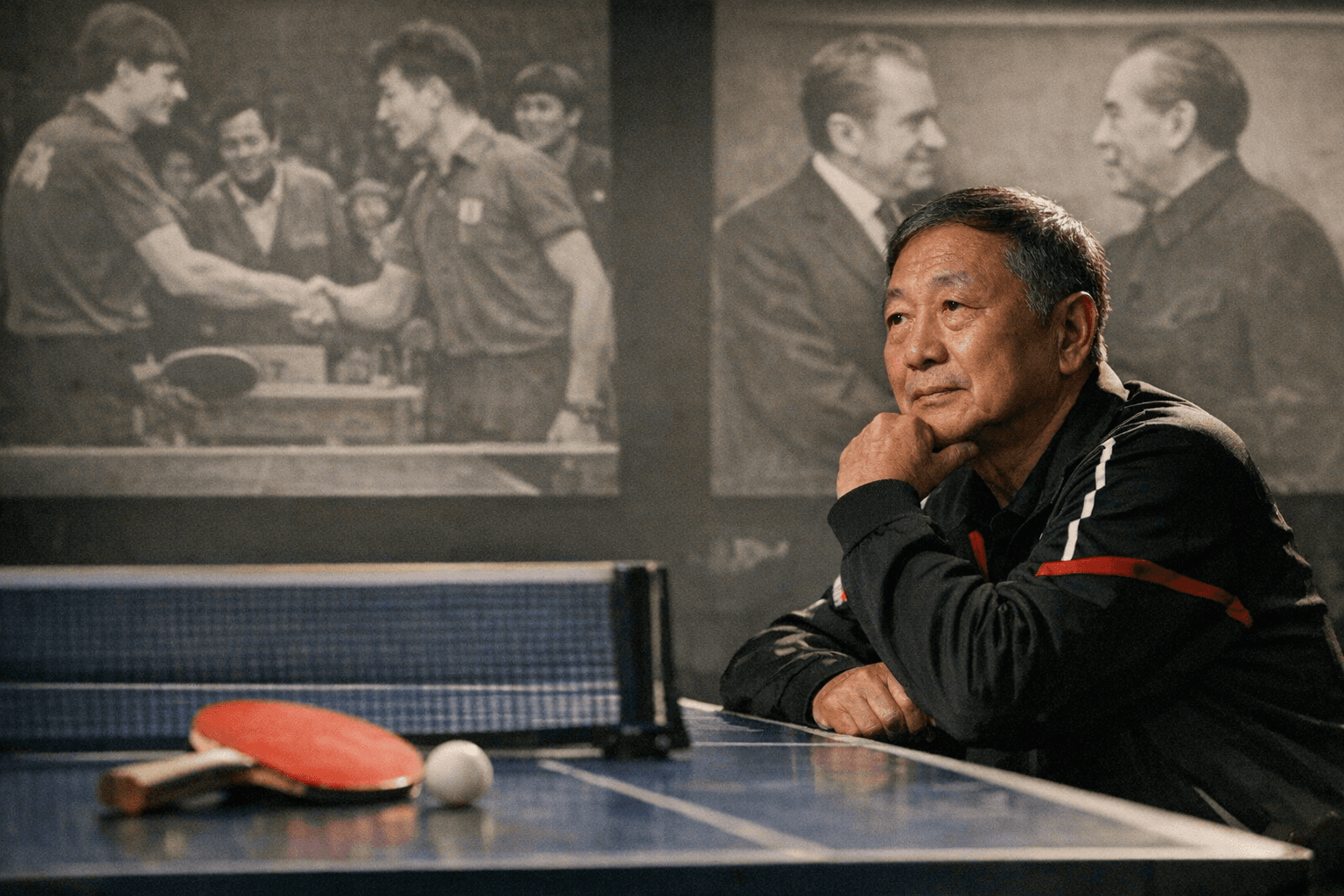
Even in his 70s, Liang Geliang practices ping-pong every day. For a man who earned 13 World Championship medals across singles, doubles, and team events, the paddle never really left his hand. But when CGTN sat down with Liang this week to mark a specific anniversary, the conversation went far beyond technique. Fifty-five years after the chance encounter that quietly rewired the relationship between two superpowers, Liang remains one of the most vivid and credible living links to the moment that gave the world the phrase "Ping-Pong Diplomacy."
The Wrong Bus That Changed History
The U.S. team was at the 1971 World Table Tennis Championship in Nagoya, Japan, when an encounter between Glenn Cowan of the U.S. team and Zhuang Zedong of the Chinese team became an international sensation. Cowan had missed his bus following practice and boarded the Chinese team's bus. What made that moment particularly resonant for Liang is that he had a direct role in setting it in motion: Glenn Cowan, after practising with Liang Geliang prior to the start of the 1971 World Championship, inadvertently boarded the bus carrying the Chinese team.
Zhuang Zedong, three-time world champion, approached the American, shaking his hand and offering him a depiction of the Huangshan Mountains on a piece of silk cloth. When they exited the bus, journalists snapped photos of the two together. Two days later, the U.S. team received an official invitation to travel to China and play exhibition matches against the Chinese team. On April 10, 1971, following the conclusion of the World Championships in Nagoya, the United States team and accompanying journalists arrived in Beijing, the first American delegation to visit the city since 1949.
For Liang, these weren't abstract historical events. They were games and conversations and bus rides that he experienced as a 21-year-old competitor at the peak of his career. The CGTN interview captures him revisiting those memories with a specificity that no archive footage can replace.
A Champion Who Lived the Diplomacy
Liang Geliang won many medals in singles, doubles, and team events in the Asian Table Tennis Championships and in the World Table Tennis Championships from 1971 to 1979. His thirteen World Championship medals included six gold medals: three in the team event, one in the doubles at the 1977 World Table Tennis Championships with Li Zhenshi, and two in the mixed doubles with Li Li and Ge Xin'ai, respectively.
That athletic record gives his reflections a particular weight. He wasn't a peripheral figure watching history from the sidelines; he was the 1971 World Championship winner, competing at the precise moment the diplomatic ice was breaking. President Richard Nixon shook hands with table tennis world champion Liang Geliang in Washington in 1972, an image that neatly illustrates just how personally intertwined his sporting career was with the broader diplomatic thaw.
The CGTN feature makes a point of grounding Liang's story in that dual identity: champion and custodian. The article presents him not just as a former player recounting glory days, but as someone who consciously understands his role as a keeper of the diplomacy legacy.
Technique as a Bridge
One of the more striking elements of the CGTN piece is that it doesn't retreat entirely into nostalgia. The interview includes on-the-table masterclass sequences where Liang demonstrates stroke mechanics and positioning for a new generation of players. It's a deliberate editorial choice that mirrors his own argument: the most durable form of diplomacy is the one you can teach.
Liang frames table tennis as an unusually powerful public diplomacy tool precisely because of its low barrier to entry. The game doesn't require expensive infrastructure, a large team, or a shared language. A table, two paddles, and a ball are enough to create the kind of shared laughter and mutual focus that can, as the 1971 episode showed, shift perceptions between nations. That argument lands differently coming from someone who lived it firsthand in Nagoya.
He also stresses that the legacy of Ping-Pong Diplomacy can't be preserved through commemorations alone. Coaching, youth outreach, and institutional programs are the mechanisms by which symbolic goodwill becomes sustained, people-to-people connection. It's a practical argument, and it reflects how Liang has spent the decades since his competitive career: not just as a historical figure, but as an active coach and mentor still embedded in the sport.
Why 2026 Makes This Story Urgent
The timing of this retrospective isn't accidental. To mark the centenary milestone, the ITTF unveiled a special centenary logo and branding featured throughout 2026, celebrating 100 years of the sport. From its earliest days, table tennis has been a sport that travels easily, welcomes widely, and connects communities, producing moments that reached far beyond the field of play. The ITTF has explicitly named Ping-Pong Diplomacy as one of the defining stories of that 100-year arc.
Against that backdrop, Liang's interview arrives at exactly the right moment. The CGTN feature re-positions the 1971 episode not as a Cold War curiosity but as a usable template: table tennis can function as a form of public diplomacy, a friendly, non-governmental engagement that builds trust and opens lines of communication. That argument has obvious resonance in 2026, when formal diplomatic channels between major powers are under strain in ways that feel uncomfortably familiar.
The Living Link
What separates this CGTN piece from a standard anniversary retrospective is Liang himself. The interview draws a deliberate line between the micro and the macro: between a coaching tip on forehand positioning and the geopolitics of Sino-U.S. relations; between the shared laughter of a practice session with Glenn Cowan on a Japanese bus and the handshake with Nixon in Washington the following year.
Liang's insistence on staying active in the sport, still demonstrating technique in his 70s, still coaching, still talking to cameras about what happened in Nagoya, is itself a form of diplomacy. The game kept its promise to him. Fifty-five years on, he's keeping his promise to the game.
Know something we missed? Have a correction or additional information?
Submit a Tip