kache v0.5.0 focuses on correct Rust build cache keys
kache v0.5.0 is a reminder that Rust build speed is worthless if the cache key lies. The real win is trust: fewer false hits, fewer false misses, and safer CI.
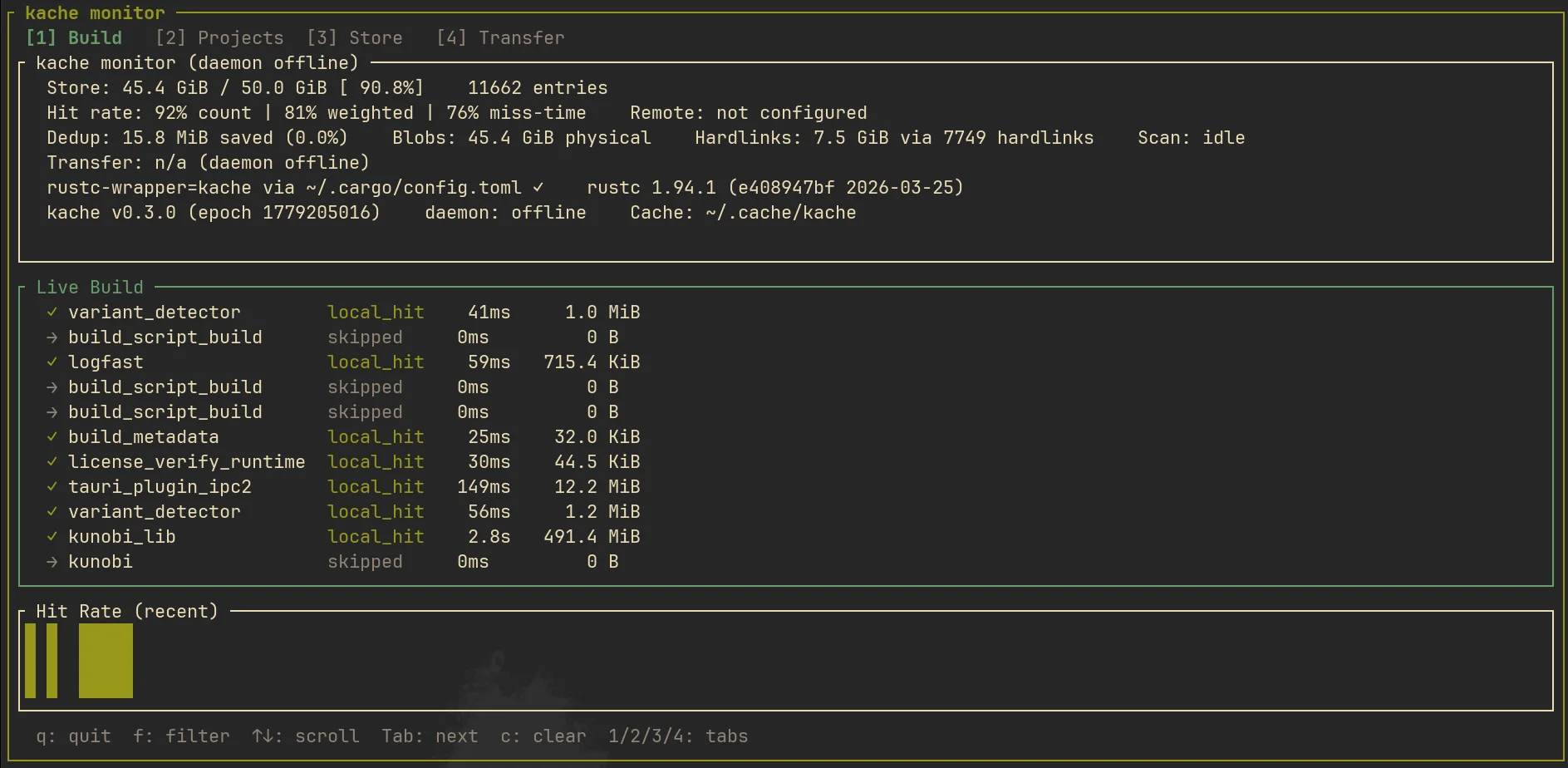
The fastest Rust build cache is the one you can trust. kache v0.5.0 makes that plain by putting cache-key correctness ahead of any flashy speed claim, because the difference between a missed hit and a wrong hit is the difference between extra compile time and a broken artifact.
Why cache-key correctness is the whole game
Every build cache lives or dies on one deceptively hard question: what counts as “the same” build? If the key is too specific, you miss when you should hit, and you pay for unnecessary recompilation. If it is too loose, you get the worse failure mode, a false hit that returns the wrong artifact and silently corrupts the result. In Rust, that tradeoff matters more than in many ecosystems because build speed is valuable, but correctness is non-negotiable.
That is the useful lens for kache v0.5.0. The release is not just about shaving cycles off rustc runs. It is about treating cache identity as a first-class part of the compiler workflow, especially when the inputs that shape output are already visible in the compiler invocation. That makes them capturable, and once they are capturable, they can be used to build a cache key that reflects what rustc actually did rather than what a wrapper thinks it probably did.
The practical takeaway is simple: a compile cache only earns its keep if it preserves the exact artifact the compiler would have produced. Anything less is just a risk multiplier with better marketing.
What kache is optimizing for
kache v0.5.0 is framed around reducing both false misses and false hits, and that distinction matters. False misses waste time because you rebuild code that should have been reused. False hits are worse because they can hide the fact that the cached output does not match the current compiler inputs, which is how a tool quietly turns into a source of build contamination.
The release focuses on the technical work behind the key, not just the resulting hit rate. That means paying attention to the inputs that matter to rustc command lines, build settings, and environment details, then deciding which of those belong in cache identity. In practice, this is the sort of work that only looks boring until you have to debug a flaky CI pipeline or a mysteriously stale local build.
For Rust teams, this is where caching stops being a generic optimization and becomes an engineering discipline. A good cache key is not “everything” and it is not “whatever seems useful.” It is the minimum precise description of the build state that keeps the artifact honest.
What the release says about larger Rust workflows
The broader point of kache v0.5.0 is that build acceleration is only useful when it scales cleanly across real workloads. That is why the release’s relevance shows up most clearly in large repositories and CI systems, where repeated builds are expensive and bad cache behavior multiplies fast. In those environments, a cache that sometimes misses too often is annoying; a cache that sometimes lies is a liability.
The release also includes broader work beyond cache-key logic, including Windows support and a reworked release pipeline. Those are not the headline lesson, but they do matter because they show the project maturing around the same core idea: if you want a tool to fit into serious Rust infrastructure, it has to work reliably across platforms and through the release process as well as through the compiler hot path.
That combination points to a larger shift in Rust tooling. The frontier is no longer just “make it faster.” It is “make it fast without weakening trust.” That is the same kind of pressure you see in other big tooling transitions, where the winning project is the one that makes developers confident enough to change habits, not just impressed enough to run a benchmark once.
How to think about cache inputs in your own Rust builds
If you are trying to reason about build cache quality, kache’s framing gives you a clean checklist for thinking about inputs. The exact rustc invocation matters. So do environment details and build settings, but only insofar as they affect compiler output.
A useful mental model is to separate inputs into three buckets:
- Inputs visible in the compiler command line, which are usually the easiest to capture automatically.
- Environment and configuration details that can change the resulting artifact even when the source tree stays put.
- Build settings that look incidental but can still alter output enough to make a cached artifact unsafe to reuse.
The trap is assuming that anything which seems “close enough” belongs in the same key. Rust builds are unforgiving that way. A key that misses a relevant input creates extra work. A key that ignores a meaningful one can hand you a build that looks successful and is still wrong.
That is why the best cache story in Rust is not about squeezing every last millisecond from incremental iteration, although that is part of it. It is about making repeated builds feel predictable. When the cache is honest, local iteration gets faster, CI wastes fewer cycles, and teams can scale Rust usage without wondering whether yesterday’s shortcut is today’s silent bug.
kache v0.5.0 lands on the right side of that line. It treats caching as a correctness problem first and a performance feature second, which is exactly how serious Rust tooling has to think if it wants to go beyond yet another speedup claim.
This article was produced by Prism’s automated news system from verified source data, official records, and press releases, then run through automated quality and moderation checks before publishing. The system is built and supervised by the people who set the standards it runs under. Read our full AI policy.
Know something we missed? Have a correction or additional information?
Submit a Tip