Rust hits highest-ever TIOBE rank as popularity keeps rising
Rust just reached No. 12 in TIOBE, its best showing ever, but the index measures search buzz more than everyday developer reality. The harder test is whether the momentum sticks.
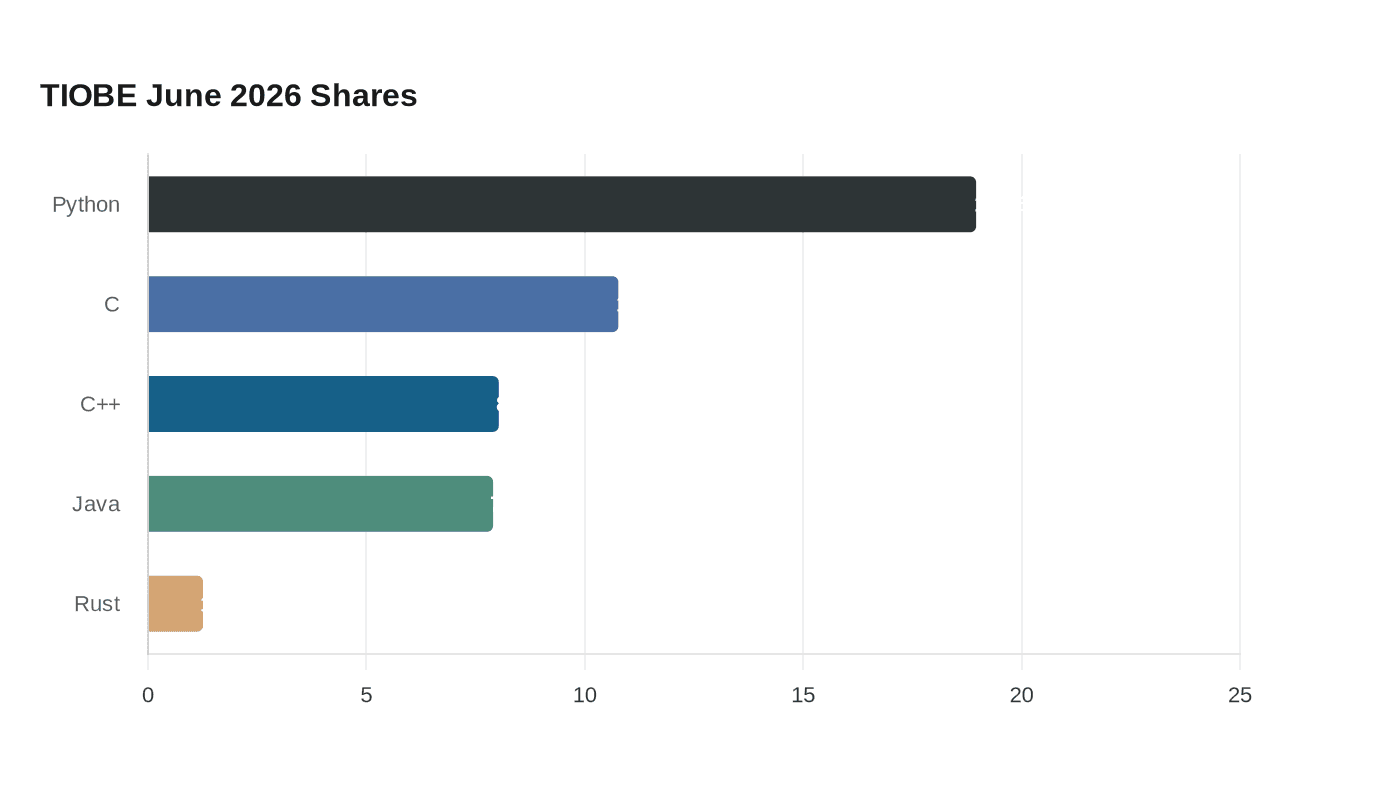
Rust has climbed to 12th place in the June 2026 TIOBE Index, its highest ranking ever in that chart, after a full year without gaining ground. That makes the move more than a vanity milestone: it is a sign that Rust is showing up in more mainstream conversations again, even if the language is still far from the top tier occupied by Python, C, C++ and Java.
TIOBE is not a Rust fan poll. The index is updated monthly and is based on search activity, the number of skilled engineers worldwide, courses, and third-party vendors, with signals pulled from sites such as Google, Amazon, Wikipedia and Bing. That is why the ranking should be read as a popularity gauge, not a verdict on language quality. Still, when Rust pushes to 1.26 percent in the index, it tells you the language is no longer confined to the usual systems-programming crowd.

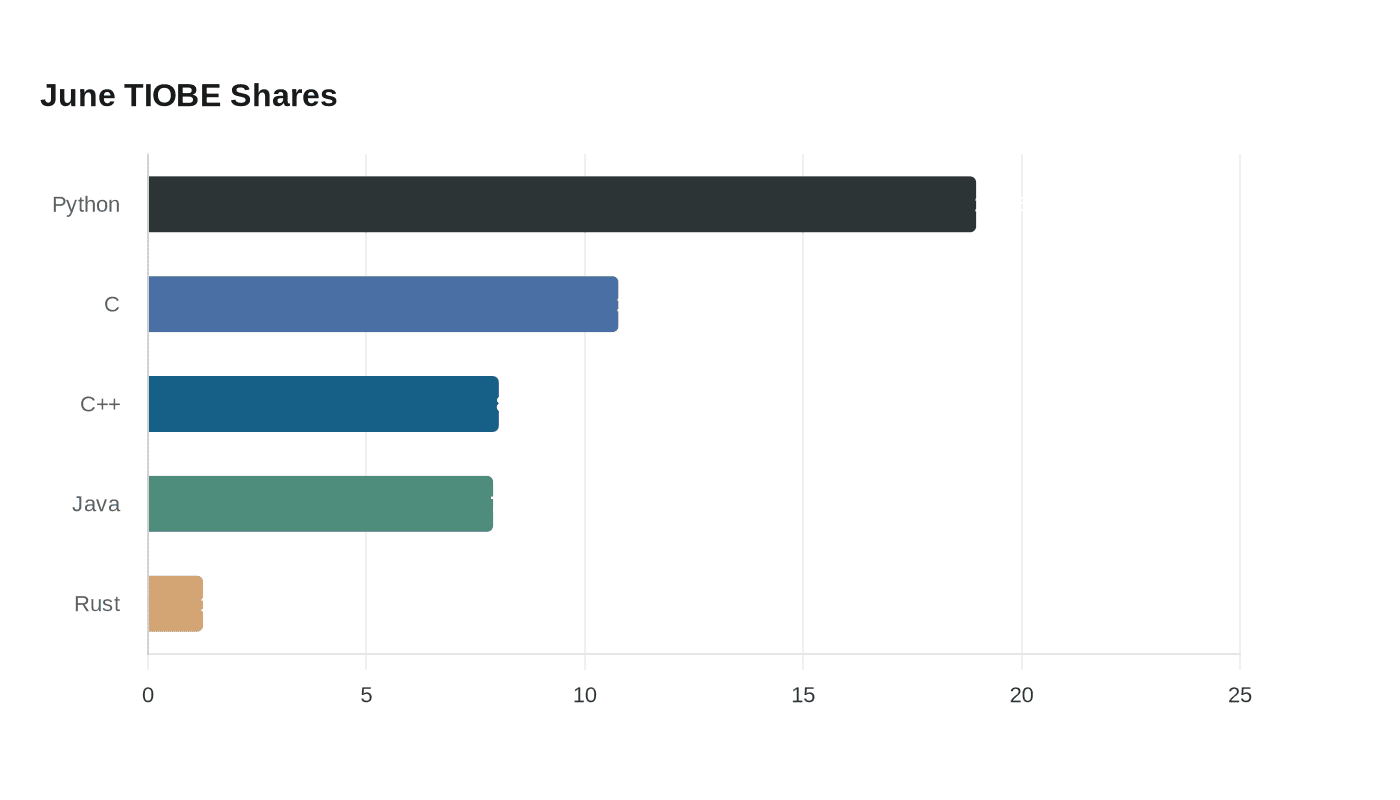
Paul Jansen, TIOBE’s president, had said just two months earlier that Rust looked as if it had plateaued. He has since revised that view, and the new high gives him reason to do it. In the same June snapshot, Python slipped to 18.96 percent from 19.98 percent in May, C held second at 10.77 percent, C++ moved back ahead of Java at 8.03 percent versus 7.90 percent, and the lower end of the top 10 kept shifting around. Rust’s rise does not knock over the giants, but it does keep it in the same conversation.
That is the important reality check for Rust users. The language’s appeal still rests on the same hard case it has been making for years: memory safety, strong performance, and modern abstractions. TIOBE says those strengths make Rust a serious competitor to C and C++, while also warning that Rust’s concepts demand relatively high programming expertise. In other words, the language can rise in visibility without suddenly becoming easy.
The sturdier signal is the ecosystem behind it. Rust first reached stable 1.0 on May 15, 2015, and the Rust project still ships a new stable language release every six weeks. The Rust Foundation, an independent nonprofit focused on infrastructure, tooling, administration and community investment, said its 2025 annual report covered its first long-term strategy period from 2022 to 2025, and it published a 2026 to 2028 strategy in January. That kind of institutional backing matters more than a single index line.
So the new TIOBE high is real, but it is not a finish line. It is a visibility bump, and the day-to-day Rust experience will still be shaped by the same two things that have always mattered most: how much the ecosystem keeps maturing, and how willing teams are to pay the learning curve.
This article was produced by Prism’s automated news system from verified source data, official records, and press releases, then run through automated quality and moderation checks before publishing. The system is built and supervised by the people who set the standards it runs under. Read our full AI policy.
Know something we missed? Have a correction or additional information?
Submit a Tip