Automating a compass light with diodes on a Bristol 35.5
A pair of cheap diodes made Nurdle’s compass lamp follow either running-light circuit, saving a breaker and keeping the helm readable at night.
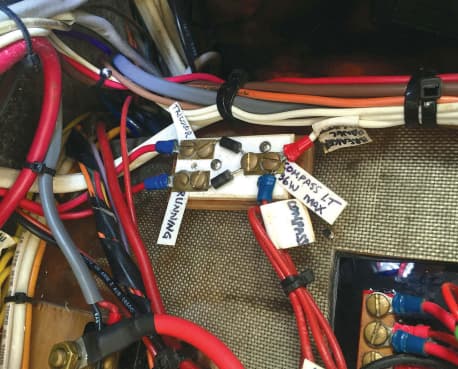
A tiny fix that solves a real cruising-boat problem
A compass light looks trivial until you need it at 2 a.m. and the helm is blacked out. On John Churchill’s Nurdle, a 1979 Bristol 35.5, the answer was not another expensive panel upgrade or a messy rewire, but a pair of diodes that let one little lamp wake up from either of two existing light circuits.
That is the kind of small electrical mod that pays back every night. It keeps the compass readable, avoids wasting a breaker on a tiny load, and makes an older boat easier to live with without pretending it needs a full modern refit.
Why this Bristol needed a smarter answer
Churchill’s boat is exactly the sort of platform where these decisions matter. The Bristol 35.5 was designed by Ted Hood and built by Bristol Yachts from 1978 to 1996, with Sailboatdata listing 183 boats built. It is a 35.50-foot masthead sloop with a 10.83-foot beam, 15,000 pounds of displacement, and 6,500 pounds of ballast. Bristol also offered a centerboard version, the Bristol 35.5C, which tells you the design lived squarely in the serious cruising world.
On a boat like that, breaker-panel space is not infinite, especially after you replace the original fragile plastic circuit breaker panel. Churchill had already done that on Nurdle, and the redesign forced him to decide which circuits deserved their own breaker. The compass light was one of the old loads staring back at him, and it was too small to justify spending precious panel real estate on a dedicated switch just for itself.
The rest of the electrical picture made the problem more interesting. Churchill had added a masthead tricolor running light, but he still had the older deck-level running lights in service. He wanted the compass light to come on whether he was sailing under the tricolor or motoring with the deck lights. In other words, he wanted one lamp to follow two different lighting setups without creating a tangle of extra switches.
How the diode trick works
The solution was simple and elegant: use diodes so current can flow to the compass light from either circuit, but cannot flow backward into the other circuit. That is the whole trick. A diode behaves like a one-way valve for electricity, so it lets the tricolor circuit or the deck-light circuit power the compass lamp without backfeeding the other line.
That matters because backfeeding is what turns a neat little workaround into a troubleshooting headache. Without the diodes, the two lighting circuits could interfere with each other, and one set of running lights might partially energize the other. With the diodes in place, each source stays isolated while still doing the only job that matters here: feeding the compass bulb when either set of running lights is on.
Churchill notes a voltage drop of about 0.6 volts across the diode, which is normal for a silicon diode and usually not a big deal for a small incandescent bulb. That kind of loss is the sort of thing you would think harder about in a charging or voltage-sensitive circuit, but for a compass lamp it is a fair trade. The light still works, the panel stays cleaner, and the boat gains a little intelligence without adding complexity.
What he built, and why the parts choice makes sense
This was not a polished factory-style module. Churchill built the mounting board from 1/4-inch scrap acrylic, which is exactly the sort of practical reuse that makes sense on a boat. He drilled and tapped brass machine-screw terminals into it, then used 3-amp barrel diodes sourced cheaply from Radio Shack, part number 276-1141. The price was $1.99 for two, which is hard to beat for a fix that can save a breaker and simplify a circuit.
The diodes were rated for about 35 watts at nominal 12 volts and up to 50 volts, which is more than enough capacity for a compass lamp. Their stiff leads also made them easier to route without soldering, and that detail matters because heat from soldering can damage diodes. In other words, the parts were chosen for the way boat wiring actually gets done in a cramped space, not for a bench-top lab.
That is why this feels like such solid marine DIY. It is not flashy, and it does not try to make the boat smarter than it needs to be. It solves one problem cleanly, with parts you can understand at a glance and a failure mode that is easy to reason through.
Why this beats a bigger electronics upgrade on many older boats
Older cruising boats often need more rational wiring, not more electronics. Once you start updating aging systems, you quickly find that the old panel architecture was never designed for the way you use the boat now. A simple diode-OR circuit like this lets one load follow two operating modes without claiming a dedicated breaker slot, which is exactly the kind of compromise that keeps a refit sane.
That matters in daily use. A reliable compass light improves visibility, watchkeeping, and night navigation, especially when the boat changes from sail to power after sunset. Instead of remembering to turn on a separate lamp, you get the light whenever the boat is already in a lighting mode where you need it.
It also keeps the cockpit and panel cleaner. Fewer dedicated switches mean fewer failure points, fewer labels to decipher, and less temptation to keep adding one more little circuit every time a new convenience comes along. On a boat like Nurdle, that is not a minor aesthetic win. It is a maintenance win.
The standards backdrop
The broader rules matter here even though the compass lamp itself is not the thing the Coast Guard is regulating. U.S. Coast Guard navigation-light rules define navigation lights as those prescribed by COLREGS and related rules to show a vessel’s presence, type, operation, and relative heading. For new recreational vessels, 33 CFR 183.810 requires navigation lights to meet technical standards, be certified by a Coast Guard-listed lab, and carry the required labeling.
ABYC E-11 sits in the background of all this as the marine electrical consensus standard for AC and DC systems on boats. It is reviewed at least every five years, which is a good reminder that marine wiring is not a place for improvisation without a reason. Churchill’s diode setup is the right kind of improvisation: narrow, tidy, and easy to defend.
In the end, this is what smart old-boat electrical work looks like. You do not always need a bigger panel or a fancier control head. Sometimes the best fix is a pair of diodes, a scrap acrylic board, and a clear idea of when one light should follow two different circuits.
This article was produced by Prism’s automated news system from verified source data, official records, and press releases, then run through automated quality and moderation checks before publishing. The system is built and supervised by the people who set the standards it runs under. Read our full AI policy.
Did this article answer your question?