Chesapeake Bay Maritime Museum Offers Hands-On Shipyard Access All Summer
CBMM's working shipyard is open all summer through its Chesapeake Celebrations series; four dates give you rare access to live restoration work on the Winnie Estelle.
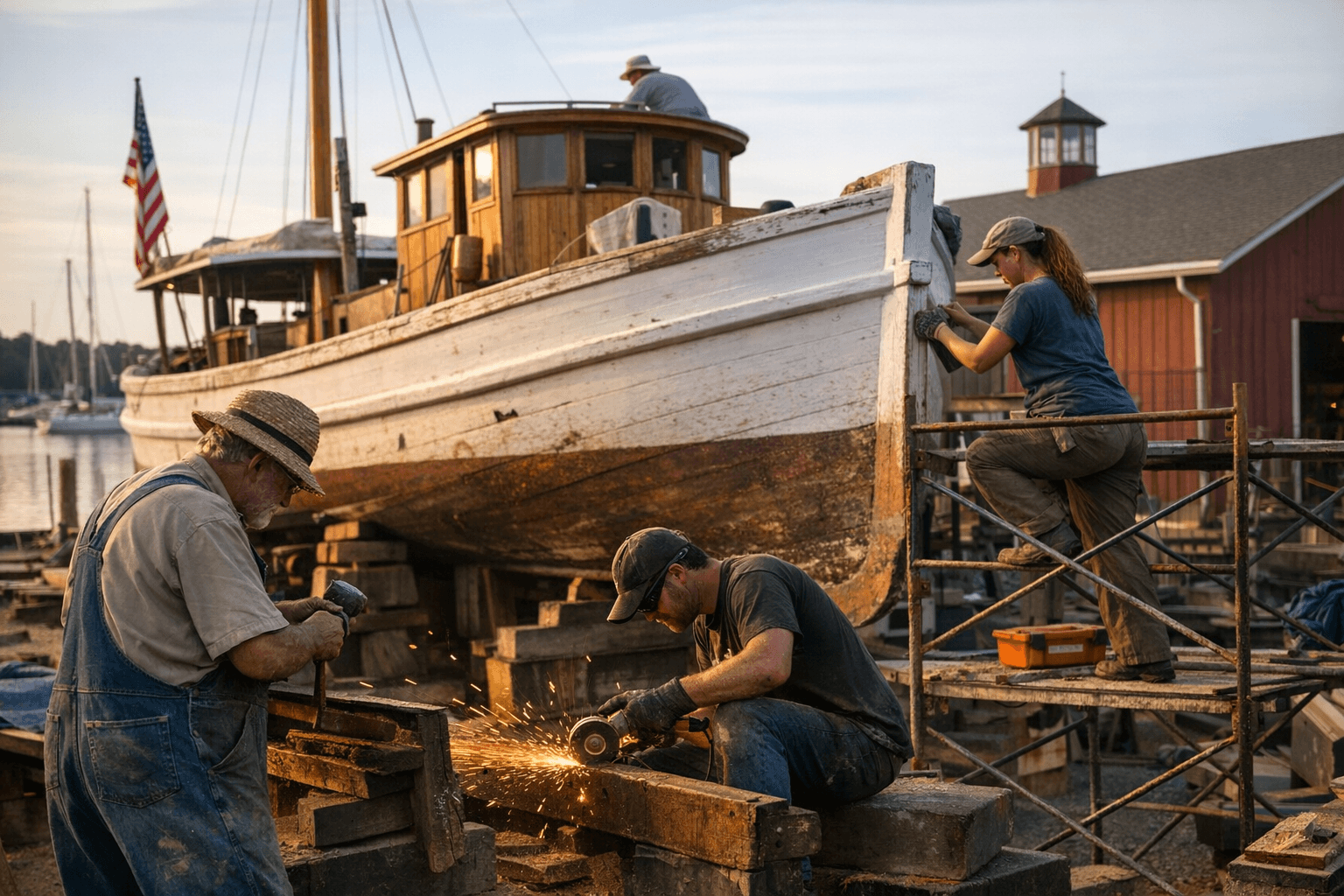
Most sailors treat a museum visit like a Sunday drive: pleasant, low-stakes, forgettable by Tuesday. That's the wrong frame for CBMM. The Chesapeake Bay Maritime Museum in St. Michaels, Maryland runs a live, working shipyard where restoration crews are actively pulling planks, reseating fasteners, and applying preservation systems to historic Chesapeake vessels. Starting May 16 and running through August 15, the museum's new Chesapeake Celebrations series opens that shipyard to the public four times this summer, bundled with general admission. Show up with the right questions and a notebook, and you can walk away with a skill-up that no YouTube tutorial delivers.
The four event dates are Savor the Shore on May 16, Play on the Bay on June 27, Stories from the Shoreline on July 18, and Love the Bay on August 15. All four take place on CBMM's 18-acre waterfront campus on the Miles River. Play on the Bay leans hardest into the boating side, with dockside programs and small craft rides alongside the shipyard access. All four days are included with general admission, free for CBMM members, and supported by the Maryland Traditions program.
The anchor project in the shipyard is the ongoing Winnie Estelle refit, a historic buyboat that has been generating real-world answers to the exact decisions that vex any DIY restorer: joinery tolerances, fastener selection, and how to reconcile traditional construction with modern adhesives. Watching the crew work on Winnie Estelle is worth the drive alone. Pay specific attention to how seams are caulked before and after planking repairs. The technique has no direct analog in fiberglass work, but understanding how caulking cotton compresses and the sequence of bedding compound application gives you a precise reference point for bedding any penetration on a wet hull.
While you're there, look for scarf joints in any plank runs being replaced. A well-cut scarf in marine lumber runs an 8:1 ratio, and seeing one in context with actual wood thickness and grain orientation in front of you is more instructive than any drawing in a boatbuilding manual. Ask the shipwright on deck what fastener spec they're running and why. At CBMM, the answer will almost always involve bronze, and the reasoning will touch on galvanic compatibility, wood species, and expected service life in brackish water: exactly the calculation you need to make when rebedding deck hardware on an aging fiberglass boat with backing plates.
The paint systems on a working wooden vessel restoration are a further resource. Ask what primer and topcoat sequence is in use, whether any epoxy barrier coat is in the stack, and how the crew handles the transition between a historic finish and a modern two-part system. The answer mirrors the decisions you face on any old hull where you're stabilizing osmotic blistering without stripping 30 years of antifouling.
CBMM's celebration days are designed as family events with local storytellers and cultural programming through the Maryland Traditions partnership, which means the shipyard access comes without the pressure of a formal workshop. That informal structure is an advantage. Volunteer shipwrights and museum conservators are generally far more willing to answer specific questions, share sourcing leads for marine-grade fasteners, or walk through an epoxy schedule on a casual event day than they would be in a paid class setting.
The next date is May 16. If your boatyard list includes anything involving wood, fasteners, bedding compound, or a paint system you're not confident about, St. Michaels is worth blocking out for a day.
This article was produced by Prism’s automated news system from verified source data, official records, and press releases, then run through automated quality and moderation checks before publishing. The system is built and supervised by the people who set the standards it runs under. Read our full AI policy.
Did this article answer your question?