Diesel Exhaust Leak Traced to Cracked Boat Manifold Port
High bilge water, water in the oil, and a cracked manifold port are not separate problems. They are one failure chain, and the engine needs a hard stop before the leak becomes a safety hazard.
What the symptom chain is really saying
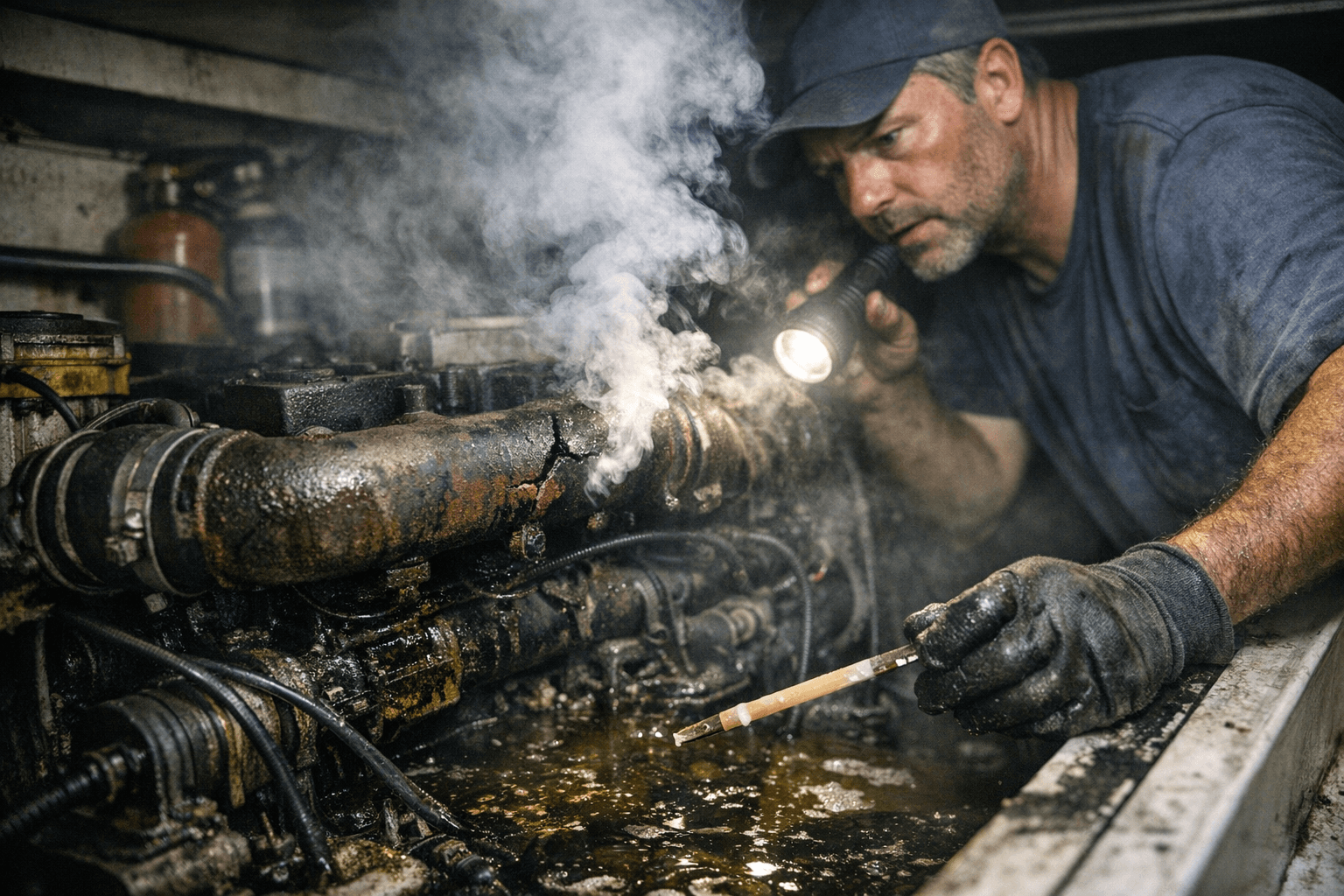
High bilge water is usually the first clue that something upstream is leaking, and in this case the trail kept going until the oil showed contamination and the crack turned up at the port side exhaust manifold. That order matters. Once you find water mixed with oil, you are no longer chasing a nuisance leak, you are dealing with a breach that can damage bearings, foul lubrication, and point straight at a failed exhaust component.
On a sailboat, this kind of problem is easy to misread because the symptom shows up in one place and the damage sits in another. A cracked manifold port, a damaged bung hole, or a failed gasket can dump cooling water into the wrong passage, then the evidence surfaces later in the bilge or in the crankcase. That is why the smartest first move is not to keep running the engine and “see what happens.” It is to stop, inspect, and trace the leak before the next hour of operation turns a repair into an engine rebuild.
Why this is not just a maintenance issue
A leaking exhaust system is a safety problem before it is a mechanical one. Exhaust gases inside the boat are dangerous, and a small leak should never be treated like cosmetic damage or a drip you can live with until haul-out. Once exhaust can escape where it should not, you are depending on luck, ventilation, and boat layout to keep the crew safe.
That is especially true on older boats and in enclosed spaces. The National Association of State Boating Law Administrators says most carbon-monoxide incidents happen on older boats and within cabins or other enclosed areas, and it calls exhaust leaks a leading cause because carbon monoxide can migrate through the vessel. The Centers for Disease Control and Prevention says gasoline-powered engines and onboard generators produce carbon monoxide and recommends a working marine-rated detector. Even though the leak here is in a diesel exhaust path, the lesson is the same: any compromised exhaust system belongs on the short list of serious hazards.
The scale of the problem is not theoretical either. CDC and NIOSH have cited about 540 carbon-monoxide poisonings tied to exhaust from gasoline-powered marine engines on recreational boats from 1990 to 2004. That number is a sharp reminder that exhaust failures can go from technical to medical fast, especially when the boat’s layout helps trap fumes.
Where to look first on the manifold side
The right repair starts with a careful inspection of the entire exhaust chain, not just the crack you can already see. The U.S. Coast Guard advises checking all metallic exhaust components for cracking, rusting, leaking, or loosening, including the cylinder head gasket, exhaust manifold, water injection elbow, and the threaded adapter nipple between the manifold and elbow. It also says to confirm proper operation of the generator cooling-water anti-siphon valve if the boat has one.
That is the checklist that keeps a small leak from hiding in plain sight. Look hard at the mating surfaces where the manifold meets the elbow, because overheating can warp those faces and make a gasket fail even after a fresh re-torque. Check the bolt torque before you assume the casting is dead. Inspect the gasket condition for crushing, burn-through, or saltwater staining. If the problem is around a welded bung hole, look for hairline cracks radiating from the weld, not just the obvious split.
If you smell exhaust in the cabin, see soot around the flange, or find water where it does not belong, do not assume you have one isolated bad part. Exhaust leaks often travel in pairs, with one weak point exposing another.
When a DIY repair makes sense, and when it does not
This is where a lot of owners get it wrong. They assume every exhaust leak ends with a parts order and a wrench. Sometimes it does. Sometimes the best repair is to remove the manifold, clean it, inspect it on the bench, and decide whether the part can be saved by a welding shop or whether it has reached the end of the road.
A DIY repair is realistic when the damage is limited and the rest of the system checks out. If the bolts simply need proper re-torque, the gasket is intact, and the mating surfaces are flat, you may be looking at a straightforward reassembly. If the crack is localized and the casting is otherwise sound, a competent welding shop may be able to repair it cleanly. That is often the smarter move than bolting a tired part back on and hoping the leak stays gone.
Replacement becomes the safer call when the manifold shows broader corrosion, repeated leaks, warped surfaces from overheating, or evidence that water has already made its way into the oil. A cracked port plus contaminated oil is a strong sign that the failure has moved beyond a simple external leak. At that point, paying for a known-good replacement is often cheaper than gambling on an old manifold that is already telling you it is tired.
The age factor nobody likes to hear
Marine exhaust manifolds, especially in saltwater service, are often talked about in the 3-to-7-year range depending on conditions. That does not mean every manifold dies on a schedule, but it does mean age and environment matter. Corrosion can weaken the casting from the inside, and a port that finally cracks may be the last visible sign of a long decline.
That is why older sailboats need a more skeptical eye. If your manifold is near the back end of that range, a crack is less of a surprise and more of a warning that the rest of the exhaust system may be living on borrowed time. In that situation, a single repair should trigger a full look at the elbow, adapters, hoses, fasteners, and any anti-siphon hardware tied into the cooling-water path.
The boat layout can make a bad situation worse
ABYC’s carbon-monoxide guidance makes the risk even clearer: accumulation depends on boat geometry, ventilation openings, swim platforms, canvas enclosures, exhaust-outlet location, vessel attitude, wind direction, boat speed, and overall maintenance. In other words, the same leak can be marginal on one boat and dangerous on another because the boat itself changes the airflow and the way exhaust moves.
That is why a cracked manifold port on a sailboat is never just an engine-room story. A hull shape that traps air, a closed cabin, a lowered companionway, or a canvas enclosure can all help exhaust linger. ABYC first published its carbon-monoxide report in 1992 and later redesignated it TH-22 in 2017, which tells you this is not a new concern, just one that keeps showing up in different forms.
The practical takeaway
If you see high bilge water, then water in the oil, then a crack at the exhaust manifold port, you already have your diagnosis chain. Stop the engine, inspect the full exhaust path, and decide whether the part can be safely reworked or whether replacement is the better bet. A cracked manifold is not a cosmetic issue, and a leaking exhaust is not something to nurse along for one more trip.
The right response is methodical: check the manifold, the gasket, the bolt torque, the mating surfaces, the elbow, the threaded adapter nipple, and any anti-siphon valve in the cooling-water system. If the part is structurally done, do not talk yourself into one more season. On a boat, exhaust leaks have a way of punishing optimism.
This article was produced by Prism’s automated news system from verified source data, official records, and press releases, then run through automated quality and moderation checks before publishing. The system is built and supervised by the people who set the standards it runs under. Read our full AI policy.
Did this article answer your question?


