How to Make a Reliable Compression Joint for Boat Fuel Systems
One extra turn can distort a fuel compression joint, invite air into the line, and leave you with hard starts, diesel smells, or a fire risk.
The mistake that turns a small fuel repair into a big problem
A compression joint on a boat fuel line looks simple until you get greedy with the wrench. Tony Davies’ advice gets right to the point: these joints are widely used on fuel-system pipework and are extremely reliable when they are assembled correctly, but over-tightening is the failure mode that bites DIY boat owners most often. Push the fitting too far and you can distort the joint instead of sealing it, which is how a tidy repair turns into a leak, a diesel smell, or a line that draws air and leaves the engine hard to start.
That is why fuel work deserves more respect than ordinary plumbing. Boat fires and explosions still injure hundreds of people and cause millions of dollars in damage each year, and the National Transportation Safety Board has documented how a small fitting mistake can become an engine-room fire. In one case aboard the containership President Eisenhower, insufficient swaging of a compression fitting ferrule allowed tubing to disconnect and spray fuel oil onto a hot component.
When a compression joint makes sense onboard
Use a compression joint where you need a reliable, serviceable connection in fixed fuel-system pipework, especially on permanently installed diesel systems. The Boat Safety Scheme is clear that any connection permanently carrying fuel should be made with efficient screwed, compression, cone-brazed or flanged joints. That is the right mindset for a boat: choose a joint that is meant to stay put, resist vibration, and be inspected later without guesswork.
It is also a reminder that not every fitting belongs in a fuel run. The same guidance warns that soft-soldered and push-on joints can fail if exposed to excess heat, which is exactly the kind of condition that matters in a machinery space. Under U.S. rules, the fuel system is defined broadly, from the fill and vent to the tank, pumps, valves, strainers, carburetors, and filters, and the standards for those components are written around leakage prevention, not convenience. Even a fuel filter or strainer installed in the system must not leak more than five ounces of fuel in 2 1/2 minutes when tested as installed.
The parts have to match, not just fit
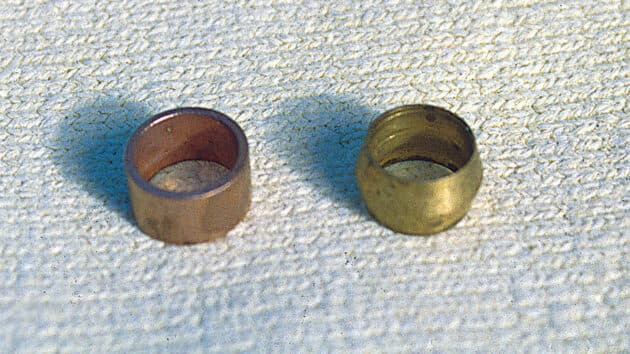
This is the bit many DIY repairs get wrong. Davies notes that copper olives adapt more easily to tightening pressure than brass olives, so the sealing ring material matters, and you should check what a particular fitting actually requires before you start. The wrong olive can seem fine on the bench and still leave you chasing a damp fitting or an air leak later.
That choice matters because fuel plumbing does not forgive assumptions. A compression joint is not a place to improvise with whatever ring is in the spares box, and it is not a place to hide a bad alignment by tightening harder. If the olive, nut, and body are not the correct match for the fitting, the joint may seal for a while and still fail under vibration, temperature change, or repeated engine use.
Build the joint like vibration is going to test it
The joint itself is only part of the repair. Davies specifically points out that saddle clips should be fitted close to the joint so the pipe is supported against movement and vibration. That is a detail with real consequences, because a fuel line that is allowed to flex at the fitting will work the joint loose over time and shorten its life.
The practical sequence is straightforward: 1. Make sure the fitting, olive, and pipe are the correct match before assembly. 2. Align the pipe so the joint is not forced into position by the nut. 3. Tighten carefully, stopping as soon as the olive seats and grips properly. 4. Support the pipe with saddle clips close to the joint so vibration does not load the fitting. 5. Inspect the finished joint again after running the engine and after the boat has had time to shake, heat, and cool.

That last part is important. A fuel joint that looks dry in the berth can still reveal a problem once the engine room gets warm and the boat starts moving.
Why suction-side leaks are worse than they look
A pressure-side leak is the obvious one: you see fuel around the fitting and know something is wrong. A suction-side leak is sneakier, because air can be drawn into the line without obvious fuel seepage. That is the kind of fault that creates mysterious hard starting, hesitation, or fuel starvation and sends you looking in the wrong place.
For diesel boat owners, that distinction is gold. If the engine cranks longer than usual, stumbles after sitting, or behaves like it is running out of fuel when the tank is still not empty, a bad compression joint on the suction side should be high on the suspect list. You may not see a drip on the outside, but that does not mean the fitting is healthy.
What the standards and incident reports are really telling you
ABYC H-33, the current diesel-fuel-systems standard, covers design, materials, construction, installation, repair, and maintenance of permanently installed diesel systems. That scope runs from the fuel fill opening to the engine connection, which is exactly why a compression joint cannot be treated as a casual hardware-store fix. U.S. Coast Guard rules for fuel systems and the Boat Safety Scheme’s guidance point in the same direction: the system has to hold fuel where it belongs, under real marine conditions.
The recent NTSB case involving the bulk carrier Lem Verbena drives the point home. Investigators cited a failed O-ring seal and misaligned fuel-system components, and the fire caused $5.5 million in damage. Different ship, different fitting, same lesson: a small sealing error can become a major fire event when fuel and heat meet.
The habit that keeps the boat starting cleanly
The best compression joint is the one you do not have to think about again. That means the right olive, the right support, and just enough torque to seal without distortion. It means respecting the difference between a dry-looking suction leak and an obvious fuel leak, and it means treating any fuel-system repair as safety-critical work rather than a cosmetic tidy-up.
Get that restraint right and the reward is simple: no diesel smell at the companionway, no unexplained hard starts after a weekend away, and no unnecessary risk hanging off a line that was supposed to be a straightforward repair.
This article was produced by Prism’s automated news system from verified source data, official records, and press releases, then run through automated quality and moderation checks before publishing. The system is built and supervised by the people who set the standards it runs under. Read our full AI policy.
Did this article answer your question?


