How to choose the right sailing tender for your yacht
A tender should make cruising easier, not heavier. Choose by storage, weight, and how you actually use the boat.
Why the tender is part of the boat, not an accessory
A good tender does more than ferry you ashore. Sailing Today’s updated guide says it can “transform your yachting life” by opening up anchorages, beaches, and creeks your deep-keel yacht cannot reach, and that is exactly the right lens for buying one. The wrong tender is not just awkward. If it is hard to launch, too heavy to handle, or a poor fit for your yacht’s lifting limits, it becomes a constant problem instead of a convenience.
Tom Cunliffe’s advice works because it starts with seamanship, not showroom fantasy. Yachting World describes him as a hugely experienced sailor, marine journalist, and former Yachtmaster instructor, and that shows in the way he frames the decision. He is not telling you to buy the flashiest inflatable on the dock. He is telling you to choose the one that actually lets you use the places you sail to.
Start with the way you cruise
The best tender for a short harbor shuttle is not always the best tender for a week of beach landings and supply runs. If your routine is simple back-and-forth trips from anchorage to pier, convenience matters most: easy launching, quick recovery, and enough stability to keep the ride civilized. If you spend your time nosing into creeks, running groceries out to the boat, or exploring spots where the yacht stops and the tender keeps going, capacity and handling move to the top of the list.
That is why this is a use-case decision, not a brand decision. A tender should match the way you cruise when the sails are down and the boat becomes your transport system. The right one improves independence, safety, and day-to-day enjoyment. The wrong one turns every shore trip into another task.
Harbor shuttles, beach landings, and real load-carrying
For harbor shuttles, lighter handling usually beats brute strength. A tender you can move, launch, and recover without a wrestle gets used more often, which is the whole point. Once you add beach landings and heavier shore loads, the conversation changes. You need enough capacity for people, bags, and the sort of gear that always seems to multiply after dark.
Sailing Today’s guide pushes that practical thinking hard. It asks you to consider capacity before you buy, because a tender that looks fine empty can be a bad fit the moment you fill it with passengers, fuel, and provisions. That is especially true on cruising boats where the tender doubles as a supply shuttle, not just a toy for getting from the mooring to the pub.
Towing versus hoisting
If you plan to keep the tender astern between moves, weight and shape matter even more, because every extra pound comes back at you when the sea gets lumpy or the recovery starts. If you plan to hoist it every time, then the load on the yacht and the crew matters more than its dockside looks. Either way, the same rule holds: buy for how you really operate, not how the tender looks on paper.
Do the weight math before you fall in love
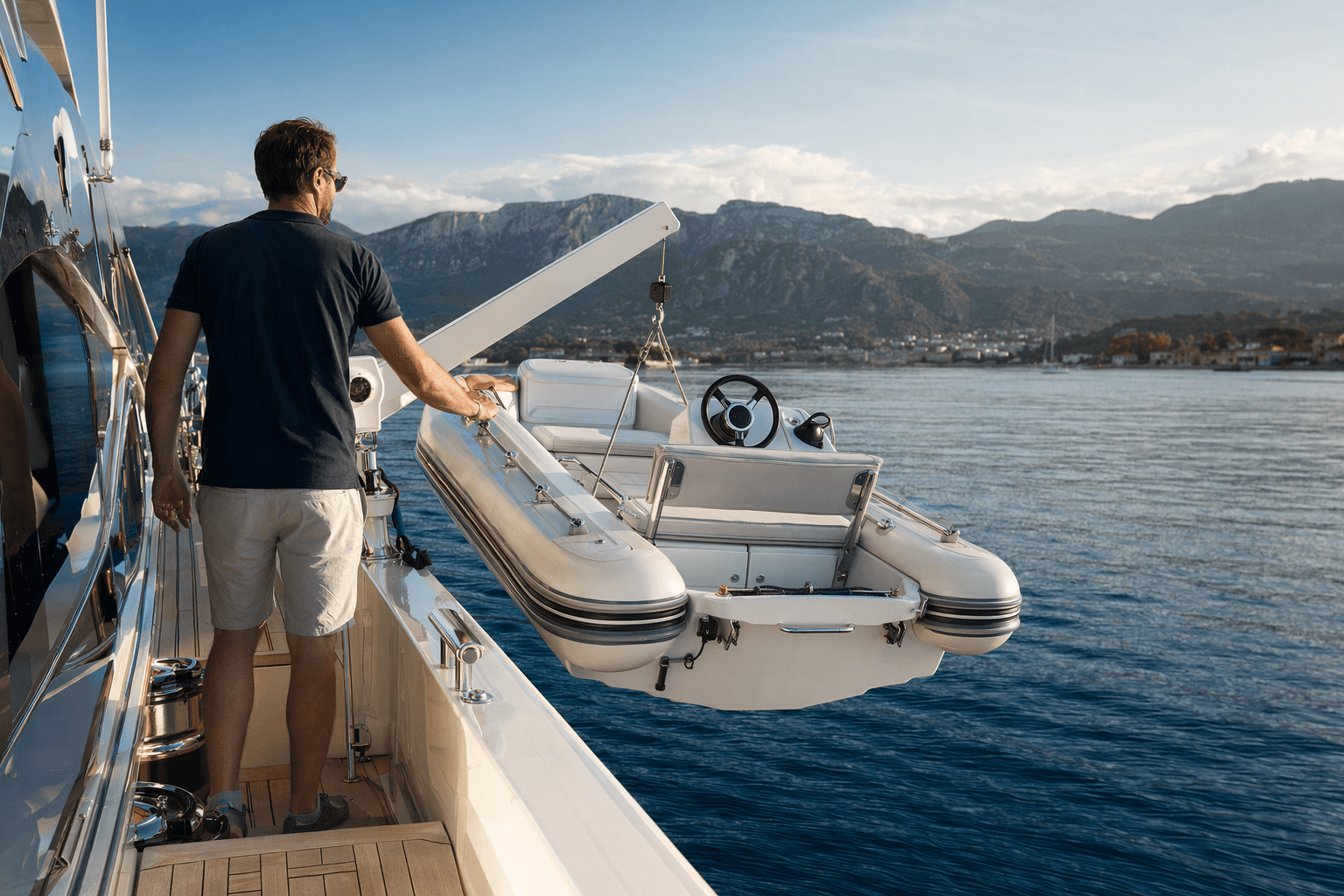
The most important number is not the tender’s bare hull weight. It is the total package weight, including the outboard, fuel, and the gear you actually leave in it. Davit suppliers make the same point bluntly when they tell buyers to calculate the loaded weight before choosing lifting gear, and that advice should be treated like safety-critical thinking, not optional fine print.
The outboard match belongs in the same calculation. Too little horsepower leaves you underpowered when you need to punch home across chop or current. Too much motor adds dead weight you will notice every time you recover the tender or try to stow it. The right setup is the one that gives you enough push without turning every lift into a strain.
Storage decides what is realistic
Cruising World’s buying advice gets one thing exactly right: storage location is often the first limiting factor. Where the tender lives tells you what type is practical, whether that means a roll-up inflatable, something with a rigid bottom, or a different layout altogether. A boat with tight stowage needs is not going to forgive a tender that looks good only when it is fully inflated and sitting on the dock.
That is where an air floor makes sense. If the tender must be rolled up and stowed in a locker, an air-deck or air-floor design is useful because it is built around compact storage. If your yacht has davits or a crane, the calculation changes again, because the storage method and lifting method now share the same weight budget.
Choose the fabric for the conditions you actually sail in
Material choice is not a styling detail. In marine materials work, Hypalon, more accurately CSM-based fabric, is known for resistance to ultraviolet light, chemicals, and harsh environments, which is why it is often recommended for high-UV tropical use. Trelleborg’s technical descriptions of CSM make the same point: it is built to stand up to chemicals, temperature extremes, and ultraviolet exposure. If you cruise where the sun is relentless, that matters.
PVC still has a place. In cooler conditions, it is commonly the lighter, lower-cost option, and that can make a lot of sense if the tender is going to see gentler use. The key is to match the fabric to the conditions, because material choice affects long-term durability and how much confidence you have when the tender is living on deck, under cover, or in and out of the water all season.
The best choice is the one that disappears into the routine
What Cunliffe gets right, and what Sailing Today keeps emphasizing in its cruising section, is that a tender should make the yacht more capable, not more complicated. The ideal setup fits the boat’s storage, the crew’s lifting limits, the cruising grounds, and the actual jobs the tender has to do. That is why the guide still lands so well: it treats the tender as part of the yacht’s operating system.
Buy that way and the tender becomes what it should be, a tool that expands where you can go and how freely you can cruise. Get it wrong and every anchorage comes with extra work. In practical sailing, that difference is enormous.
This article was produced by Prism’s automated news system from verified source data, official records, and press releases, then run through automated quality and moderation checks before publishing. The system is built and supervised by the people who set the standards it runs under. Read our full AI policy.
Did this article answer your question?