Kids Build and Race Model Boats at Fremantle Maritime Museum Family Day
A sold-out milk-carton boat workshop at Fremantle's WA Maritime Museum is the 60-minute build your sailing family or yacht club can steal, hull balance problems included.
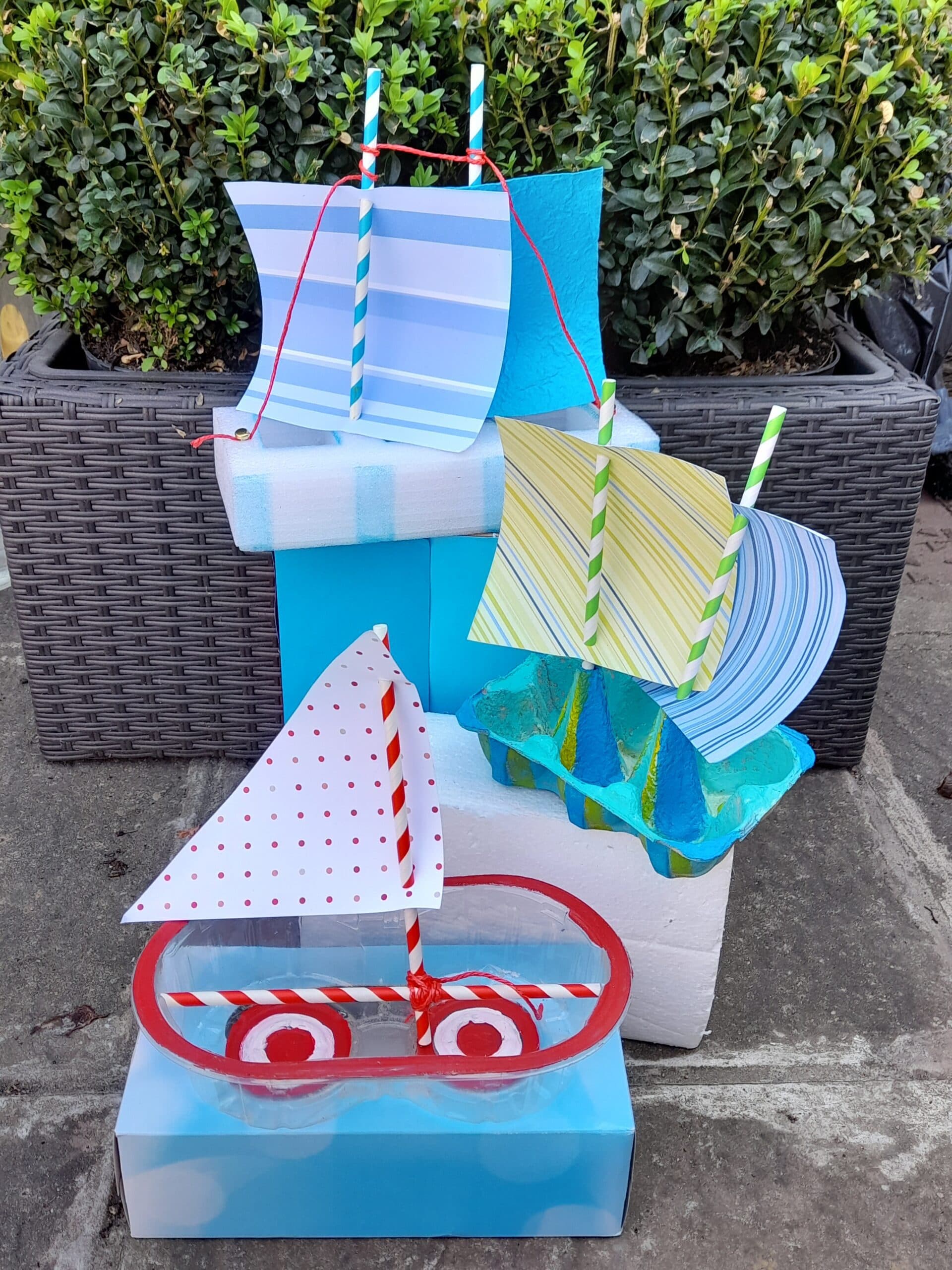
A milk carton looks like the most forgiving thing you could hand a seven-year-old and call a boat-building project. It floats by default, it tolerates tape and paint, and it won't splinter if dropped. But set one in a water trough and watch it crab sideways before it crosses the first meter, and you'll recognize immediately that the physics are the same ones you fight on the water every weekend. Off-center mast: lee helm. No keel plane: leeway. Ballast too far forward: bow buries, boat yaws. The hull does not care how old the builder is.
That lesson, embedded quietly inside a kids' activity, was what made the boat-building workshop at the WA Maritime Museum's Fenians Festival Family Fun Day worth reverse-engineering. The event ran on March 29, 2026, at Victoria Quay in Fremantle, organized jointly by the museum and the Fenians Festival. Workshop slots filled completely before the day started. The format was exactly as advertised: "Build it, decorate it, race it."
Facilitators provided milk cartons and craft materials. Children built small model boats, decorated them, and raced them in a large water trough on site. Stripped of the festival noise and the Catalpa ship tours and the live podcast recording about the 1876 prison break, the workshop is a 60 to 90-minute session you can run at home or at your club with a group of children aged five and up. Here is the build.
The materials, per boat: one clean one-liter milk or juice carton, a bamboo skewer or wooden dowel for the mast, a piece of stiff cardstock or craft foam cut into a triangle for the sail, waterproof packing tape or duct tape, craft paint or permanent markers for decoration, and a small lump of modeling clay or a couple of metal washers for internal ballast. Scissors, a ruler, and a pencil complete the kit. For the race course, a large plastic storage tub or a children's wading pool filled to about 15 centimeters gives enough water to reveal tracking behavior honestly.
Start by rinsing and drying the carton. Cut the top flaps off flush, or fold them flat and tape them down. The open face becomes the deck. Run a strip of waterproof tape straight across the opening to seal the hull. This seam matters more than it looks. If the tape bows even two or three millimeters to one side, the deck profile becomes asymmetric and the boat will pull in that direction under any sail force. Use the ruler to run the tape in a single straight pass along the centerline.
Mark the centerline of the deck with a pencil. Push the bamboo skewer through the tape at that exact center mark, angling it two to three degrees aft of vertical to give the sail a slight rake. Press the base of the skewer into a small ball of modeling clay inside the carton, right at the keel centerline. This clay is doing two things: holding the mast upright, and acting as ballast to lower the center of gravity. Without it, the mast will wobble and the boat will heel to leeward the moment any sail force hits.
Cut a triangular sail about 10 centimeters on the luff. Punch a hole near the head and near the tack, then thread the skewer through both holes so the sail sits on the starboard side of the mast. Run a piece of string from the clew to a small tape anchor at the aft edge of the deck. This is the sheet; it keeps the sail from flagging out of shape and directs thrust toward the bow rather than sideways. Tape the sheet end to the deck firmly.
Decoration happens now, before launch. Acrylic craft paint works if you give it five minutes of drying time. Permanent markers are faster and less messy for a group setting. Once paint hits water it runs off immediately, so the sequence matters.
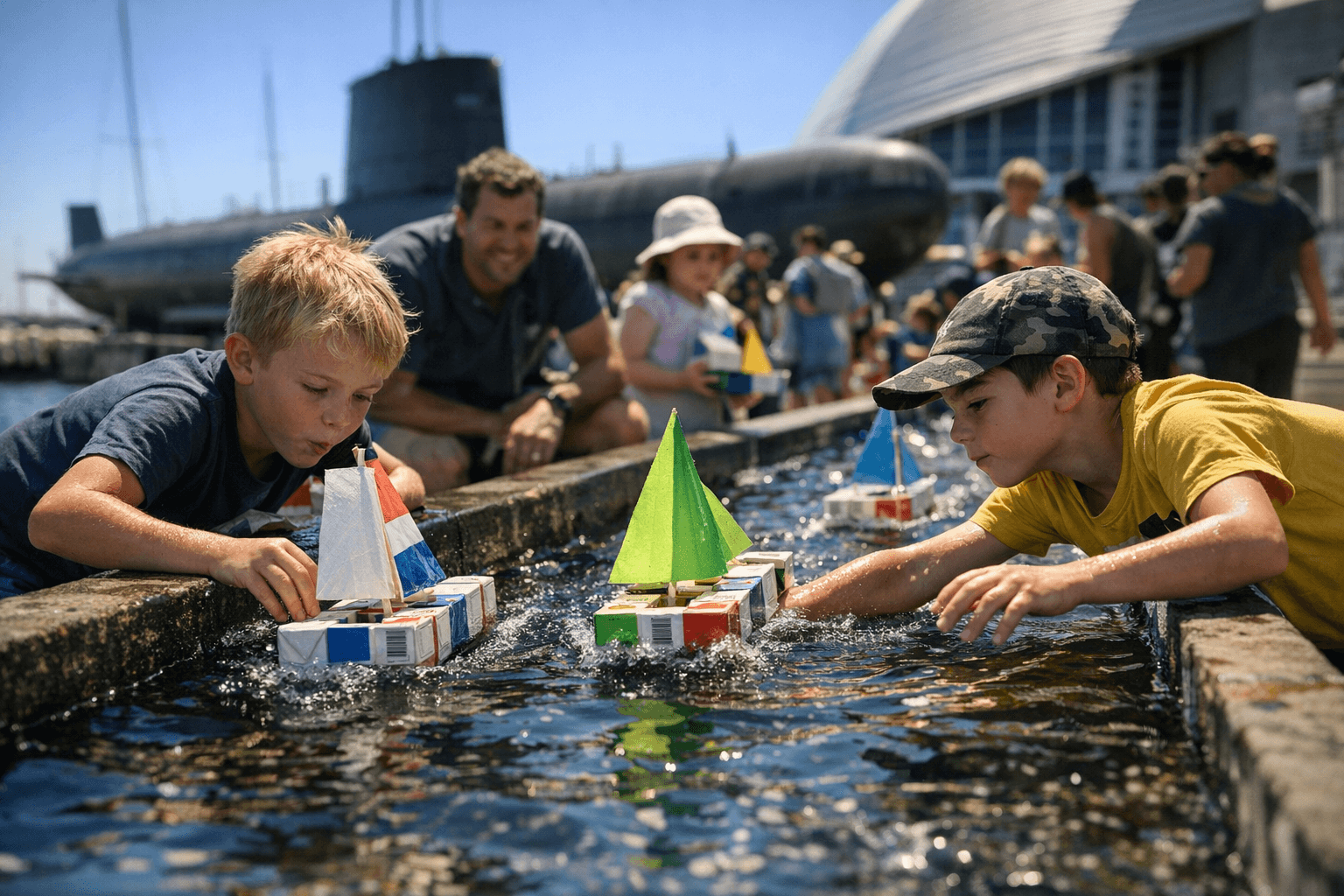
For the race, set the trough in a straight line and mark a start and finish with tape. Rules: no touching the boat once launched, and propulsion comes from blowing on the sail from a position slightly to one side of directly behind. Children figure out within two heats that blowing from directly astern is inefficient and that angling the wind slightly to one side of the sail produces a cleaner, faster run. They have discovered the broad reach without being told what it is called. Run three heats: a standard run, one with the water level dropped a centimeter to change the draft and test hull stability, and one with the clay ballast moved aft to show the group what happens to helm balance when the center of gravity shifts. The third heat is the most instructive part of the whole session.
Why the boats don't track straight:
Most boats in a session like this fail to track for five reasons, and each one maps directly to a full-scale problem. The mast is stepped off the centerline, which introduces a constant rolling moment that drives the bow downwind. The sail is sheeted so loosely it flags rather than generates any lift or directional force. The ballast is missing or positioned too far forward, putting the center of gravity ahead of the center of lateral resistance so the bow buries and the boat yaws. The deck tape was applied crooked, making the hull profile asymmetric. Or the hull has no keel surface at all, meaning there is nothing below the waterline to resist leeway.
The fix for each is the full-scale fix at small scale. Move the mast back to the marked centerline. Trim the string sheet tighter until the sail holds its shape. Shift the clay aft until the boat floats stern-down by a few millimeters. Retape the deck seam with a ruler in hand. For the missing keel, fold a strip of cardboard lengthwise and tape it flat along the bottom centerline of the carton hull. That strip adds enough lateral plane to produce a visible improvement within one boat length.
Children between seven and twelve absorb these corrections faster than you'd expect once they have a boat in the water to compare. The feedback loop is immediate and completely honest.
The WA Maritime Museum offered the workshop free by donation as part of a week of programming centered on the 150th anniversary of the Catalpa escape, in which a whaling ship purchased with donations from the Irish diaspora in the United States sailed roughly 60,000 kilometers to break six Fenian political prisoners out of Fremantle and carry them to freedom. The men raced 20 miles south to Rockingham by horse carriage on Easter Monday 1876 to reach the waiting whaleboat offshore. The people who planned that operation understood exactly what a hull could be made to do under pressure.
Running this build at your yacht club takes a trough, the listed materials, and 45 minutes of prep. The concepts it puts in front of young builders, center of lateral resistance, mast placement, ballast and trim, are the same ones worth revisiting before any season opener on the water.
This article was produced by Prism’s automated news system from verified source data, official records, and press releases, then run through automated quality and moderation checks before publishing. The system is built and supervised by the people who set the standards it runs under. Read our full AI policy.
Did this article answer your question?