Sailrite's Sail Repair Manual Offers DIY Sailors a Complete Home Guide
Sailmaker Jim Grant's 70-page softcover covers everything from hand-stitching to fixing draft flaws, making sail repair genuinely doable at home or at sea.

A torn sail at the wrong moment can end a passage or cost you hundreds at a loft. If you've ever watched a seam blow open mid-beat and thought "I should really know how to fix that myself," Jim Grant wrote the book for you, literally. *The Sail Repair Manual*, published in its 3rd Edition in 1992 and sold through Sailrite (SKU 36302), is a 70-page softcover that treats sail repair as a learnable skill, not a specialty trade secret.
Sailrite has built its reputation as a long-standing provider of sewing machines, sailmaking supplies, and instructions aimed at helping owners make or repair sails at home. This manual fits squarely in that mission: it's a self-sufficiency tool, not a coffee table book.
What the Manual Actually Covers
The scope here is broader than most DIY sailors expect from a 70-page book. Grant covers six distinct areas of practical sail work:
- Sail patching and repair
- Methods for correcting draft and seaming flaws
- Sail cleaning
- Size modifications
- Hand-stitching techniques
- How to adjust a home sewing machine to sew through heavy sailcloth
That last point is worth pausing on. A lot of sailors own a home machine and assume it can't handle sailcloth. Grant addresses exactly that assumption, walking you through the adjustments needed to make a standard home sewing machine functional for this kind of work. That alone puts this manual above the generic "sew a patch" advice you'll find scattered across sailing forums.
The draft and seaming section is equally underappreciated. Patching a hole is one thing; understanding why a sail has developed a hard spot or a persistent twist, and knowing how to correct it through seam work, is a different level of capability. Grant's inclusion of this material means the manual is useful even when your sail isn't visibly damaged, just sailing badly.
How the Instruction is Structured
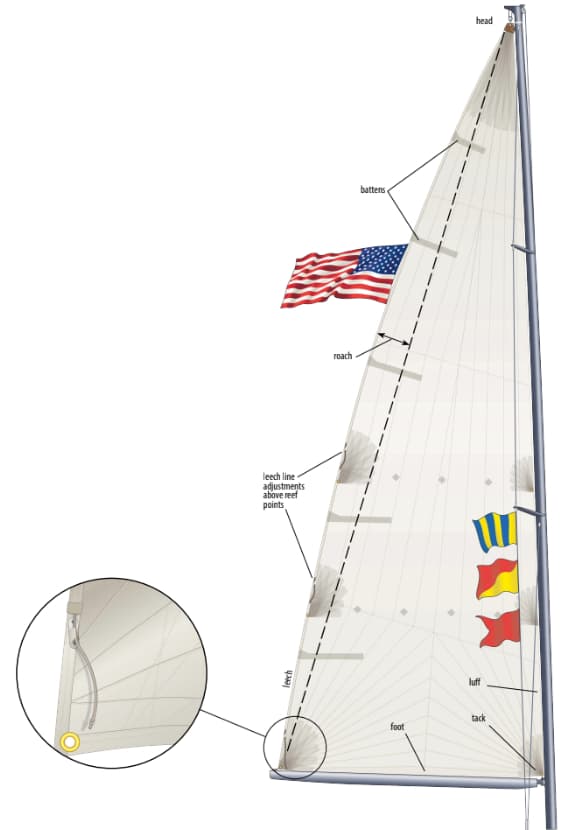
Every procedure in the manual is presented step-by-step with illustrations. That format matters. Sail repair involves spatial reasoning, material behavior, and hand techniques that are genuinely hard to describe in prose alone. The detailed illustrations that accompany each step close that gap, showing needle angles, patch placement, and machine settings in ways that words can't fully carry.
This is not a manual that assumes you already know how to hold a palm or thread a sailmaker's needle. It builds from hand-stitching basics upward, which means it's accessible to someone who's never touched a sail repair kit, while still covering the kind of corrective work (draft adjustment, seam modification) that intermediate DIYers will find genuinely useful.
Who Jim Grant Is
Grant isn't an armchair author. He's a sailmaker, which means the techniques in this manual come from shop floor experience, not from synthesizing other people's instructions. That credibility matters when you're about to take a needle to a $2,000 headsail. The fact that Sailrite chose to carry and publish this manual under their own brand speaks to how well it aligns with their broader philosophy of owner-level competence.
Physical Details and What You're Buying
The manual is a softcover, 70 pages, with detailed illustrations throughout. It's the 3rd Edition from 1992, and Sailrite lists it under SKU 36302. At time of listing, 239 units were shown as available. At 70 pages, this isn't a tome; it's a working reference you can keep in a nav station drawer or a ditty bag without it taking up meaningful space.
The softcover format is a practical choice. These pages are going to get handled in a cockpit, possibly with wet hands, and a softcover survives that use pattern better than a hardbound book with glued binding.
Pairing the Manual With the Right Tools
Sailrite's product page lists several items alongside the manual that are worth knowing about if you're setting up a sail repair kit for the first time. The Sailmakers Palm Adjustable Right Hand from William Smith & Sons is a proper sailmaker's palm, the kind of tool that makes hand-stitching through multiple layers of sailcloth actually feasible. Without a palm, you're trying to push a needle through dacron with your thumb, which is both ineffective and painful.
Two ready-built kits also appear on the same page: the Small Sail Repair Kit Right Palm and the Yachtsman Sail Repair Kit, also configured for a right-hand palm. If you want to combine the manual with the tools it teaches you to use, these kits are the logical starting point. Sailrite's broader catalog covers everything from leech line and shock cord to sealants, adhesive promoters, and sail covers, meaning you can source whatever consumables a repair calls for from the same supplier.
Why a 1992 Manual Still Holds Up
The techniques in sail repair haven't changed the way electronics or navigation software have. Dacron is still dacron. A sailmaker's palm works the same way it did thirty years ago. Hand-stitching a seam or patching a blow-out requires the same fundamentals regardless of what year it is. The criticism that a 1992 edition is dated misunderstands what this manual is: a craft reference, not a product review. The materials discussed (sailcloth, heavy thread, patching material) are still widely used and widely available.
What *has* changed is the availability of affordable home sewing machines capable of handling multiple layers of sailcloth, which actually makes Grant's section on machine adjustment more relevant now than it was when the manual was first published. More sailors have access to machines; they just need guidance on how to set them up properly for this application.
The Honest Case for Adding This to Your Boat
Sailrite's own product description calls it "a must-have for your boating library," framing it as an essential reference for self-sufficiency at sea or at home. That's not hyperbole for anyone who's been caught with a damaged sail and no loft within reasonable range. Seventy pages is a manageable read. The step-by-step format means you can work through a specific repair without having to read cover to cover first.
If you already own a Sailrite machine or are considering one, pairing it with this manual gives you the instructional foundation the machine alone can't provide. If you're purely a hand-stitcher working from a basic kit, the hand technique sections stand entirely on their own. Either way, the price of a 70-page softcover is a reasonable hedge against the cost of a professional sail repair on a passage where getting to a loft isn't an option.
Know something we missed? Have a correction or additional information?
Submit a Tip