Tulsa Man Builds 74-Foot Steel Sailboat in Front Yard, Bound for Ocean Research
Doug Jackson built a 74-foot, 40-ton steel sailboat in his Tulsa front yard over 10 years, using salvaged school-bus parts, then sailed it to Ireland.
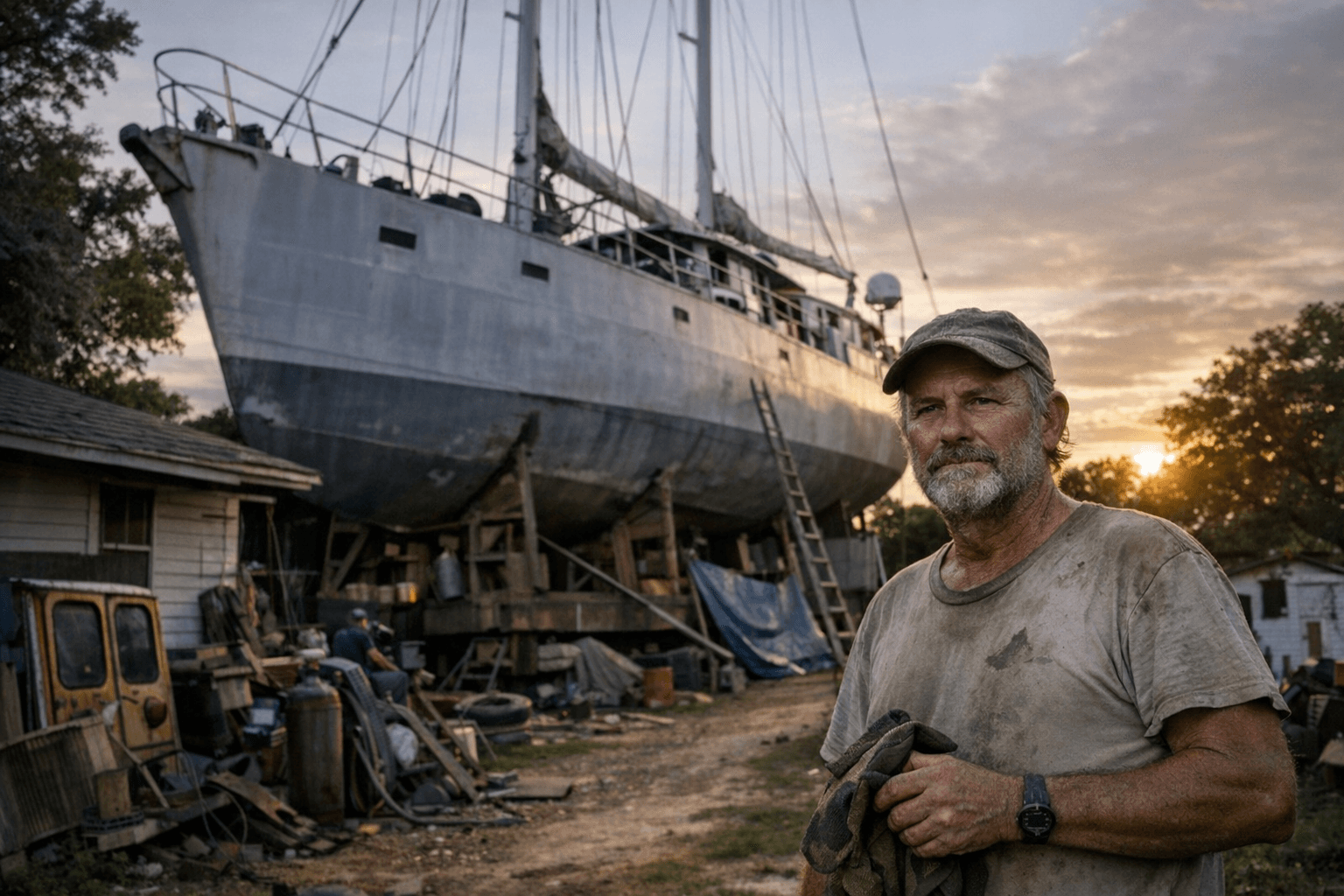
Plan to haul a 40-ton steel hull through city streets in landlocked Oklahoma and you find out immediately which decisions made over the previous decade cannot be undone. Doug Jackson, a retired Oracle Database Administrator who spent his working years running databases for Oklahoma energy company ONEOK, spent 10 years making sure none of those decisions were wrong.
It took a full decade for Jackson to build the 40-ton, 74-foot steel three-masted Chinese Junk sailboat in his front yard, at North Lewis and Ute Street in Tulsa, Oklahoma, starting in late 2011. SV Seeker stretched 74 feet long and 16 feet wide. Jackson funded every plate, fitting, and fastener out of personal savings, no sponsorship, no institutional backing.
The hull design was not an accident of preference. The Chinese junk origami-steel construction method suits home building specifically because the geometry relies on flat-panel fabrication — no shipyard press-forming, no compound curves requiring industrial tooling. "She's twin-keeled," Jackson said. "She's Chinese junk rigged and she's a motor sailor." The twin-keel configuration was also a practical draft decision: shallower combined draft means more waterways are navigable, and when your vessel has to exit Oklahoma via river before it ever reaches open water, every inch of draft is a negotiation with the channel charts.
Sourcing ran the same hard logic. One of the engines came from an old school bus. The dragons on the outside of the boat were made of Styrofoam. The masts came from salvaged light poles, chosen for structural steel specification and immediate availability. Watertight doors throughout the vessel were fabricated by hand. Where standard parts simply didn't exist for a one-off 74-foot junk-rigged build, Jackson poured them himself using a backyard foundry he constructed on-site.
The shop ran open the entire time. Jackson taught welding to neighbors and kept the build accessible to anyone willing to work. Hundreds of volunteers from across the world came to contribute labor. The project's YouTube channel, also called SV Seeker, documented every step in real time, and that transparency was structural, not just promotional: crowdsourced problem-solving from the channel's global audience resolved fabrication challenges that no single backyard builder could anticipate alone. The Hackaday engineering community had picked up the story by July 2013, years before mainstream outlets arrived. The vessel eventually picked up the name it still carries: "The Boat the Internet Built."
"If you ask, people will always help. We live in a good place," Jackson said.
The mission behind SV Seeker came from a childhood memory. Doug Jackson grew up watching "The Undersea World of Jacques Cousteau" and instantly fell in love with the sea. His version of the Cousteau model: a free research platform available to scientists, divers, and archaeologists who need blue-water access but don't have institutional backing, built with school-bus parts and poured in a backyard foundry.
The SV Seeker was moved to the Port of Catoosa, Oklahoma's inland port, as the first leg of her trip to the ocean. Every dimension of the hull, every clearance, every weight distribution decision made during 10 years of construction had to remain compatible with that overland journey first. From the Port of Catoosa, SV Seeker headed toward the Gulf of Mexico. She ultimately crossed the Atlantic and reached Ireland, confirming what a decade in a Tulsa front yard had been building toward.
Before committing to the first plate cut on a large steel hull, the SV Seeker project maps the verification sequence that actually matters. Confirm your hull design supports flat-panel home fabrication without industrial press-forming. Measure every inch of the overland transport route from your build site to the nearest navigable water, and design your beam and height to clear every bridge and power line before you weld anything permanent. Establish your full waterway route from launch point to open ocean and know the draft restrictions at every chokepoint. Source your power plant first and build the engine room around it. Budget the extraction operation as a primary project cost with its own line item, not a footnote. Jackson spent a decade proving the sequence works. Ireland proved the hull was sound.
Know something we missed? Have a correction or additional information?
Submit a Tip