USNI Fleet Tracker Helps DIY Sailors Plan Safe Coastal Routes
Ignore a security zone and you spend the afternoon talking to the Coast Guard. The March 30 USNI Tracker showed 27 naval ships underway locally — here's how to route around them.
Ignore a security zone and you spend the afternoon talking to the Coast Guard instead of sailing. That is the practical stakes behind the USNI News Fleet and Marine Tracker, which on March 30, 2026, published its latest snapshot of where the U.S. Navy has ships deployed and underway. The numbers alone tell you something: 292 ships in the battle force, 106 deployed, 86 underway on that date, split between 59 at sea in deployed areas and 27 operating locally along U.S. coasts. Those 27 local ships are the ones you might actually share water with on a spring shakedown.
For a DIY sailor coming off a winter refit, the March 30 tracker is worth 15 minutes of your trip-planning time. The Abraham Lincoln Carrier Strike Group (CVN-72, homeported at Naval Air Station North Island) remained in the Arabian Sea supporting Operation Epic Fury, meaning the waters off San Diego were quieter than they would be during a carrier workup period. But four guided-missile destroyers were independently deployed in the Eastern Mediterranean, including USS Thomas Hudner (DDG-116) out of Mayport, Florida. Ships come home, and homecoming transits generate temporary operating areas and VHF traffic that catch coastal sailors off-guard. The March 30 entry was also updated after initial publication to correct destroyer counts in the Eastern Mediterranean, which tells you the tracker team is actively maintaining accuracy, not just filing and forgetting.
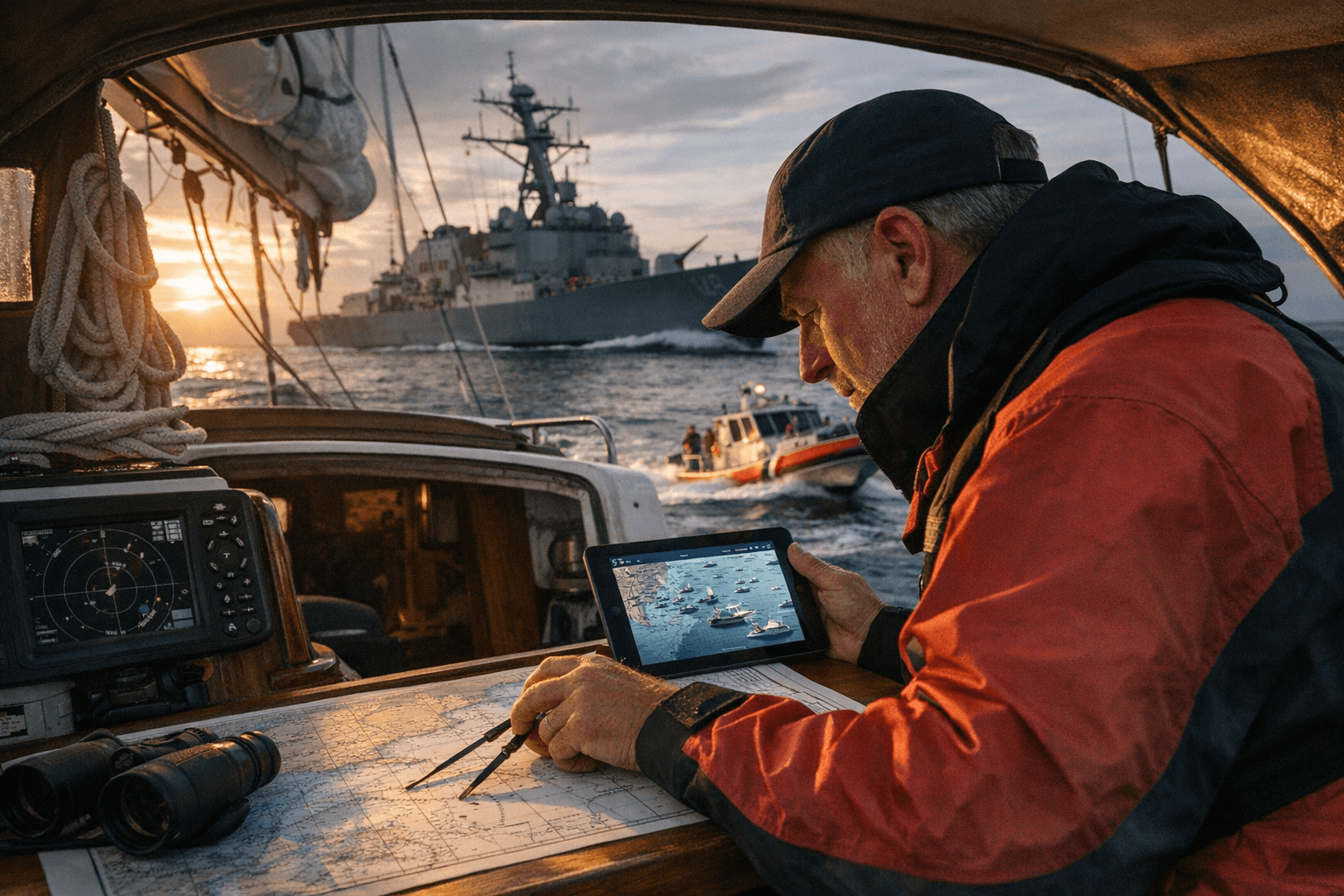
Here is the pre-departure workflow that actually keeps you out of trouble. Pull the USNI Tracker for the nearest dated entry, note which ships are listed as "local" underway, then cross-reference with your NAVAREA IV Notice to Mariners from the National Geospatial-Intelligence Agency. Search specifically for "Naval Exercise" and the OPAREA designators relevant to your coast. On the East Coast, W-122 off Marine Corps Air Station Cherry Point and W-72 east of Norfolk close without much warning. Monitor VHF Channel 16 continuously from departure, and shift to Channel 22A when transiting near any naval installation; that is the working channel between recreational vessels, the Coast Guard, and Navy patrol craft. If a gray hull hails you, respond promptly with your boat name and destination and comply without negotiating.
Put that into a concrete scenario. You have just resealed a keel-stepped mast and want a day sail from Beaufort, North Carolina, out through Beaufort Inlet toward Cape Lookout. First waypoint check: W-122 sits directly east and can extend 25 nautical miles offshore when active. Pull the current NAVAREA IV NTM; if W-122 is hot, shift your offshore waypoint 10 miles west and track inside the range boundary near the shoalwater. Second check: any transiting vessels heading south from Norfolk or north from Mayport. Set a VHF watch from the moment you clear the inlet. If a patrol craft hails you, give your vessel name, state you are on a post-refit sea trial, and ask for any advisories in the area. Nine times out of ten you will get a courteous "no restrictions" and a clear heading. Plan your return before 1600 local, when range schedules typically go active for evening exercises.
The Fleet and Marine Tracker publishes approximate positions of deployed carrier strike groups and amphibious ready groups based on Navy and public data, which makes it a fast 30,000-foot read rather than a binding navigational document. It does not replace a Notice to Mariners, but knowing that USS Gerald R. Ford (CVN-78) was in Souda Bay, Crete, for repairs and USS George Washington (CVN-73) was in Yokosuka on March 30 tells you which coasts are quieter this week, and where to expect homecoming traffic as those ships rotate back.
This article was produced by Prism’s automated news system from verified source data, official records, and press releases, then run through automated quality and moderation checks before publishing. The system is built and supervised by the people who set the standards it runs under. Read our full AI policy.
Did this article answer your question?