West Marine guide breaks down required boat safety gear by vessel size
Cross 16 feet and the gear list changes fast. This guide shows the legal minimum versus the smart extras before launch, inspection, or sale.
Why boat length changes the checklist
The expensive mistake is assuming a 15-foot safety kit still works the minute the hull crosses 16 feet. West Marine’s length-based guide, written by USCG Certified Captain Brian Gordon, is useful because it treats boat prep like what it really is: a legal inventory check, not a casual dockside guess.
That matters because federal rules do not apply as one flat list to every vessel. The Federal Boat Safety Act of 1971 gave the Coast Guard authority to set minimum safety standards for boats and associated equipment, and that framework is why size, operating area, and even who is aboard can change what you must carry. If you are getting ready for launch, inspection, or sale, this is the part that saves you from the awkward, costly moment when someone asks for gear you thought was optional.
Life jackets are the first line item
West Marine opens with PFDs for a reason: drowning is still the killer to plan around. In the Coast Guard’s 2023 recreational boating statistics, there were 564 fatalities, 75 percent were drownings, and 87 percent of those drowning victims were not wearing life jackets. The Coast Guard’s wear-rate work has tracked real-world use since 1999 and has observed 364,219 recreational boats and 1,021,455 boaters, which is a long paper trail for a simple truth: people still launch underprepared.
The legal baseline is straightforward, but owners miss the details. Children under 13 generally must wear a Coast Guard-approved PFD while the vessel is underway, unless they are below deck or in an enclosed cabin, and state law can add more requirements on top of that. The National Safe Boating Council kept the message fresh with its “Wear It For Them” initiative on January 10, 2024, because the point is not just to check a box, but to keep a bad day from becoming fatal.
The 16-foot threshold is where people get caught
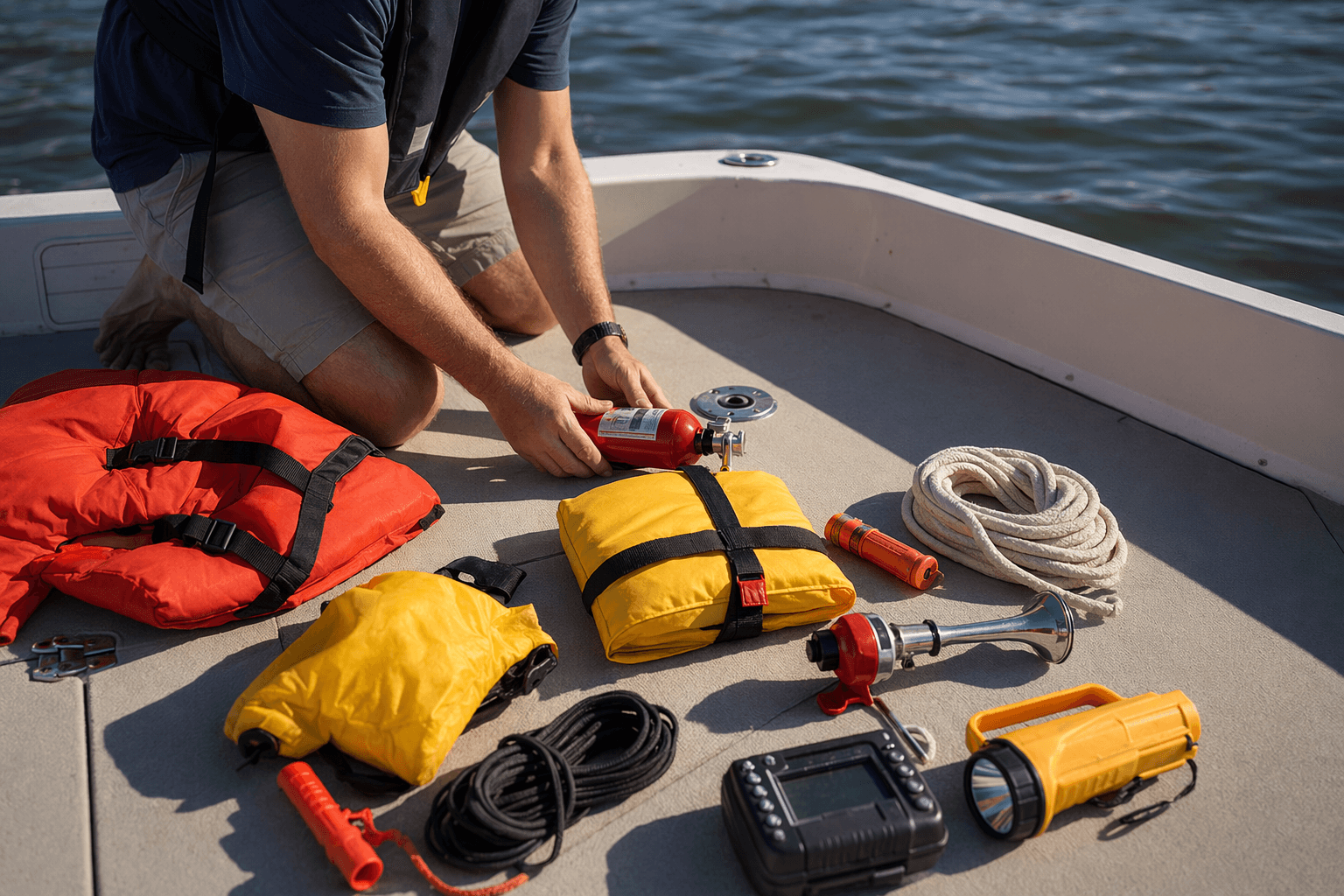
Once a recreational vessel is 16 feet or more in length, the gear list changes in a way that catches owners off guard. Federal rules require one throwable PFD in addition to the wearable PFDs required for each person aboard. That means the boat needs both the right count of wearable jackets and a throwable device ready to use, not stuffed under gear or borrowed from another hull.
This is exactly where DIY owners get embarrassed during a pre-sale walkthrough or a safety inspection. A kayak, canoe, or small skiff may have a very different legal profile from a 16-foot runabout or cruiser, and the difference is not cosmetic. If the hull length changes, the checklist changes with it.
Signals, lights, and sound devices are not window dressing
For boats 16 feet or more operating on coastal waters of the United States or the Great Lakes, visual distress signals are part of the legal picture. The acceptable options include an electric distress light, an orange distress flag, and approved pyrotechnic devices, including hand-held red flares, parachute flares, orange smoke signals, and floating orange smoke devices. The smart move is to treat those items as consumables with expiration dates and storage problems, not as gear you buy once and forget.
Sound signals are another place where size matters. Under the Navigation Rules, a vessel of 12 meters or more must carry a whistle, a vessel of 20 meters or more must also have a bell, and a vessel of 100 meters or more must also carry a gong. Even if you never expect to use them beyond fog or a crowded channel, they are part of the legal structure that keeps your boat compliant and easier to sort during a sale or inspection.
Fire protection belongs on the same checklist
West Marine’s guide also points readers toward fire extinguishers, and that belongs on any serious audit. Coast Guard fire-safety requirements for recreational vessels sit under 33 CFR part 175, subpart E, so this is not one of those items you can shrug off as optional because the engine compartment looks clean.
That is the big lesson in the guide: the legal minimum is only the start. A boat that is technically compliant can still be a poor fit for the weather, distance, crew experience, or operating area it actually faces.
What is required versus what is simply smart to carry
The useful part of West Marine’s breakdown is that it separates must-have gear from the extra kit that makes real-world boating safer. Beyond the basics, the guide points to VHF radios, rescue slings, EPIRBs, PLBs, and liferaft considerations, depending on conditions and vessel size. Those are not there to pad the shopping cart. They are the difference between a manageable inconvenience and a call for outside help when something breaks offshore or the weather turns faster than expected.
That distinction matters for sailors and powerboaters alike. A short day hop in protected water does not call for the same loadout as a longer run offshore, and a boat that is going up for sale should show that the owner knows the difference. Buyers notice the same thing inspectors do: whether the boat is legally equipped, and whether it looks like someone thought about the day something goes wrong.
A fast audit before launch, inspection, or sale
The easiest way to use the guide is to walk the boat in the same order you would on the water:
- Count one Coast Guard-approved wearable PFD for every person aboard.
- If the boat is 16 feet or more, add one throwable PFD.
- If children under 13 will be underway, make sure their PFD use matches federal rules and any stricter state requirement.
- If you are on coastal waters of the United States or the Great Lakes in a boat 16 feet or more, confirm your visual distress signals are the right type and still in date.
- Check that your whistle, bell, or gong matches the vessel length rules under the Navigation Rules.
- Verify fire extinguishers, navigation lights, and the rest of the required safety kit under the Coast Guard’s recreational-vessel rules.
- Then decide whether the smarter add-ons, VHF, rescue sling, EPIRB, PLB, or liferaft planning, fit the water you actually run.
That is the real value of a length-based safety guide: it stops you from buying the wrong gear, forgetting the mandatory gear, or showing up at the ramp with a boat that looks ready but is not. The best-prepared boat is not the one with the most gadgets. It is the one whose safety kit matches the hull, the route, and the law before the bow ever leaves the dock.
This article was produced by Prism’s automated news system from verified source data, official records, and press releases, then run through automated quality and moderation checks before publishing. The system is built and supervised by the people who set the standards it runs under. Read our full AI policy.
Did this article answer your question?