West Marine guide decodes sailing navigation light rules by boat size
Get the light combo wrong and your boat can become invisible, illegal, or rewired twice. Here’s the size-by-size fix before you replace a single fixture.
Why this matters before you buy a single LED
The most expensive navigation-light mistake is assuming “the light is there” means the boat is legal. A fixture can be installed, powered, and still be wrong if it sits too low, shows the wrong color, gets blocked, or belongs to the wrong rule set once the engine comes on.
The U.S. Coast Guard treats navigation lights like road rules on the highway for a reason: other skippers read them to judge your size, speed, course, and type. Get that signal wrong and you are not just risking a citation, you are making yourself harder to interpret in the exact moments when boats are closing, weather is fading, and nobody wants to guess.
Match the rule to the boat, not the mood
West Marine’s breakdown is useful because it starts with the two things that actually control the answer: vessel type and vessel size. The federal rules require lights from sunset to sunrise, and shapes by day, so this is not a “night cruising accessory” problem. It is a compliance problem every time you leave the dock after dark, or even sit at anchor where others need to see you clearly.
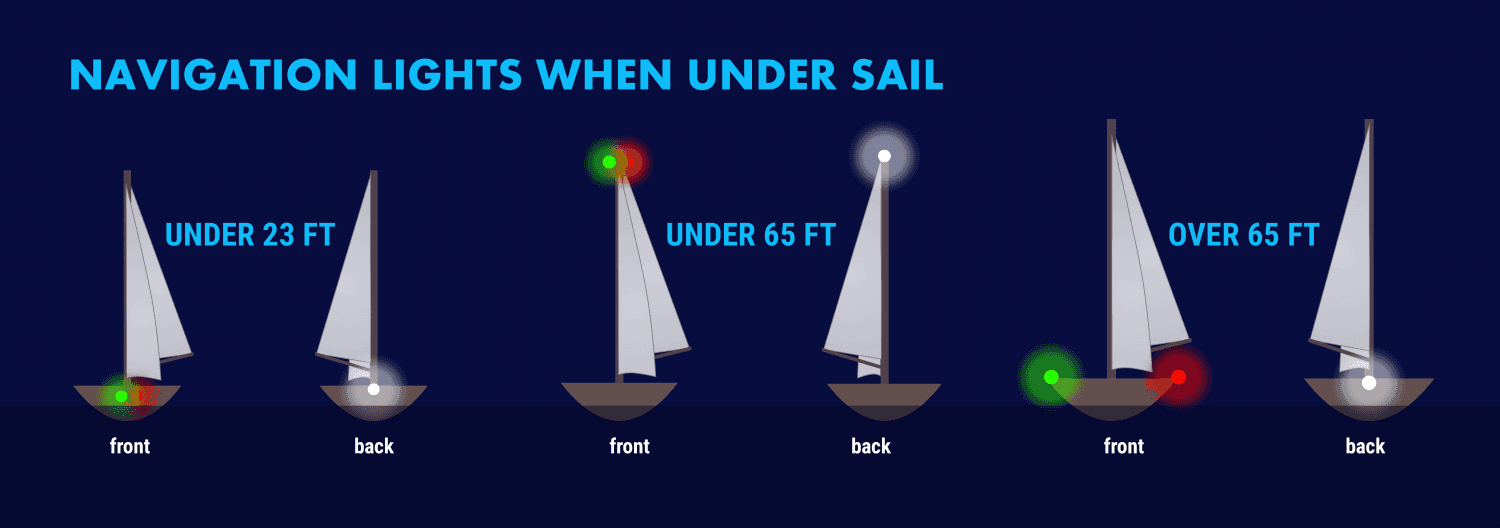
For a sailboat under sail, the size breakpoints matter. Boats under 7 meters may use a flashlight or lantern if practical lighting arrangements are not available, which is the kind of detail that keeps a small boat from being overbuilt for no reason. From 7 to 20 meters, the required setup is sidelights plus a stern light, or a tricolor arrangement. Over 20 meters, the rule set expands to sidelights, a masthead light, and a stern light.
The trap is that sailboat rules do not stay fixed once the engine is engaged. A sailboat under power is treated like a powerboat, and that is where a lot of owner-installed switch panels get people into trouble. If you wire a boat as if sail and power can share one lazy lighting layout, you can end up needing a full redo later.
Know what each light is supposed to say
The Coast Guard’s Rule 21 definitions are worth knowing because they tell you exactly what each lamp is supposed to communicate. A masthead light is white and shows an unbroken 225-degree arc. Sidelights are red on port and green on starboard, each showing an unbroken 112.5-degree arc. A sternlight is white and shows an unbroken 135-degree arc.
That geometry is not trivia. Those arcs are how another skipper tells whether you are coming at them, crossing, or sliding away. A light that is present but mounted too low, aimed wrong, or hidden by railings, dodgers, canvas, or gear can still fail the whole point of the rule because it does not present the correct arc to the water.
There is one more useful size rule that saves rewiring on smaller boats: a vessel under 20 meters may combine sidelights in one lantern on the fore-and-aft centerline. That can simplify the install, but only if the lantern is actually positioned and aimed to do the job it is supposed to do.
The installation mistakes that cost money
The Coast Guard’s Boating Safety Circular 75b gets specific about a mistake many DIY owners make: sailboats with auxiliary engines need separate circuits so the masthead light can be turned off when sailing alone. If the boat is wired like a powerboat and you are under sail only, you can wind up showing the wrong profile to anyone around you.
That same circular says a sailing vessel underway at night under sail alone, which displays the lights of a powerboat, is expected to maneuver in accordance with the Navigation Rules for a powerboat. In other words, the wrong light package does not just confuse other people. It can change how your own boat is treated under the rules.
Another common error is mixing anchor lighting and underway lighting. The Coast Guard says running lights and anchor lights should not be displayed at the same time while underway. At anchor, the correct signal is an all-around white light visible at two nautical miles, and during the day the standard anchor signal is a black anchor ball. If you leave both systems on because “more light feels safer,” you are not helping your case.
White deck lights and spreader lights are another classic night-vision killer. The Coast Guard warns they can significantly impair night vision, so they should be turned off when not needed. That matters in a crowded harbor almost as much as offshore, because your own dark adaptation is part of seamanship too.
A dockside check you can run fast
Before you replace a fixture, look at the boat in three modes and ask three questions:
- Am I under sail, under power, or at anchor?
- How long is the vessel, and does that put me in the under-7-meter, 7-to-20-meter, or over-20-meter bucket?
- Can another skipper actually see the correct color, arc, and height without obstruction?
If the answer to any of those is fuzzy, stop and fix the wiring or placement before you spend on more hardware. That is how you avoid the expensive do-over, the failed inspection, and the moment when another boat reads your lights wrong at close range.
Why this is still the real world, not a textbook rule
These rules are not new, and that is part of the point. The international collision-avoidance rules were formalized in the 1972 COLREGS and became effective July 15, 1977, so modern navigation-light practice sits on a long-standing framework rather than a trend that showed up in last season’s catalog.
The broader safety picture is just as practical. The Coast Guard says it has coordinated the National Recreational Boating Safety Program since 1971 and estimates that effort has saved about 95,000 lives. In 2024, the Coast Guard reported 556 recreational boating fatalities, the fewest in more than 50 years, along with 3,887 incidents. That is a reminder that the safety bar has moved up, but visibility and collision avoidance are still daily, very real risks.
If you wire the lights correctly the first time, you are not just making the boat look tidy. You are making it legible to everyone else on the water, which is the whole game after dark.
This article was produced by Prism’s automated news system from verified source data, official records, and press releases, then run through automated quality and moderation checks before publishing. The system is built and supervised by the people who set the standards it runs under. Read our full AI policy.
Did this article answer your question?