Why Cruising Boats Need Smarter AC Power Design Now
The lithium bank is not the weak link. The danger shifts to the AC system, where shore power, inverters, and generators can turn one sloppy connection into a serious problem.
Why the AC side deserves a redesign
The biggest mistake in a modern cruising refit is thinking the hard work ends after solar, lithium, and a smart inverter/charger go in. The boat may feel electrified, but the AC side is often still wired like an afterthought, with grounding, breaker protection, and source switching held together by compromise instead of design. If you follow marine-electrical conversations from people like Nigel Calder, Ward Eshleman, William Brian Criner, Colin Althen, Andy Brown, and Denis Bonneau, the message is the same: once the energy system gets serious, the AC side has to be treated seriously too.
That matters because the risk profile changes the minute you start mixing shore power, inverter power, generator power, and the hotel loads that make cruising life work. Air conditioners, water makers, cooktops, and ovens are not optional garnish anymore. They shape the panel, the protection scheme, and the way the whole boat is grounded and isolated.
The hidden safety gap in shore power
Shore power is where a lot of otherwise careful owners get exposed. The boat side of the system needs to remain ungrounded and floating, which in practice means an isolation transformer is doing real work, not decorative work. That is the difference between a system that simply plugs in and one that is designed to keep dangerous current paths off the boat.
The galvanic side matters just as much. Victron’s galvanic isolator documentation says these devices block low-voltage DC currents that can enter through the shore-power earth wire and cause corrosion of underwater metals. That is not a theoretical problem for a boat that lives on docks, adapters, and unfamiliar pedestals. If you want to keep the prop, shaft, through-hulls, and underwater metals from becoming the sacrificial parts of your electrical system, you have to treat shore-power grounding as part of the corrosion strategy, not just the safety strategy.
Breaker sizing is not a guess
A lot of DIY electrical work fails because the builder starts with the device and ends with the breaker. On a cruising boat, it has to work the other way around. Double-pole breakers are required in the architecture described here, and the load plan needs to account for big appliances from the start, not after the panel is already crowded.
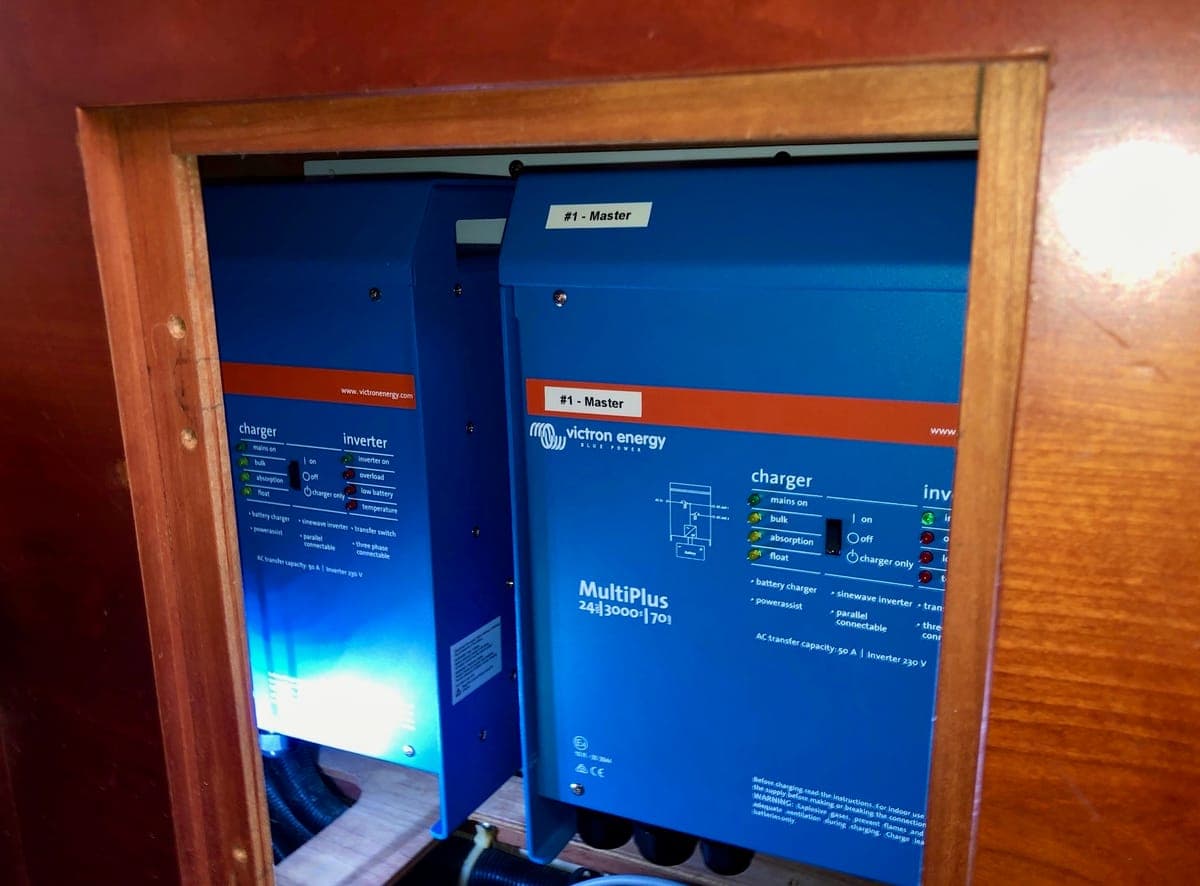
That is especially true when you move between Europe’s 230V world and the U.S. 240/120V setup. The basic architecture is similar even if the hardware differs, but the split-phase details matter. Victron’s current autotransformer documentation says it can be used for step-up, step-down, and split-phase output balancing, which is exactly why it shows up in smarter U.S. AC designs. It can create a center tap and help support both 240V and 120V loads while keeping the distribution balanced between the two legs.
The lesson is simple: if you are planning air conditioning, water heating, cooking, or water making, the panel cannot be an afterthought. You build the distribution around the real load list, not the fantasy list.
Where the line isolation monitor comes in
Once the boat is blending shore power, inverter power, and generator power, the line isolation monitor becomes one of the most interesting parts of the system. The point is not just to pass power through the boat. The point is to know what the system is doing, and to do it at a cost and complexity level that makes sense for a cruising boat.
That is why the concept keeps showing up in serious AC redesigns. The author of the technical article wants to explain and design a lower-cost version than the commercial units currently available, because the need is real: when multiple power sources are in play, one bad assumption can create a dangerous grounding path or a misleadingly “working” system that is not actually safe. This is exactly where a modern inverter/charger integration stops being a convenience upgrade and starts being a system-design problem.
ABYC is not optional reading anymore
The American Boat & Yacht Council has been developing marine safety standards since 1954, and that history matters because the standards are still evolving for recreational boats that now carry far more electrical complexity than older cruising rigs ever imagined. ABYC’s E-11 standard covers AC and DC electrical systems on boats, and its A-28 standard applies to galvanic isolators used on boats with AC shore-power systems operating at 50 or 60 Hz and less than 600 V.
ABYC also says compliance with E-11 is recommended for systems and associated equipment manufactured and or installed after July 31, 2019, in the 2018 edition previewed on ANSI Webstore. That is a useful line in the sand for anyone retrofitting an older boat and wondering whether the electrical panel can stay “good enough.” It is also a reminder that standards are not museum pieces. ABYC keeps publishing standards and training, including its standards library and development resources from Annapolis, Maryland.
The training path tells you where the industry thinks the hard problems are. ABYC’s Marine Electrical Certification covers grounding and bonding systems, battery and inverter installation, and AC and DC components. The Advanced Marine Electrical Certification goes further into AC power-conversion equipment, galvanic isolation, and three-phase power distribution. That is not marketing fluff. It is the curriculum for the exact problems owners hit when they try to modernize a cruising boat without redesigning the electrical backbone.
The Coast Guard sets the floor, not the finish line
The United States Coast Guard Boating Safety Division is blunt about one thing: federal equipment requirements are minimum requirements and do not guarantee safety. That is the part many owners miss when they see a regulation and assume that compliance equals good design. It does not.
The Coast Guard’s marine electrical technical section points to 46 CFR Subchapter J, which provides specifications for electrical equipment and systems aboard vessels, including cabling, lighting, grounding, and hazardous locations. That framework matters, but it is the floor. If you are building for real cruising loads, real corrosion exposure, and real source switching, you still need a system that makes sense physically, not just legally.
What you can safely DIY, and where to bring in help
You can usually handle the planning work yourself if you are disciplined: mapping loads, deciding what must run on 120V versus 240V, listing the big appliances, and understanding how your inverter/charger, autotransformer, isolation transformer, and galvanic protection fit together. You can also do the clean owner-level work of labeling, documenting, and replacing like-for-like devices when the architecture already exists and the design is sound.
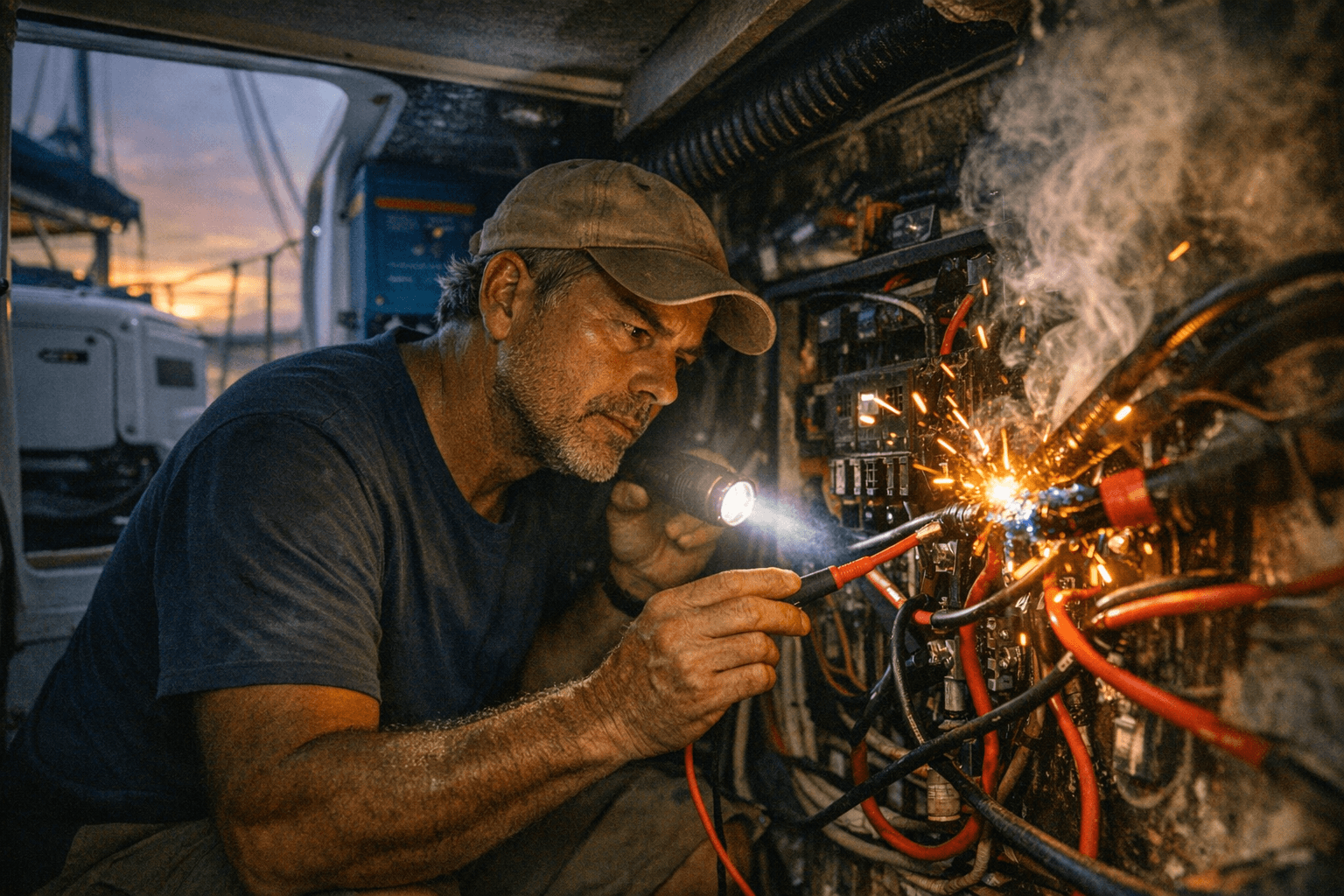
Bring in a marine electrician when the job crosses into system architecture. That means shore-power redesign, grounding and bonding changes, split-phase panel work, breaker coordination, source transfer logic, line isolation monitor integration, or any installation that changes how the boat handles shore power, inverter output, generator input, or corrosion protection. If the fix changes where fault current goes, it is not a casual weekend project.
The boats that age best are the ones whose owners stopped treating AC as an accessory circuit and started treating it like the nervous system of the whole cruiser. Once you do that, the panel gets simpler, the protection gets smarter, and the boat stops depending on luck to stay safe.
This article was produced by Prism’s automated news system from verified source data, official records, and press releases, then run through automated quality and moderation checks before publishing. The system is built and supervised by the people who set the standards it runs under. Read our full AI policy.
Did this article answer your question?