Why every serious boatowner needs a heavy-duty sewing machine
When your boat starts demanding sails, covers, cushions, and heavy canvas fixes, a real sewing machine stops being a luxury and starts paying rent.
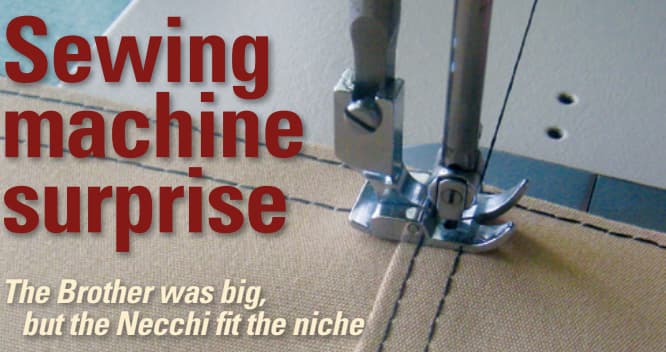
The old industrial Brother didn’t come back from storage as a nostalgia piece. It came back as proof that once a boat starts generating real fabric work, a household machine and a steady hand are no longer enough. In Don Casey’s world, the question is not whether you like sewing, but whether you want to keep paying other people to solve every canvas problem that shows up on the dock, on passage, or in the cockpit.
When the work gets thick, the machine has to get serious
The line in the sand is heavy marine fabric. Casey’s Brother was shown stitching through 12 layers of 9.25-ounce acrylic canvas, which is exactly the sort of abuse that turns a sewing machine from a convenience into equipment. That kind of stack is not a cute upholstery project or a single hem on a cabin curtain. It is sail cover territory, dodger territory, full enclosure territory, the kind of material that laughs at light-duty gear and punishes weak feed systems.
That matters because sailing rarely gives you one neat sewing task at a time. One month it is a sail patch. The next it is a bunk cushion, then a settee cushion, then an awning, then a full boat cover. Casey’s machine handled sails, awnings, dodgers, full boat covers, bunk and settee cushions, upholstery, and even household and automotive repairs, and that range is the real lesson. Once one machine can cross from boat work to shore-side repairs, it stops being a hobby toy and starts becoming part of how you live.
The real tipping point is repetition, not novelty
A lot of sailors can get by improvising for a while. Hand-stitching works when the job is small, the fabric is forgiving, and you have time to nurse every seam. A household machine can also look good right up until marine canvas enters the picture and the needle, presser foot, and feed system run out of confidence. The upgrade makes sense when the jobs are no longer occasional, light, or optional.
That is the moment when canvas stops feeling like a specialist’s bill and starts looking like a recurring maintenance line. BoatUS keeps canvas care, covers, bimini tops, refitting, and DIY makeovers in the normal run of boat ownership, and that is the right frame. These are not oddball side projects. They are part of keeping a boat usable, protected, and ready to launch without calling a shop every time a seam splits or a cover sags.
What a real marine machine actually buys you
The appeal of a heavy-duty machine is not just power. It is the kind of control that comes from a machine built for dense, layered material. Sailrite describes its Fabricator as a full-size industrial, straight-stitch machine with a compound walking foot and servo motor, built for canvas, upholstery, leather, and awning shops. That combination is not overkill if you are feeding marine canvas through multiple layers and want consistent stitch length instead of a machine that stalls halfway through the seam.
Sailrite’s Ultrafeed sits in a different but equally useful lane. It is a portable heavy-duty machine designed for sails, marine canvas, leather, and upholstery. That portability matters if your sewing space is limited, if your boat life is cramped, or if you need to stow the machine when it is not in use. The point is not that every sailor needs the biggest possible machine. The point is that once you are making or repairing serious gear, you need a machine built for that material, not one that merely tolerates it.
Space, setup, and the practical cost of waiting too long
A real machine also changes the space equation. Casey’s Brother sat in a power table with a large motor, which tells you everything about the kind of footprint an industrial setup can demand. That is the tradeoff. You give up some room, some portability, and some casual convenience, but you gain the ability to do work that would otherwise get outsourced or delayed.
That tradeoff is easiest to justify when your boat projects start stacking up. If you are repairing sail covers, building cushions, sewing new bags, or fabricating a full cover, the machine earns its berth fast because it saves trips to a loft and lets you fix problems on your schedule. If the machine also handles shore-side jobs, the value climbs again. A heavy-duty sewing machine is not just for the boat; it becomes a shared tool for the whole cruising life.
Why the DIY sail-and-canvas world keeps coming back to this
There is a reason this conversation has been around for decades. Sailrite traces its roots to 1969, when Jim and Connie Grant became interested in building their own sails. Jim Grant made a full set of sails for a Cal 20 National regatta and finished second, then the business began by selling supplies and instructions for sewing sails and canvas. That history matters because it shows the DIY sail-and-canvas mindset is not a fad. It is a long-running response to a simple reality: sailors need fabric gear, and fabric gear wears out.
That is why the serious boatowner eventually lands in the same place Casey does. Once you are past the odd hand repair and into repeated work on sails, covers, cushions, and canvas, a proper machine stops being an indulgence. It becomes the difference between patching around the edges and owning the job from start to finish. And when that old Brother comes out of storage again, it is not a surprise at all. It is the machine that says the boat has finally grown into it.
This article was produced by Prism’s automated news system from verified source data, official records, and press releases, then run through automated quality and moderation checks before publishing. The system is built and supervised by the people who set the standards it runs under. Read our full AI policy.
Did this article answer your question?