Brussels Symposium Unites Researchers and Bakers to Advance Sourdough Science
Over 1,000 bakers from 33 countries submitted starter samples to HealthFerm researchers, producing Europe's most geographically diverse sourdough fermentation dataset.
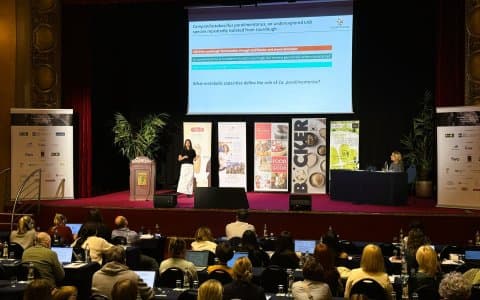
Brussels hosted the 9th International Sourdough Symposium at Hotel Le Plaza from February 23 to 27, the event returning to its founding city for the first time since Puratos and Vrije Universiteit Brussel co-initiated the series there in 2003. Twenty-two years on, the organizing committee led by Prof. Luc De Vuyst (VUB), Prof. Christophe Courtin (KU Leuven), and Karl De Smedt (Puratos) drew researchers, artisan bakers, and industrial technologists into a five-day program organized under the theme "Forward with the Past."
The schedule opened with a lecture by Friedrich Heinrich of VUB tracing the pre-history of bread from the Neolithic Revolution through the Green Revolution, then moved through plenary sessions on microbial biodiversity, fermentation technology, functional properties, and industrial practice. Eight of those presentations drew directly from HealthFerm consortium results, the EU-funded project running coordinated sourdough and fermented food research through 2026.
The citizen science initiative anchoring much of the HealthFerm work drew particular attention. Thomas Gettemans of VUB presented findings from a co-designed effort that enrolled more than 1,000 participants from 33 countries, with 671 starter samples ultimately submitted. Participants completed standardized at-home fermentation experiments and sensory evaluations, generating a dataset that maps baking habits, flour type, feeding schedules, and environment against measurable physicochemical and sensory outcomes. For a field that has historically worked with laboratory-controlled conditions, the geographic breadth and real-world variability of that sample pool is a meaningful departure.
Several researchers received awards during the symposium. Gabriela Samaniego of VUB presented research on the genomic blueprint of Companilactobacillus paralimentarius, a bacterial species with direct implications for sourdough applications. Eline Lambrechts of KU Leuven presented on the enzymatic conversions critical to successful fermentation with kilned oat wholemeal flour. Stefan Cappelle of Puratos was also recognized and moderated a panel discussion featuring Belgian artisan bakers Henrik Durnez of Bio Bakery De Trog, Laurent Maes of Renard Foods, and Philip Fastré of Panerex, connecting bench results to real bakery decisions.
De Vuyst delivered a keynote on flavor production during sourdough fermentation, grounding the analytical program in the outcomes that matter to practitioners. The broader agenda also addressed the gap between producing microbial sequencing and metabolomics data and converting those outputs into reproducible baking guidance. HealthFerm has flagged standardized metadata collection and cross-platform metabolomics as the necessary next steps before microbial species lists become actionable at either artisan or industrial scale.
The citizen science dataset now represents the most geographically diverse snapshot of household sourdough fermentation practices in Europe. The patterns beginning to emerge from it, connecting specific microbial compositions to flavor, texture, and process behavior, mark the point where sourdough science acquired a sample size large enough to say something definitive.
This article was produced by Prism’s automated news system from verified source data, official records, and press releases, then run through automated quality and moderation checks before publishing. The system is built and supervised by the people who set the standards it runs under. Read our full AI policy.
Did this article answer your question?