King Arthur's Frozen Butter Grating Technique Promises Flakier, More Uniform Pastry Layers
Grating frozen butter on a box grater's slicer side outperformed cubed fat in King Arthur tests, producing finer, uniform strands that resist warmth and lift laminated sourdough pastries more evenly.
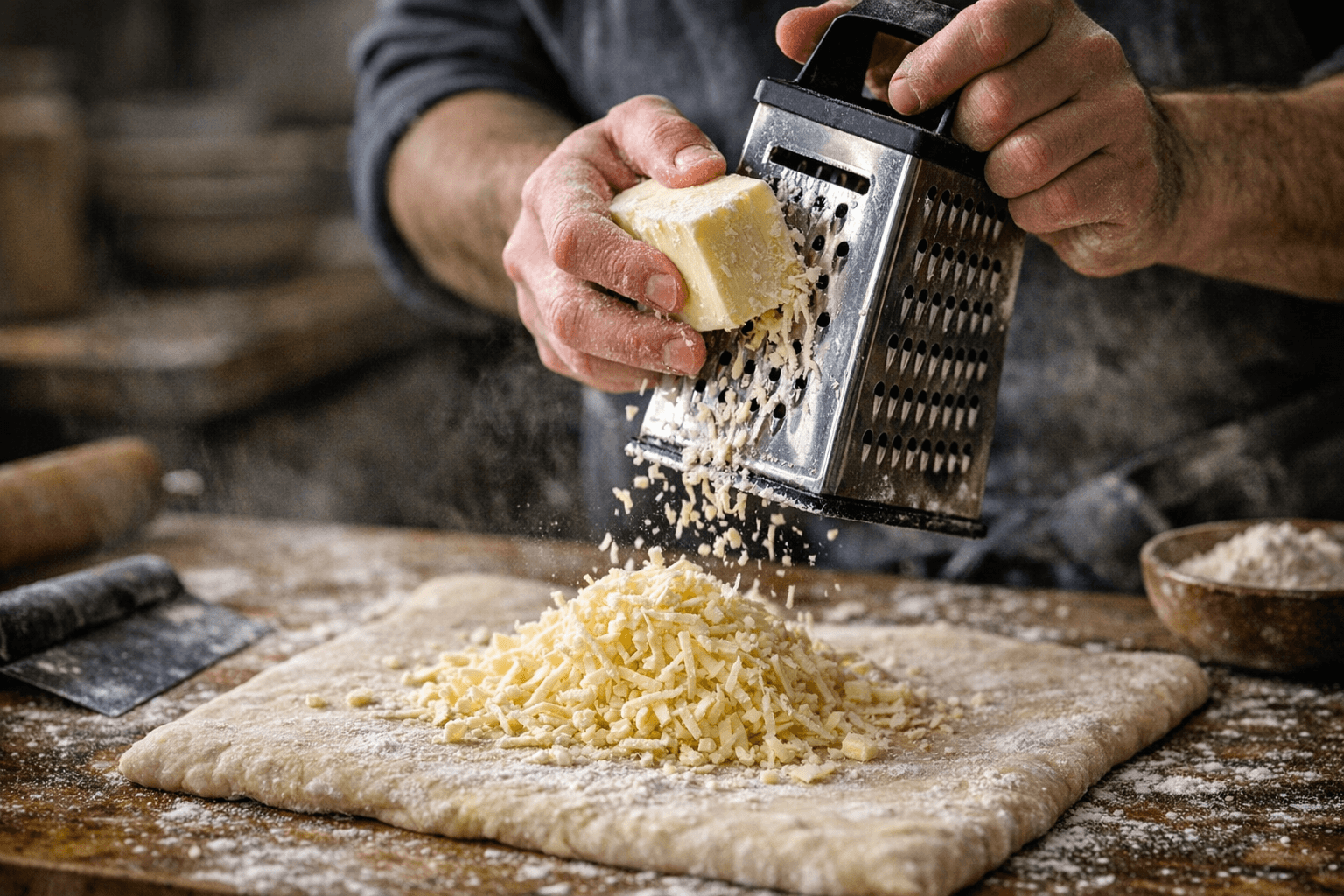
Particle size turns out to be one of the most consequential decisions in laminated pastry work, and a side-by-side test run by King Arthur's test kitchen made the case plainly: grated frozen butter consistently outperformed cubed butter in both uniformity and temperature retention, with measurable effects on layer definition, lift, and crumb texture.
Sarah Jampel, King Arthur's Recipe Development and Test Kitchen Manager, spent nearly half a year developing a single biscuit recipe before landing on grating as her preferred butter incorporation method. Her specific tool of choice sharpened the result further. Rather than the standard large-hole grating surface, Jampel used the slicer side of the box grater, which produces long, thin sheets of butter rather than small shreds. The larger sheets distribute through the dough differently: the fine shreds integrate evenly throughout, while the slicer's sheets preserve more distinct cold pockets.
The physics behind why this matters is articulated cleanly by Top Chef winner Mei Lin, who described the mechanism precisely: "Grated butter creates finer, more consistent strands of fat throughout the dough. As the butter melts in the oven, it releases steam in a more uniform way, which gives you more even lift, a softer, more tender crumb, and defined layers without feeling greasy or heavy." That uniformity is exactly what cubed butter, handled by warm hands and cut into irregular chunks, tends to undermine. Large, uneven pieces melt at inconsistent rates and leave greasy pockets where smaller pieces would have generated clean steam.
The temperature argument is just as important as the geometry. Chef Gale Gand extends the logic past butter entirely, grating the full ball of frozen butter-rich dough for her Hungarian Shortbread Bars, a recipe from the cookbook "Baking with Julia." Freezing the whole mass and grating it directly into the pan eliminates handling warmth at every stage, not just during butter incorporation.
For sourdough bakers moving into laminated territory, these particle-size and temperature principles translate directly. King Arthur's Croissant Sourdough Bread uses grated frozen butter laminated into an egg yolk-enriched dough to create pull-apart layers and a light, open crumb. The lamination process calls for grating roughly two-thirds of the frozen butter over a stretched 14-inch dough square, folding in thirds, then grating the remaining butter over the top before rolling into a log. That staged grating approach keeps the butter in consistent, thin contact with the détrempe at every fold rather than concentrating fat unevenly at a single layer.
Temperature control is treated as the most critical variable in this laminated sourdough context. Because the technique mirrors pie crust and biscuit logic, the butter must stay solid inside the dough until it hits the oven; placing the laminated dough in any environment above 80°F risks smearing the fat into the gluten structure instead of preserving discrete layers. Sourdough doughs compound this risk. A levain-influenced détrempe is typically more extensible and acidified than a straight-yeast dough, which makes it faster to warm and more prone to tearing under pressure if the butter has softened.
The grating technique directly addresses both vulnerabilities: smaller, colder butter particles lock into place more quickly during folding and require less mechanical pressure to distribute, reducing the friction that warms dough and butter alike. Working fast off a frozen block and returning the dough to the refrigerator between folds keeps the lamination intact through a fermentation schedule that straight-yeast pastry never demands.
This article was produced by Prism’s automated news system from verified source data, official records, and press releases, then run through automated quality and moderation checks before publishing. The system is built and supervised by the people who set the standards it runs under. Read our full AI policy.
Did this article answer your question?