Climbers Build Budget Box-Truck Home for Rugged Off-Road Living
Jess and Shawn turned a former ambulance into a 96-square-foot off-road home with smart storage, a hidden bath, and real off-grid power.
Why this box truck works
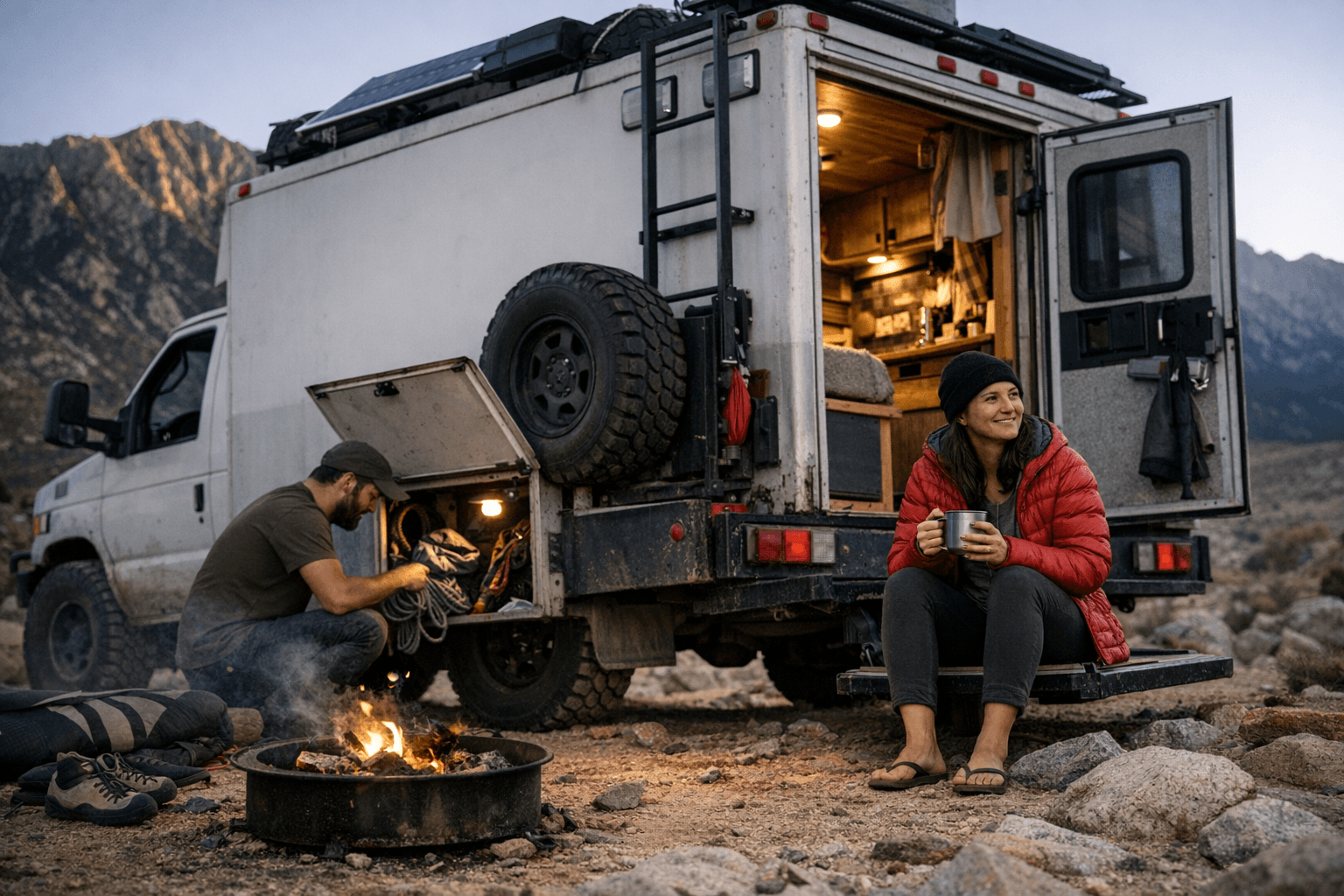
Jess and Shawn did not just build a tiny home, they built a mobile base camp with room to breathe. After nearly six years in a camper van, the climbing- and outdoors-focused couple moved up to a 2008 Chevy Kodiak C4500 because they wanted something bigger, sturdier, and better suited to rough roads and long stints off-grid.
That is the part tiny-house builders should pay attention to: this is not about chasing square footage for its own sake. It is about choosing a platform that matches how you actually live. Box trucks make sense here because they give you straight walls, more usable interior volume, and fewer awkward compromises than a typical van shell.
Start with the right base vehicle
The truck started life as an ambulance for the Oregon Fire Department, which is exactly the kind of donor vehicle that makes a practical conversion possible. Jess and Shawn bought it for $13,500, then put another $24,800 into the conversion, covering the mechanics, the habitation box, and the interior fitout. That total matters because it puts the build in the realm of serious DIY effort, not boutique custom luxury.
If you are cost-checking a project like this, the lesson is simple: the chassis is only the beginning. You are also paying for suspension, power, fabrication, insulation, cabinetry, and all the little things that make a box on wheels livable. A used commercial platform can still be a smart buy, though, especially when it gives you a strong frame and a body style designed for upfitting.
Chevrolet’s current medium-duty chassis-cab lineup still points in the same direction, with commercial platforms built for heavy upfits and a max available GVWR of 23,500 pounds. That tells you why a Kodiak/C4500-type truck can be such a solid foundation for a mobile home conversion: it was made to carry more than a weekend bag and a mattress.
The layout is the real flex
The custom box took two months to build and measures 12 feet long, 8 feet wide, and 8 feet tall, with an added three-foot attic. On paper, 96 square feet of living space does not sound generous. In practice, the layout feels much bigger because the couple treated every inch like it had a job.
They stripped away the old rear components and attached the custom-built box directly to the frame, turning the truck into a studio-style home on wheels. The result includes three doors, fold-down steps, underbody toolboxes, an elevator bed, and a hidden bathroom, all while keeping the original red cab, air horns, and strobe lights. That mix of utility and restraint is what makes the build memorable: it looks like a real expedition rig, not a glossy tiny house that forgot about dirt, gear, and access.
The attic is another smart move. In a small mobile build, vertical storage is often the difference between “cute” and “actually livable.” A three-foot attic gives the couple a place to stash the bulky stuff that would otherwise eat floor space, which is exactly what a climbing rig needs.
Borrow the storage tricks, not just the style
This is the part tiny-house builders can steal without ever touching a box truck. The strongest ideas here are not decorative, they are spatial. The underbody toolboxes keep equipment outside the living zone. The hidden bathroom saves the visual clutter that usually makes small interiors feel cramped. The elevator bed frees floor area when it is up, which matters in a 96-square-foot space where every open patch of floor changes how the room feels.
A few takeaways are especially useful for other small-space projects:
- Build storage into dead zones first, not after the furniture is already in place.
- Use a bed system that disappears or transforms if you need floor space during the day.
- Keep wet or messy gear outside the main cabin when possible.
- Add vertical volume, like an attic or overhead locker, before adding more fixed furniture.
- Make the entry and circulation easy, because tight spaces feel smaller when they are hard to move through.
The big lesson is that storage is not just about capacity. It is about circulation. The reason this box truck feels surprisingly spacious is that Jess and Shawn designed for movement, not just stuff.
Off-grid capability is part of the design, not an afterthought
The roof carries 800 watts of solar panels feeding a 600-Ah battery bank, which gives the rig real off-grid range. That matters for a couple whose lifestyle revolves around climbing and outdoor travel, because a mountain road is not the place to discover your power setup was built for campground hookups and best-case weather.
Solar and battery capacity are not glamorous details, but they are what make a mobile home self-reliant. In a build like this, the electrical system has to support daily living without turning the owners into generator babysitters. The fact that the truck stays functional and discreet while still packing serious power is a big reason the layout works as a long-term home instead of a weekend novelty.
Why this conversion hits the budget-conscious sweet spot
What makes this build interesting is not just that it is clever, but that it is disciplined. The couple did not chase oversized finishes or waste room on unnecessary features. They chose a used emergency vehicle, kept the original cab identity, built a compact box, and packed the important systems into places that would not steal living space.
That is the part of the story that tiny-house builders can use immediately. If your project budget is tight, the smartest move is often to upgrade the shell and the layout logic before you get lost in finishes. A well-planned 96-square-foot interior can feel far better than a bigger space with bad circulation and no place to put your gear.
Jess and Shawn’s box-truck home proves that rugged living does not have to look improvised. With the right chassis, a disciplined footprint, and storage that earns its keep, a tiny mobile build can handle the trail, the road, and the daily grind without feeling like a compromise.
This article was produced by Prism’s automated news system from verified source data, official records, and press releases, then run through automated quality and moderation checks before publishing. The system is built and supervised by the people who set the standards it runs under. Read our full AI policy.
Did this article answer your question?