Vesta Nook blends Scandinavian design with playful tiny-house twists
Vesta Nook keeps the Scandinavian basics, then sharpens them with black finishes and a red fridge, so the tiny home feels curated instead of copied.
A tiny home that knows exactly what it wants
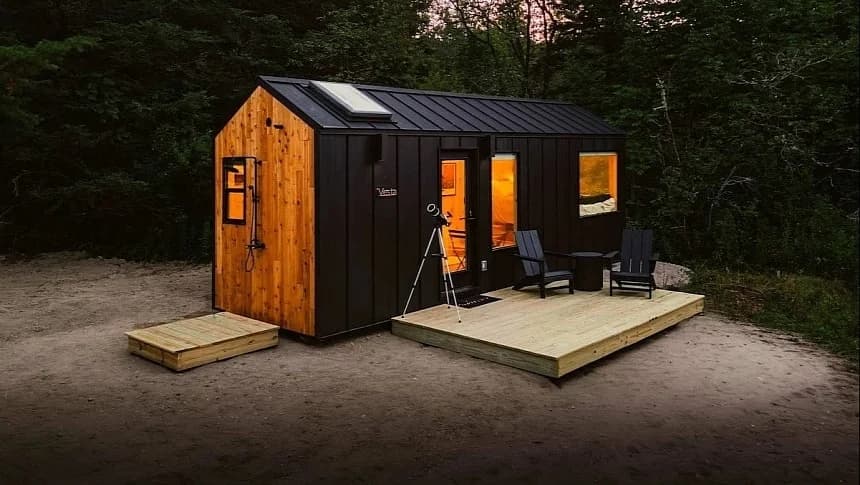
Vesta Nook does not read like another white-box tiny home trying to pass itself off as Nordic. The model, one of the tiny homes offered by Nature Nooks in Sullivan, Maine, leans into Scandinavian design just enough to feel familiar, then breaks the formula with a few deliberate punches of color and contrast. It can sleep up to three guests, thanks to a pull-out sofa and an open bedroom, which tells you right away that this is built as a stay-ready product, not just a pretty shell.
That matters because the tiny-house market has moved past the phase where the only question was whether a builder could cram in a bed, a bath, and a kitchenette. Vesta Nook is selling a point of view: compact, yes, but styled with enough discipline and personality to feel like a finished idea.
What it borrows from Scandinavian design
The Scandinavian part is not window dressing. Britannica describes the style through light, minimalism, functionality, and natural materials, with roots in northern climate and a design culture shaped by restraint rather than excess. Vesta Nook follows that logic with a raw-wood base that gives the interior warmth before anything else enters the frame.
That choice is the anchor. Raw wood keeps the home from feeling sterile, and it gives the rest of the palette something honest to sit against. In a tiny home, that matters more than in a larger house because every finish is louder when the square footage is tight. If the bones are wrong, the whole place feels forced. Here, the bones are doing the heavy lifting.
Where the model breaks from the usual Nordic script
This is where Vesta Nook gets interesting. Instead of staying in soft neutral territory, the interior adds black cabinetry, black window frames, black tapware, and a bright-red retro-style mini fridge. That combination changes the mood fast. The black details sharpen the wood, while the red fridge prevents the place from drifting into the predictable beige-and-oak sameness that has flooded so many Scandinavian-inspired small homes.
That is the best kind of tiny-house twist, because it is not gimmickry for its own sake. It is a controlled departure that gives the home identity. Buyers who want a compact space that photographs well and still feels memorable will see the appeal immediately. The people who usually get burned by “Scandi-inspired” builds are the ones who end up with an over-literal imitation. Vesta Nook avoids that trap by treating Scandinavian design as a foundation, not a template.
The layout is built for actual staying, not just looking
The sleeping setup is straightforward, and that simplicity is part of the appeal. An open bedroom plus a pull-out sofa is an efficient way to stretch the occupancy to three without making the floor plan feel like a puzzle box. There is no sense here that the home is trying to impress with awkward fold-down tricks or overly clever conversions.
The kitchen reinforces that same practical approach. It includes an induction stove, a microwave, a large sink, and self-catering essentials, which makes the home feel like a real hospitality unit rather than a decorative cabin with a hot plate. For tiny-house owners and guests, that means fewer compromises at mealtime and fewer reasons to leave the place feeling underbuilt. The layout works because it does not overcomplicate the basics.
- sleeping for three without crowding the main room
- a kitchen set up for self-catering, not just reheating
- a visual plan that stays open and readable instead of cluttered
- finishes that create character without sacrificing function
If you care about livability, this is the kind of detail that matters most:
That balance between restraint and warmth is exactly where a lot of tiny homes fail. They either go too sparse and feel cold, or they pile on style until the place stops functioning cleanly. Vesta Nook stays in the middle lane, which is where the smarter small-home designs usually win.
Why this tiny house fits the market right now
Vesta Nook also lands at a moment when compact living is being discussed in much broader terms than novelty or trendiness. ArchDaily ties the tiny-house movement to housing crises, homelessness, debt, and downsizing, while also noting that tiny homes can run into legal trouble because zoning and safety rules vary widely. It also points to the International Code Council’s 400-square-foot threshold for what counts as officially tiny, which is useful context when people compare true tiny homes with other compact builds.
That broader housing shift is showing up elsewhere too. The U.S. Department of Housing and Urban Development defines accessory dwelling units as independent living quarters on single-family lots with kitchen and bathroom facilities, attached or detached. In a 2008 case study, HUD noted that reduced regulatory restrictions can benefit communities, and California’s housing department says ADU ordinances have grown exponentially as cities, counties, and homeowners look for ways to increase housing supply. The market is clearly moving toward smaller, more flexible formats.
The National Association of Home Builders has been tracking that same pull toward smaller footprints. In its February 26, 2025 reporting, the median new-home size fell from 2,200 square feet in 2023 to 2,150 square feet in 2024, the lowest level in 15 years. Median lot size also dropped to 8,400 square feet over the same long run, and townhomes reached a record 17% of the single-family market in 2024. That is not a tiny-house story by itself, but it is the same direction of travel: smaller, more personal, more efficient.
Vesta Nook fits that moment because it does not sell smallness as deprivation. It sells a coherent little home with a clear visual language, a workable kitchen, and a sleeping arrangement that feels intentional. The Scandinavian influence gives it calm, the black-and-red contrast gives it personality, and the layout gives it enough livability to justify the price of attention. That combination is what separates a smart tiny home from the endless parade of Nordic-inspired copies.
Know something we missed? Have a correction or additional information?
Submit a Tip