Inside the Soviet synth underground, Polivoks, Formanta and Aelita
Soviet synths were not clones: Polivoks, Formanta and Aelita grew from scarcity and state factories into a separate branch of vintage tone.
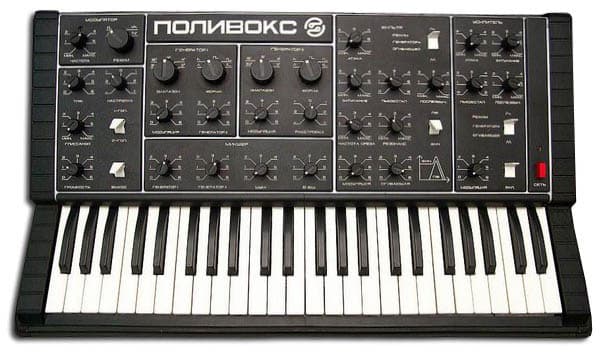
Open a Polivoks, then an Aelita, and the usual Minimoog-to-Juno story stops making sense. The Soviet synth world grew under component shortages, import restrictions and state manufacturing, and those pressures produced instruments with their own voices, their own failures and their own cult following. Polivoks may be the headline name, but Formanta and Aelita show the bigger truth: this was a parallel branch of vintage synthesis, not a bargain-bin imitation.
A different industrial climate
The Soviet instrument landscape was shaped by a planned industrial system, not a free market. Comecon, or CMEA, was established in January 1949 as the Soviet-led economic framework for the Eastern Bloc, and that kind of centralized structure mattered all the way down to how electronic instruments were conceived, built and distributed. When parts are limited, imports are restricted and production is routed through state factories, design stops being an abstract exercise and becomes a series of compromises you can hear.
That is why Soviet synths are interesting even before you get to the sound. Availability of components, research priorities and factory realities pushed builders toward rugged layouts, idiosyncratic controls and electronics that had to work with what was on hand. The former Soviet Union had a thriving synth industry for years, and when the Iron Curtain fell, Western players were surprised to find a real ecosystem behind the iron, not just a handful of odd curiosities.
Polivoks: the machine that defined the myth
Polivoks sits at the center of that story for good reason. It was designed at the Urals Vector plant and produced by the Formanta Radio Factory in Kachkanar, Russian SFSR, with production commonly dated from 1982 to 1990. It is a duophonic analog synthesizer, and one source identifies it as among the first synthesizers produced in the USSR.
The original intent was not to make a quirky Soviet outsider. One account says the Polivoks was meant to sound similar to synthesizers from Roland, Moog and Korg, which tells you how closely Soviet engineers were tracking the outside world even when they could not build in the same ecosystem. In practice, the machine earned a different reputation: Sound On Sound described it as crude, cheaply made and horrible to play, while also admitting that it sounded like nothing else.
That contradiction is exactly why players still chase it. The build can feel rough, the controls can be unforgiving and the instrument does not flatter sloppy technique, but the payoff is the voice, which has a ragged, aggressive edge that sits outside the polished Western canon. If you are buying one today, listen for the filter behavior, the instability and the overall sense that the instrument is fighting back a little.
Formanta as a family, not just a label
Formanta is bigger than the Polivoks nameplate. The same Soviet factory ecosystem also produced other machines that collectors now trade stories about, including the EMS-01, Maestro and P432, and those names matter because they show how broad the Soviet synth effort actually was. In other words, Polivoks was the best-known face of a wider manufacturing culture, not a one-off experiment.
The EMS-01 has become a good example of the restoration side of the hobby. A recent live performance on a restored unit noted that the oscillator sections are very hard to tune and that there are not many fully working, fully tuned examples left in the world. That is the kind of maintenance reality that comes with Soviet gear: documentation is thinner than on Japanese or American classics, repair knowledge is often community-driven and a clean, stable example can be more valuable than a cosmetically prettier one with hidden faults.
That also changes how you shop. A trusted marketplace matters, but completed sales and seller notes matter just as much, because a Soviet synth with replacement wiring, missing hardware or a shaky power section can turn into a long restoration instead of a playable instrument. The appeal is real, but so is the risk.
Aelita: the oddball with a very specific voice
Aelita is the other important name because it reminds you that Soviet design did not all point in one direction. It is often referred to as the Murom Aelita, and sources describe it as a monophonic analog synthesizer manufactured in the Soviet Union in the 1980s. One detailed description calls out three detunable oscillators based on divide-down organ technology, which already tells you this is not a standard Western synth layout.
Visually, Aelita is a beast. It is described as having a massive metal case with colorful horizontal sliders, which gives it a very different physical presence from the smaller, more standardized Western boxes people usually compare it to. Sonically, it has a pronounced, basic character, and one gear forum description is blunt about the payoff: a nasty, sharp, razor-like sound with a mean band-pass filter setting that is unusual compared with most analog synths.
That makes Aelita valuable for different reasons than Polivoks. Polivoks is the famous face, but Aelita shows how Soviet engineers could arrive at a voice through different technical assumptions, especially when divide-down circuitry and organ-derived ideas were in the mix. If you want the sound of Soviet synthesis to make sense in your head, Aelita is the machine that proves there was more than one road to that result.
What collectors should listen and look for now
The best Soviet pieces are not just rare because they came from the USSR. They are rare because they survived a different industrial system, with different maintenance habits, different service documentation and different expectations about finish quality. Ruskeys, the Museum of Soviet synthesizers, has become one of the useful reference points for manuals, sounds and model tracking, which tells you how community knowledge has filled in where factory support never existed.
- power stability and regulator health
- oscillator tuning and calibration drift
- missing sliders, knobs and caps
- hacked or incomplete MIDI retrofits
- evidence of recap work, cleaning and shipping damage
A modern buyer should focus on concrete things:
That practical checklist is part of the fun, because it keeps the mythology honest. A Soviet synth is not automatically better because it is obscure, and it is not automatically inferior because it feels crude. The real question is whether the machine still speaks in the way its designers accidentally or deliberately created.
Behringer’s 2023 Polivoks project with original designer Vladimir Kuzmin shows the point is still alive. Kuzmin remains the key name attached to the instrument, and the continued interest from modern builders says these machines have moved beyond nostalgia into their own lane of design history. That is the correction to the usual Western canon: Polivoks, Formanta and Aelita were not cheap oddities on the side of synth history, they were what synthesis looked like when scarcity, state factories and component limits forced a different kind of invention.
This article was produced by Prism’s automated news system from verified source data, official records, and press releases, then run through automated quality and moderation checks before publishing. The system is built and supervised by the people who set the standards it runs under. Read our full AI policy.
Did this article answer your question?