New book traces yoga’s ties to nationalism, power, and Western appropriation
A new book argues that modern yoga’s global image was built through politics, body culture, and appropriation, not just tradition. That claim is rattling the studio-friendly story many of us know.
A yoga book that refuses the clean studio story
Stewart Home’s *Fascist Yoga: Grifters, Occultists, White Supremacists, and the New Order in Wellness* takes aim at one of the most comfortable myths in modern yoga culture: that what you practice today is a neutral inheritance handed down untouched from an ancient past. The book argues something far messier and far more uncomfortable, that yoga’s global image was shaped by power, nationalism, and Western reinvention, and that the version many people now treat as timeless was built through modern political and cultural projects.
That is why the book is landing as more than a review copy conversation. Across Germany, Spain, the UK, and the United States, readers and critics have been forced to sit with Home’s central claim: modern yoga in the West cannot be cleanly separated from authoritarianism, racial thinking, occultism, and far-right wellness culture. For anyone who came into yoga through a spotless boutique studio or an Instagram-friendly flow, that is a direct collision with the language the industry often uses to sell the practice.
What Home is actually arguing
Scroll.in’s review makes an important distinction right away: Home is not arguing that yoga is inherently fascist, and he is not saying that stepping onto a mat inevitably leads to reactionary politics. That matters, because a lazy reading of the title could make the book sound like a blanket condemnation of the practice itself. It is not that. It is a critique of what has been done with yoga, how it has been repackaged, mythologized, and pressed into service for other agendas.
The review describes Home as an adept yoga practitioner himself, and that long engagement gives the book its edge. This is not the work of someone sneering at the discipline from outside. It comes from someone who has paid attention to how bodies, belief systems, and power move through the same space. That makes the critique harder to dismiss, because it is not built on contempt. It is built on proximity.
The modern yoga story is less ancient than many people think
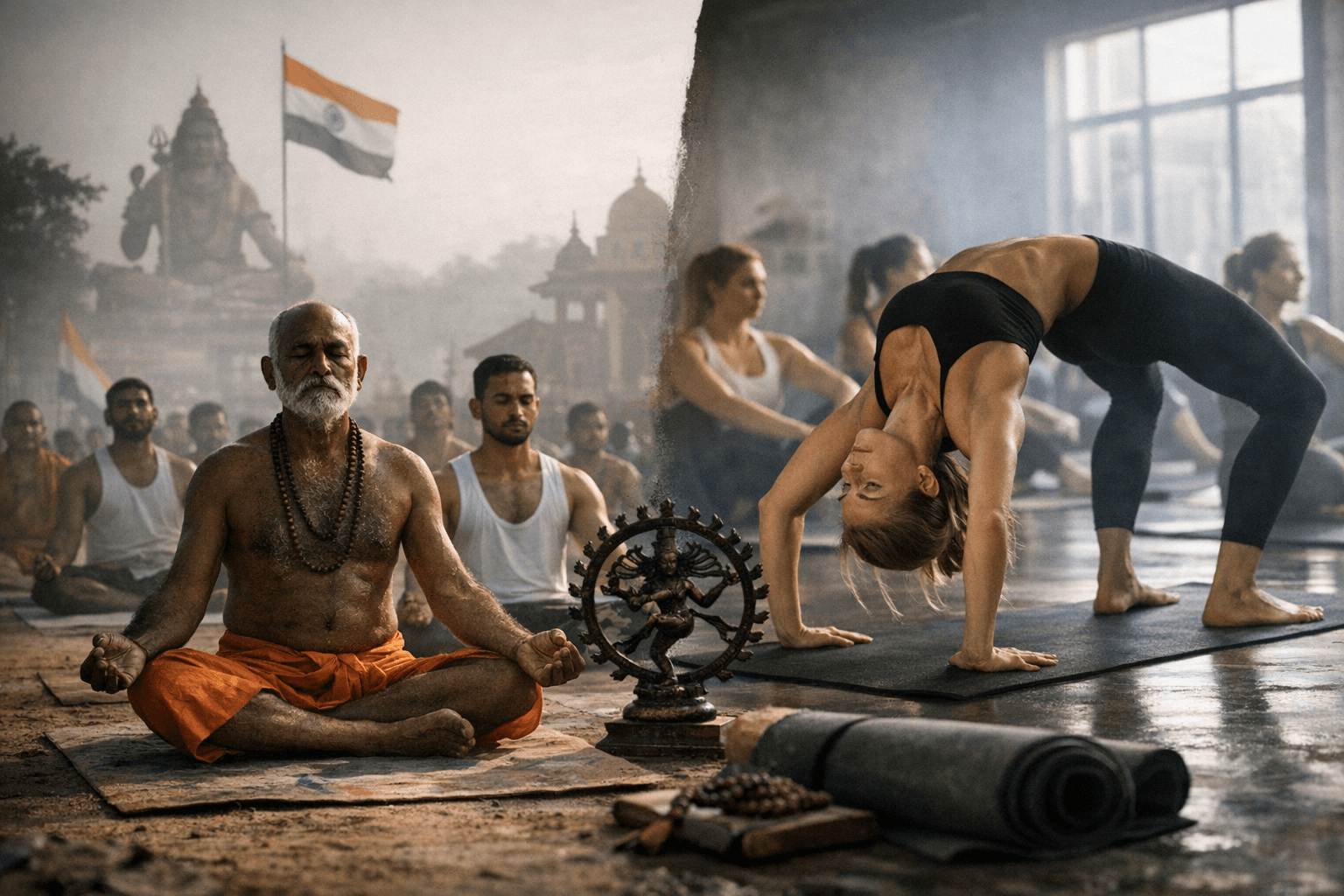
One of the book’s most challenging claims is that much of what is popularly sold as “ancient” yoga is actually a modern hybrid. According to the review, Home traces its reshaping to the late 19th and early 20th centuries, when European physical-culture movements were obsessed with discipline, masculinity, and racial regeneration. In that telling, yoga did not simply survive the modern world. It was recast by the modern world.
That recasting involved more than one influence. The book points to gymnastics, bodybuilding, military drill, and colonial encounters as part of the mix that helped form the body culture now associated with yoga’s global spread. If your mental image of yoga is built around clean alignment cues, athletic sequences, and a self-improvement ethic that sounds suspiciously like a wellness startup pitch, this is the history that explains why. The modern form is not just spiritual inheritance. It is also a product of the same era that obsessed over training, order, and bodies as social instruments.
Why Eugen Sandow sits at the center of the story
Home’s historical architecture gives special weight to Eugen Sandow, the Prussian-born strongman often described as the father of modern bodybuilding. That is not a random cameo. Sandow represents the moment when physical training was framed not only as exercise, but as moral duty and civilizational duty.
That framing is crucial to the book’s argument about modern yoga. Once you start seeing the body as something that can be disciplined into national strength or racial improvement, it becomes easier to understand how physical practices travel across cultures with political baggage attached. Sandow is the bridge between gym culture and a wider ideology of bodily control, and the review makes clear that Home uses him as a central figure in tracing how modern body culture helped shape yoga’s public image.
For mainstream yoga readers, that may be the hardest part to swallow. The studio version of yoga usually presents the body as personal, private, and therapeutic. Home’s history says the body has also been treated as political territory.
Why the book is making reviewers uneasy
The review notes that *Fascist Yoga* has already drawn attention from reviewers in Germany, Spain, the UK, and the United States, with discussion appearing in outlets including Die Welt, El País, The New York Review of Books, The Observer, and The Telegraph. That range matters. This is not a niche dispute confined to one country’s yoga scene. It is a broader argument about how yoga was made legible to the modern West and what ideological freight came along with that translation.
That wide response also tells you something about where the pressure point is. The book is not just challenging the pieties of yoga marketing. It is challenging the habit of treating yoga as a floating, depoliticized lifestyle brand. Once you connect yoga to nationalism, occultism, white supremacy, and far-right wellness culture, the practice stops looking like a sealed-off wellness product and starts looking like a contested cultural form with a long record of being used, borrowed, and repurposed.
Why this matters inside today’s yoga world
The practical value of this book is that it forces a more honest conversation about what gets erased when yoga is sold as universal and apolitical. Modern studios often flatten the history into a feel-good origin story, then strip out the contradictions that made yoga what it is now. Home’s argument pushes back against that flattening by insisting that the story of yoga’s rise cannot be separated from the story of modern power.
Rajesh Thind, the London-based reviewer who is also co-founder of PinduYoga, frames the book from inside the community rather than outside it. That perspective matters because this is not only an academic quarrel. It is a live debate for teachers, practitioners, and studio owners who have to decide whether they are teaching a practice, selling a brand, or inheriting both at once.
The takeaway is not that yoga should be abandoned. It is that the most polished version of yoga, the one that feels easiest to buy, teach, and package, is also the one most likely to hide how it was assembled. Home’s book asks readers to stop confusing sanitization with authenticity. Once that lens is in place, the global yoga conversation gets sharper, less comfortable, and much more honest.
This article was produced by Prism’s automated news system from verified source data, official records, and press releases, then run through automated quality and moderation checks before publishing. The system is built and supervised by the people who set the standards it runs under. Read our full AI policy.
Did this article answer your question?