Seattle unveils first city-hosted Swami Vivekananda statue, honoring yoga legacy
Seattle became the first U.S. city government to host a life-size Swami Vivekananda statue, putting yoga’s Western roots on display in Westlake Square. The unveiling drew regional mayors, diaspora leaders and fresh backlash.
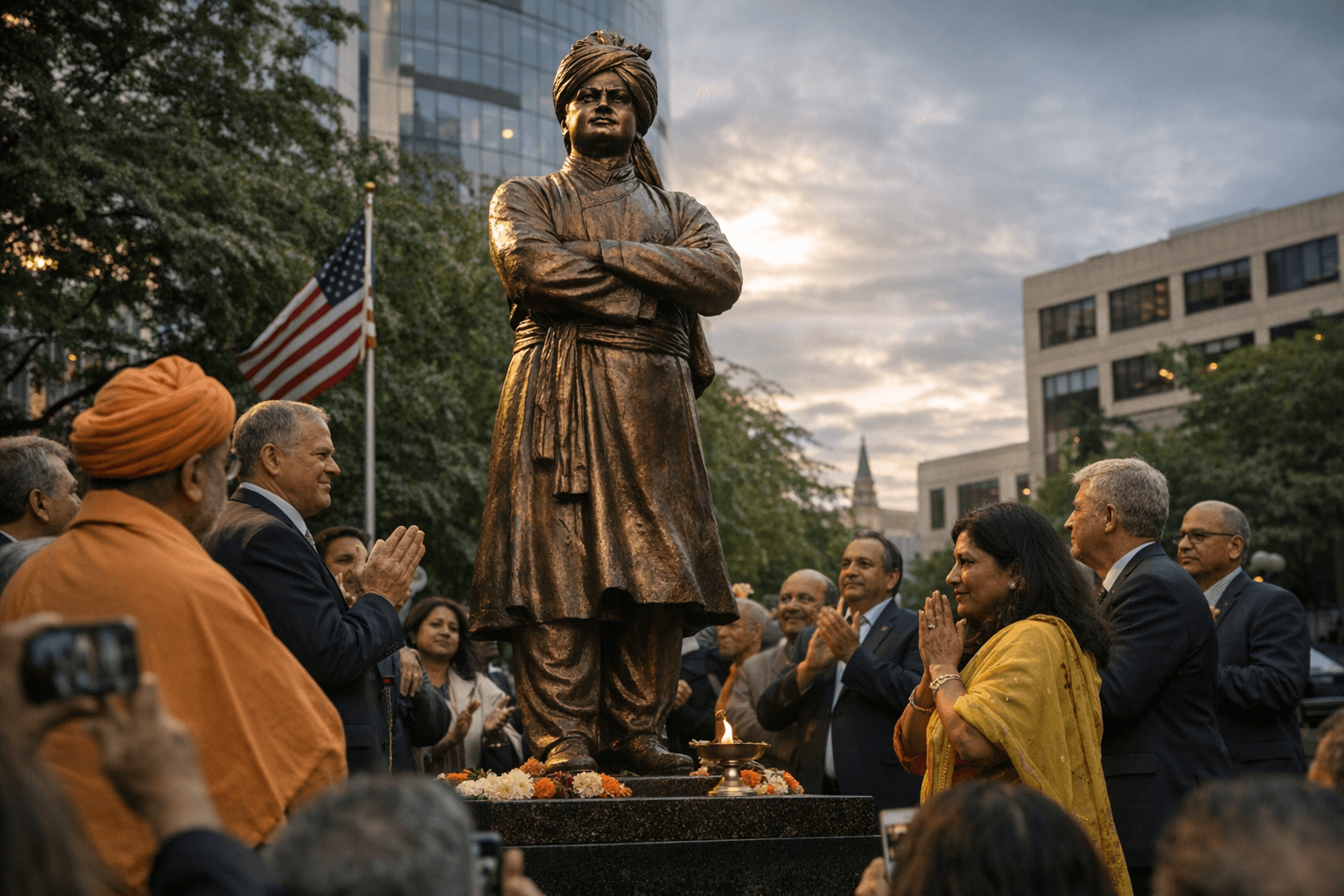
Seattle turned Westlake Square into a civic marker for yoga history with the unveiling of a life-size bronze statue of Swami Vivekananda, the monk widely credited with bringing Vedanta and yoga to Western audiences. The city said it was the first city government in the United States to host a statue of Vivekananda, a claim that gives the monument weight far beyond a typical public artwork.
Mayor Katie Wilson and Prakash Gupta, the Consul General of India in Seattle, jointly unveiled the statue on April 11 at Westlake Square, also known as Westlake Park, in downtown Seattle near Westlake Avenue, 6th Avenue and Stewart Street. The site is not a quiet corner. The consulate says the plaza records more than 400,000 visits a day and draws millions of people each month, placing the monument in one of the city’s most visible public spaces.
The statue was a gift from the Indian Council of Cultural Relations to the City of Seattle and was unveiled on ICCR Day, tying the ceremony to India’s broader cultural diplomacy push in the Pacific Northwest. Seattle Parks and Recreation worked with stakeholders to fit the monument into the urban landscape, while the location itself reinforces the city’s attempt to treat the statue as part of public memory, not just an ornamental installation.
The turnout reflected that civic framing. Mayors Dana Ralph of Kent, Nancy Backus of Auburn, Tom McLeod of Tukwila, Eric Zimmerman of Normandy Park and Kelly Curtis of Kirkland attended, along with members of city councils from Bellevue, Bothell, Dupont and Redmond. Community leaders from the Indian American diaspora were also present, underscoring how the unveiling landed as both a local event and a regional gathering.
Vivekananda, who lived from 1863 to 1902, remains best known for his 1893 address at the Parliament of Religions in Chicago, where he spoke on universal brotherhood and religious tolerance. That history is what makes this statue resonate for yoga people: it pushes the story of yoga in the United States back before studios, leggings and fitness branding, and back toward philosophy, Vedanta and immigrant identity.
The monument was sculpted by Indian artist Naresh Kumar Kumawat, whom the consulate says has more than 600 installations in more than 80 countries. Not everyone welcomed it. Some MAGA supporters attacked the installation as a “meaningless civic gesture,” giving the statue a sharper political edge as Seattle places a foundational figure of yoga history into one of its busiest public squares.
This article was produced by Prism’s automated news system from verified source data, official records, and press releases, then run through automated quality and moderation checks before publishing. The system is built and supervised by the people who set the standards it runs under. Read our full AI policy.
Did this article answer your question?