שואב 3 ב-1: רובוט, מוט וידני באותו גוף
The eufy E20 tries to replace a robot, a stick vacuum and a handheld in one body. The real test is not the spec sheet, but whether that modularity saves space and hassle in a small Israeli home.
A 3-in-1 vacuum only matters if it makes daily cleaning simpler
eufy’s E20 is not interesting because it has another flashy spec. It is interesting because it tries to answer a very practical problem in Israeli homes: too many cleaning tools, too little storage, and too much friction when a quick job turns into a hunt through the closet. The pitch is simple, and blunt enough to matter: one device that can act as a robot vacuum, a stick vacuum and a handheld in the same body.
That idea landed in Israel through Hamilton, the official eufy importer, alongside the E25 and E28. The local launch positioned the series as premium, with smart docks, app control and AI-based obstacle detection, and prices in Israel started at 2,799 shekels. For a small apartment in Tel Aviv, a crowded family home in the Sharon or a rental flat in Jerusalem, the question is not whether the concept is clever. It is whether it actually replaces three separate devices without turning cleaning into a more complicated ritual.
What the E20 actually changes in daily use
How the 3-in-1 FlexiONE system works in real life
The E20 uses eufy’s FlexiONE modular system to switch between robot mode, stick mode and handheld mode. In robot use it delivers up to 8,000Pa, while in stick or handheld use it reaches up to 30,000Pa. That is a meaningful gap, and it shows the product’s logic: autonomy for routine floor cleaning, more muscle when you take control.
The dock is part of the point, not an afterthought. eufy says the auto-empty station works in every mode, so the bin management stays centralized instead of spreading across separate devices. In a small home, that matters as much as suction numbers. If a device takes up one charging station, one dust bin routine and one maintenance flow, it is much easier to live with than a pile of overlapping appliances.
Where the modular approach helps and where it slows you down
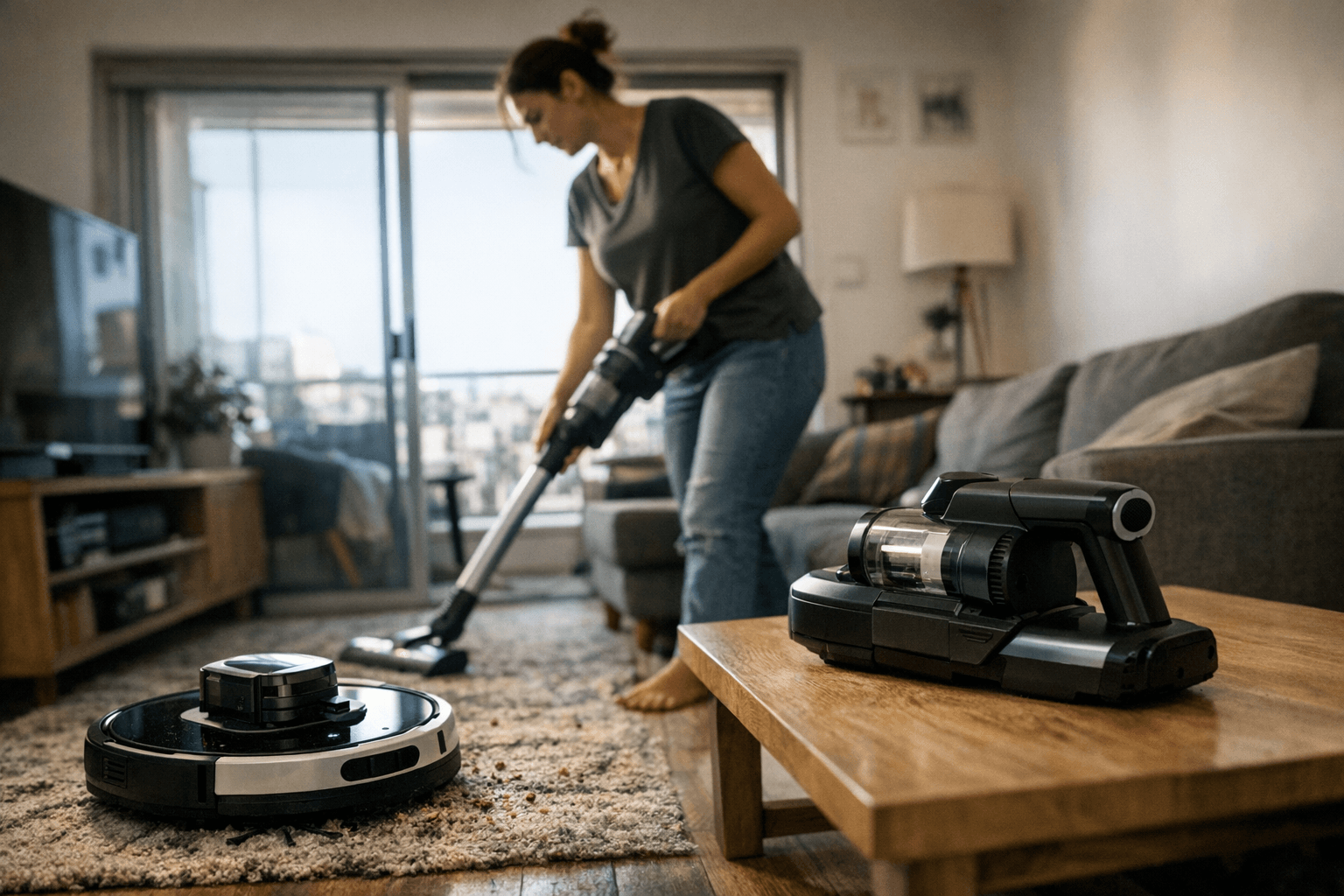
The strongest argument for the E20 is convenience. A robot vacuum handles the open floor, then the stick mode can deal with crumbs by the kitchen counter, and the handheld reaches shelves, sofa corners and tight spots. That is exactly the workflow many homes end up using anyway, except usually with three different machines and three different batteries.
The tradeoff is that modularity adds decision-making. You need to detach, reattach and carry the unit between tasks, and that can be a real nuisance if the family wants a fast cleanup after dinner. A standard robot stays on the floor and does one job. A separate handheld stays ready for spot cleaning. The E20 asks the user to accept a little more complexity in exchange for less storage and less duplication.
| Use case | E20 advantage | Tradeoff |
|---|---|---|
| Open floors | Robot cleans on its own | Lower power than manual mode |
| Kitchen crumbs | Stick mode adds reach | Requires switching modes |
| Sofa, shelves, corners | Handheld mode is flexible | More handling and setup |
| Small storage space | One body instead of three devices | More complex unit overall |
Why the E20 fits small Israeli homes better than big ones
Why storage is the hidden selling point
In Israel, space is the real luxury item. Many homes do not have a utility room, and even the standard storage closet gets crowded fast. A modular vacuum can make sense precisely because it collapses three purchases into one footprint. That is a much more concrete benefit than marketing language about innovation.
The E20 also helps when the house has stairs, narrow hallways or furniture-packed rooms. A robot alone cannot solve those spots, and a standalone stick vacuum still leaves you with another object to store and charge. Here, the appeal is not just “smart home” polish. It is reducing the amount of equipment that has to live in the apartment.
What the suction numbers say about performance
The headline figures are aggressive for the category. eufy says the E20 reaches up to 30,000Pa in handheld and stick use, and up to 8,000Pa in robot mode. That difference is exactly what you would expect from a hybrid design. The robot side is built for routine maintenance; the manual side is built for more stubborn dirt.
The five-stage AeroTurbo filtration system is another useful part of the package. eufy says it captures 99.97% of particles down to 0.3 microns, which puts it in the serious-cleaning camp rather than the toy-gadget camp. For allergy-sensitive households, that is not a decorative detail. It affects how much dust gets reintroduced into the air after cleaning.
The maintenance question: is one body easier than three devices?
Battery, charging and day-to-day upkeep
eufy says the E20 fully charges in about 2.5 hours and charges 40% faster than competing models. It also claims coverage of up to 1,500 square feet on a single charge. That is a useful range for larger apartments and compact houses, but the real point is not battery bragging rights. It is whether the device is ready when the family needs it, not only when the schedule allows it.
The Pro-Detangle Comb mechanism is also practical, not glamorous. Hair wrapped around a brush is one of the most common frustrations with vacuum ownership, especially in homes with pets or long hair. If the brush stays cleaner and needs less manual untangling, the whole concept becomes much more believable.
Does it replace three devices or just pretend to?
This is where the E20 earns its value test. If someone already owns a good robot vacuum and a decent handheld, the E20 has to justify itself with space savings and smoother upkeep. If the home is small, the closet is already full and the family keeps shifting between floor cleaning and spot cleaning, the logic is much stronger.
The E20 is less convincing as a gadget for people who enjoy specialization. It is more convincing for people who want one platform that can move from routine cleaning to targeted cleanup without buying into a full ecosystem of separate machines. That is why the product feels more relevant in Israel than it might in a bigger home with abundant storage. The local use case is tighter, and the benefit of consolidation is easier to feel.
How it compares with buying a robot and a handheld separately
The cost side of the equation
At launch, the E20 carried a price of $549.99 in the US, with local Israel pricing starting at 2,799 shekels for the series. That puts it in premium territory, but not absurd territory for a serious robot. The real comparison is not “one expensive device versus one cheap device.” It is one expensive device versus a robot plus a handheld plus the storage and charging mess that comes with both.
That is why the E20 makes the most sense when the user is already planning to buy multiple tools. If the budget is fixed and the home is small, the modular model can be smarter than spreading money across separate appliances. If the goal is only floor cleaning, a conventional robot is still simpler.
Why the CES recognition matters, but only a little
The E20 was introduced at CES on January 6, 2025, and earned Best of Innovation recognition in the Home Appliances category for 2025. That tells you the industry sees the concept as more than a stunt. It also explains why eufy calls it the first detachable robot vacuum in the category.
Still, awards do not clean floors. What matters is whether the modular idea survives daily Israeli life: quick breakfast messes, sand tracked in from outside, tight storage rooms and a constant need to do small cleaning jobs fast. That is the bar the E20 has to clear.
E25 and E28 set the range, but the E20 defines the idea
Why the rest of the lineup matters
The E25 and E28 help explain the strategy. They arrived with smart docks, app control and AI obstacle detection, and the E28 adds a detachable dock that can also clean fabric, sofas and upholstery. That widens the story from one hybrid vacuum to a broader attempt to make cleaning systems more integrated.
But the E20 is the clearest expression of the idea. It is the model that asks the most direct question: do you really need separate appliances for the robot, the stick and the handheld, or is that just how the market has trained you to buy? In a compact Israeli home, the answer may tilt toward consolidation, as long as the user accepts a little more complexity in exchange for less clutter.
שאלות נפוצות
Is the E20 better than buying a robot vacuum and a handheld separately?
If the home is small and storage is tight, the E20 has a real advantage because it folds three functions into one body. If the user wants maximum simplicity in each task, separate devices are still easier to live with.
Does the E20 clean as well in robot mode as in manual mode?
No. eufy gives it up to 8,000Pa in robot mode and up to 30,000Pa in stick or handheld use, so the manual modes are built for stronger spot cleaning. The robot mode is for routine floor maintenance.
What makes the E20 relevant for Israeli apartments?
The biggest issue is space. Many homes in Israel do not have room for three separate cleaning devices, and the E20 cuts down on storage, charging clutter and duplication.
Is the auto-empty dock useful in all modes?
Yes. eufy says the auto-empty station works in every mode, which makes the system more practical because dust handling stays consistent whether the unit is being used as a robot, stick or handheld.
יודעים משהו שפספסנו? יש לכם תיקון או מידע נוסף?
שלחו טיפ