AI citations favor listicles across major models, study finds
AI search may look futuristic, but the data says old-school listicles still win the citation game. Across nearly 400 million citations, models keep reaching for tightly structured comparison pages.
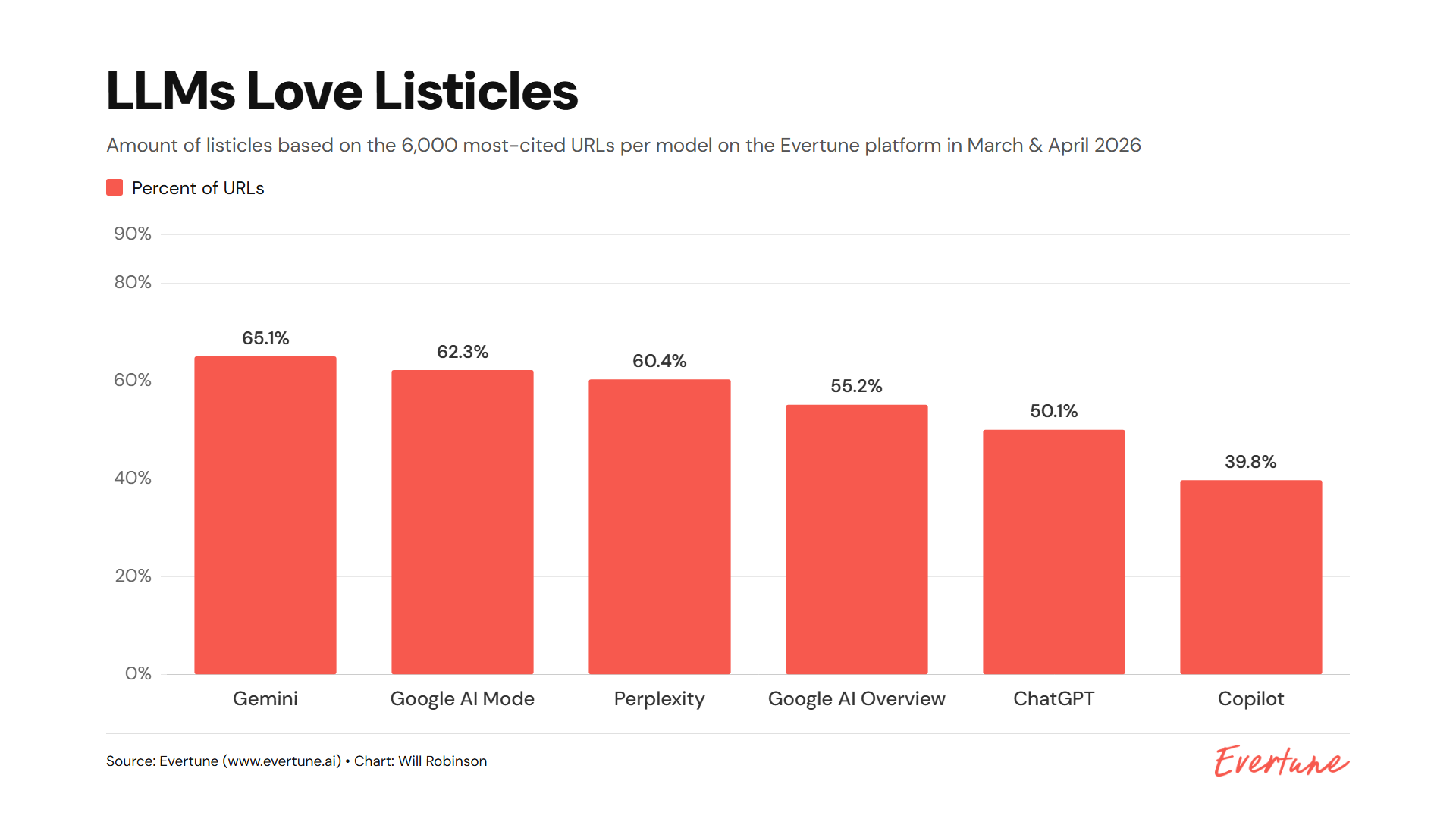
The most useful thing this study reveals is also the least glamorous: AI search keeps rewarding the format marketers have been using for years. Across ChatGPT, Copilot, Gemini, Google AI Mode, Google AI Overview, and Perplexity, the 6,000 most-cited URLs per model in March and April 2026 produced a clear pattern. Half of the roughly 25,000 unique URLs were listicles, and 63% of nearly 400 million citations pointed to them.
That is the counterintuitive takeaway worth sitting with. Brands love to talk about narrative, authority, and thought leadership, but the models are showing a stronger appetite for compact, structured pages that reduce uncertainty fast. Evertune, the research and marketing platform behind the analysis, says it tracks hundreds of brands across 250 categories across major large language models, and its findings suggest that AI visibility is still being shaped by format as much as by brand strength.
Why listicles keep winning
Listicles are not just common in the dataset. They are dominant across the board, accounting for 40% to 65% of the most-cited URLs depending on the model, with Copilot at the low end and Gemini at the high end. The reason is not mysterious once you look at how these systems answer recommendation queries. Listicles are tightly focused, easy to parse, and built for head-to-head comparison, which makes them a natural fit for searches where the user wants rankings, options, or buying guidance.
That matters because recommendation intent is where listicles shine the most. When someone asks for the best project management tool, the best running shoe, or the best grill under a certain budget, a good listicle gives the model a ready-made structure: features, price, materials, use cases, pros, and tradeoffs. In practice, that means the page is doing two jobs at once. It helps the user decide, and it gives the model a cleaner source to cite.
The format also appears to be broadly useful across the model landscape, not just in one corner of it. The analysis found listicles heavily represented across every system studied, and ranked lists made up the majority of the format. That is a useful reminder that AI citation behavior is not random. It tends to favor pages with a clear spine, visible comparisons, and obvious decision support.
What this means for brand content
If you are trying to influence AI search visibility, the lesson is not to flood the web with generic “best of” pages. It is to build pages that map cleanly to the way models compare options. The strongest pages in this class usually do a few things well: they answer one question, stay tightly scoped, and make the comparison structure obvious from the top of the page.
The broader source mix in the study also matters. Corporate, earned media, and affiliate domains were the top sources, which suggests AI systems are pulling from a blend of editorial, commercial, and authoritative pages rather than leaning on one publisher type alone. That is good news for brands that can publish genuinely useful decision pages, but it also means the bar is higher than simply stuffing a page with keywords and a few product names.
A practical way to think about it is this:
- Build pages around a single comparison job, not a broad topic dump.
- Use headings that mirror the query language people actually use.
- Put the key criteria early, including price, features, and use case.
- Keep rankings and recommendations defensible, not decorative.
- Make sure the page is useful even if the model only extracts the top section.
The wider research says the same thing in different ways
This listicle-heavy result lines up with other recent studies on AI citations. A March 24, 2026 analysis found that listicles, articles, and product pages drove 52% of citations across 75,000 AI answers, which reinforces the idea that format and intent are doing a lot of the work. A separate April 16 study from AirOps found that the top retrieval result was cited 58.4% of the time, and that pages between 500 and 2,000 words performed best. That is not a call for verbosity. It is a warning against bloated pages that bury the answer.
The same theme shows up in content ordering. A February 18 study found that 44.2% of ChatGPT citations came from the first 30% of content. That means front-loading matters. If the comparison, the answer, or the core recommendation sits too far down the page, the model may never get there. The cleanest pages in this space are the ones that expose the decision logic early, then support it with detail below.
There is also a warning label attached to the tactic
Listicles are powerful, but not all listicles age well. A February 4 report noted that some SaaS brands saw visibility drops of 30% to 50% after leaning too heavily on self-promotional “best of” listicles. In those cases, the problem was not the format itself. It was the execution. Lightly refreshed pages chasing recency signals, especially those padded with “2026” in the title and little else, looked vulnerable once search systems started getting better at spotting thin promotion.
That tension is the real story here. The format is still strong, but the system is getting pickier. A shallow listicle can win attention for a while, then lose trust fast if it feels self-serving or underdeveloped. The pages most likely to last are the ones that behave like real comparison tools, not marketing wrappers.
The ecosystem is broader than listicles alone
One more recent study helps put the pattern in context. A March 31 analysis found that Reddit was the most-cited domain in AI-generated answers, followed by YouTube and LinkedIn. That does not weaken the listicle finding. It shows that AI citation systems draw from different source types depending on the question. Community posts, video, professional profiles, product pages, and listicles all have a role, but they tend to win in different query environments.
For brands, the clear takeaway is that AI search visibility is now an information-architecture problem. The pages that get cited most often are narrow, structured, and directly useful for a specific intent. The old-school listicle still works because it gives both the model and the reader exactly what they want: a clean comparison, a fast decision, and fewer reasons to hesitate.
Know something we missed? Have a correction or additional information?
Submit a Tip