Barcelona superblocks boost walking and activity, study finds
Barcelona's superblocks trade car lanes for usable public space, but a St. Antoni study shows the fitness payoff depends on how people actually use the streets.
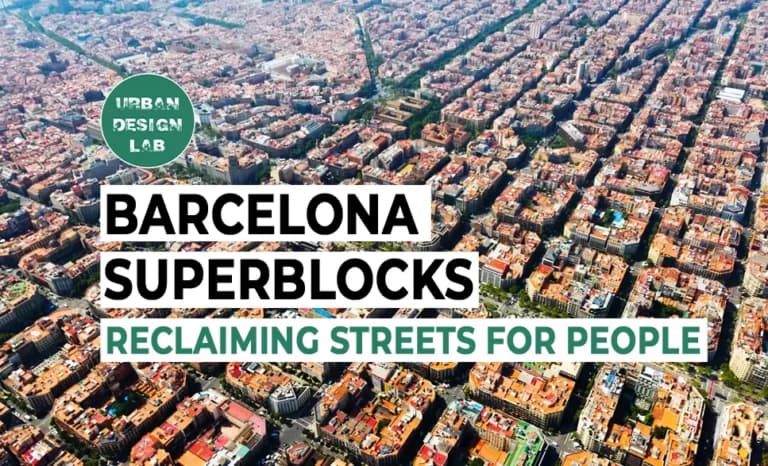
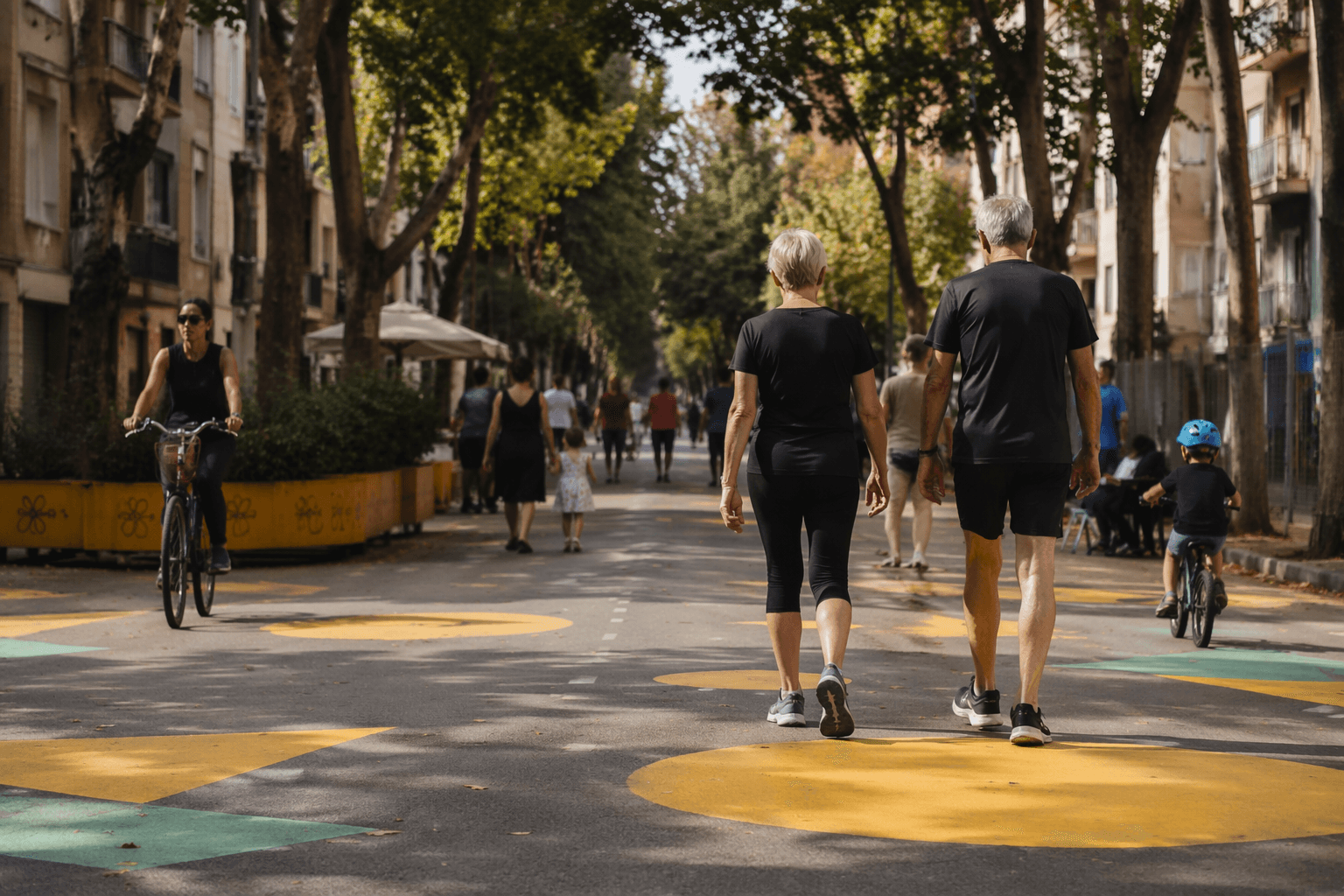
St. Antoni Market Square is the clearest place to see what Barcelona’s superblocks are trying to do: turn road space into places to walk, stand, talk, and move. The city has been unusually explicit about that goal: healthier, greener, fairer, safer public space that also supports social ties and the local economy. The real test is not whether the streets look calmer, but whether people actually use the reclaimed ground in ways that add movement to daily life.
What Barcelona is trying to change
Barcelona’s Superilles programme is built around a simple idea: take space back from private vehicles and make it work for people. In the Eixample, the aim is for residents to have a square or green street within 200 metres of home, with more meeting and relaxation spaces concentrated in the district center. The model is bigger than a one-off pedestrian makeover. It is a neighborhood-scale attempt to make walking and lingering the default, not the exception.
The practical part matters. Superblocks only affect fitness if the street network makes short trips easier on foot, gives people somewhere to stop without feeling pushed aside, and reduces the friction that keeps older adults, teenagers, and parents with kids from using public space.
How the St. Antoni study measured movement
At St. Antoni Market Square, researchers used the System for Observing Play and Recreation in Communities, known as SOPARC, to record sitting, standing, walking, vigorous activity, and e-scooter use. They tracked the site across five weekly observation points, the opening week and then at three, five, eight, and twelve months, with a comparison site observed at one year.
A neighborhood can look busier and still not produce more movement; it can also look calmer while becoming a far better place for low-intensity activity. SOPARC captures ordinary behavior such as crossing through, pausing, talking, sitting on the edge, and moving through the square multiple times a day.
What changed on the ground in St. Antoni
The headline numbers are more complicated than a simple “more exercise” narrative. At baseline, observers recorded an average of 2,340 citizens per hour using the superblock. That figure fell 12% in the next three observation weeks and 17.6% after one year, with the biggest declines among elderly people and teenagers. Walking activity also dropped, from 2,170 citizens per hour at baseline to 1,930 after one year, an 18.2% decline. Vigorous physical activity slipped as well, from 73 citizens per hour to 65, an 11% fall.
Barcelona’s design alone did not automatically increase measured activity over time. The comparison site showed similar walking and vigorous-activity patterns.
Why Sant Antoni became the clearest example
Sant Antoni shows what the reclaimed space looks like in concrete terms. The neighborhood regained 24,000 square metres for local people in 2017. The market area includes a 1,800-square-metre square and two small triangular plazas, which together create 5,000 square metres of pedestrian space around the market.
The mobility data show the same thing from another angle. Sant Antoni produced an average traffic reduction of 17%, rising to 83% on Carrer Comte Borrell. Pollution fell 40% at the Comte Borrell/Tamarit junction, and noise dropped by 2.5 to 4 decibels depending on the time of day. WHO reported a 25% decrease in NO2 and a 17% decrease in PM10 around Sant Antoni, alongside improved well-being, tranquility, sleep quality, and social interaction among residents and workers.
- A pedestrian square large enough to host lingering, not just passing through.
- Small plazas beside a market, where short stops and repeated crossings happen naturally.
- Traffic reduction on perimeter streets, especially where vehicle flow once cut through the neighborhood.
- Lower speeds on local streets, which make walking and informal movement feel safer.
The bigger public-health bet behind the model
The superblock idea did not appear overnight. The concept has existed since the 1980s and was proposed by urban planner Salvador Rueda. Barcelona gave it political force in 2016 with the local measure “Omplim de vida els carrers,” and the first modern pilot appeared in Poblenou that year, followed by Sant Antoni in 2018. Barcelona’s public-health work has since extended into three neighborhoods, Poblenou, Sant Antoni, and Horta, through the Salut als Carrers project.
The long-range vision is even larger. A 2024 review found that the original proposal envisioned 503 superblocks citywide, built around a traffic hierarchy with perimeter streets at about 30 km/h and local streets at 10 km/h. ISGlobal estimated that fully implementing the original proposal could prevent 667 premature deaths each year and generate 1.7 billion euros in annual savings, while WHO said the wider health gains could prevent almost 700 deaths a year.
Why the debate is still alive
The public-health case is strong, but the political and spatial trade-offs are still real. The same studies that found better rest, less noise, cleaner air, and more social interaction also identified unresolved questions about displaced traffic, surrounding streets taking more pressure, and equity. One academic study examined the political cost of superblocks in the 2015 and 2023 local elections.
This article was produced by Prism’s automated news system from verified source data, official records, and press releases, then run through automated quality and moderation checks before publishing. The system is built and supervised by the people who set the standards it runs under. Read our full AI policy.
Know something we missed? Have a correction or additional information?
Submit a Tip