Monday.com bets on AI that understands business context and execution
Monday.com is betting that AI wins when it knows the workflow, not just the prompt. The edge now is context, permissions, and execution.
The next AI battle in workplace software is not about who has the slickest interface. It is about which system knows enough about a business to act safely, usefully, and at the right moment.
That is the strategic divide Christian Klein put his finger on in SAP’s recent argument: enterprises do not run on prompts, they run on execution. A chatbot that can answer a question is useful; an AI that understands inventory reroutes, liquidity exposure, approvals, and policy tradeoffs is something closer to infrastructure. For monday.com, that is the right frame for understanding why the company has turned itself into an AI Work Platform rather than just another work-management app with an assistant bolted on.

Context is the product
SAP’s examples are telling because they are so ordinary in enterprise terms. A global manufacturer trying to reroute inventory during a supply-chain disruption does not need a generic reply, it needs operational context. A CFO looking at liquidity exposure in volatile markets does not need a summary of definitions, it needs an AI that understands where the numbers came from, what the dependencies are, and what decisions are already in motion.
That is the criticism underneath the current AI boom: tools can generate activity without creating progress. They can produce text, tickets, and drafts, but still leave the real work untouched if they are disconnected from the business rules that govern permissions, sequence, and accountability. For a company like monday.com, which lives inside that messy middle layer between strategy and execution, that is not an abstract argument. It is the product thesis.
What monday.com changed
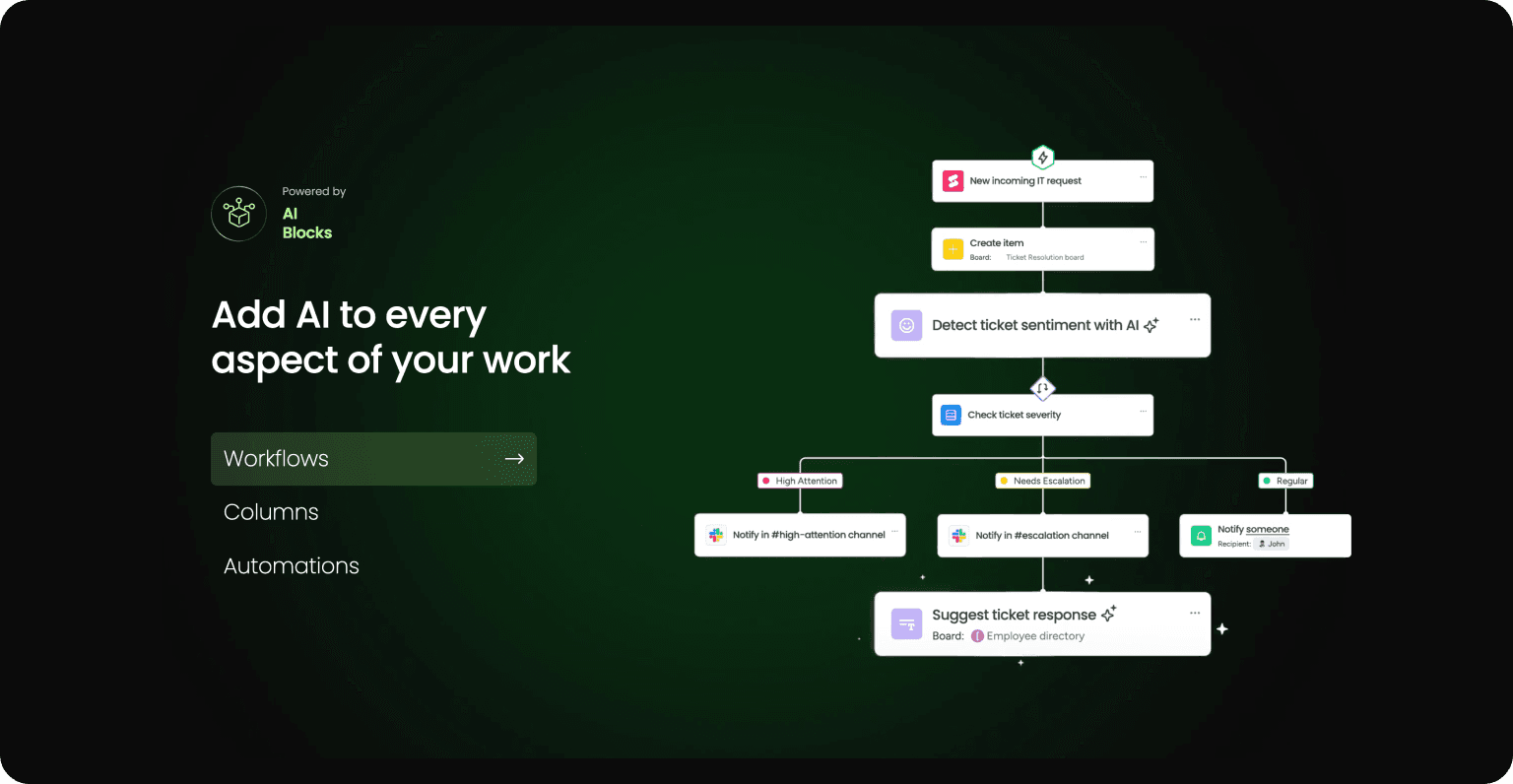
monday.com said on May 6 that it made “the most significant change in its history” when it relaunched as an AI Work Platform. The company’s pitch is not that AI should sit on top of work management, but that it should sit inside it, drawing on live data across departments, workflows, and priorities while staying inside the same permissions, security, and governance the business already trusts.
The use cases are broad but not random. monday.com says the platform is designed to help teams draft campaigns, qualify leads, close support tickets, onboard new hires, and process purchase requests, all under human supervision. That matters because the company is not selling AI as a one-off productivity hack. It is trying to position AI as a layer that can actually move work forward across marketing, sales, operations, and HR without forcing teams to leave the system they already use.
The timing is also important. monday.com says it has 250,000 customers worldwide, and it framed the relaunch as a response to a wider enterprise gap: while access to AI has broadened by 50%, only 25% of enterprises have moved 40% or more of their experiments into production, and just 34% are using AI to transform their businesses deeply. In other words, plenty of companies are experimenting; far fewer are getting to dependable execution.
Why the March infrastructure matters
The more technical shift came earlier, on March 11, when monday.com introduced infrastructure that lets AI agents sign up, authenticate, and operate directly inside the platform. That is a bigger change than adding a chat panel or letting an assistant generate summaries. It means agents can enter the system through a dedicated flow, update workflows, trigger automations, generate reports, and coordinate work across teams.
For engineers, that is the difference between a demo and a platform. If an agent is going to do useful work, it needs permissioning, memory, workflow awareness, and a clean way to inherit the business’s existing controls. monday.com is effectively arguing that agent software should not live in a parallel universe of integrations and brittle handoffs. It should be agent-ready at the platform layer.
The company also said the platform is designed to work with leading agents and frameworks including Claude, ChatGPT, Copilot, Gemini, Perplexity, Cursor, OpenClaw, and Grok. That broad compatibility hints at the competitive reality monday.com is navigating: customers will not live in one model ecosystem forever, so the value has to come from the work system itself, not from allegiance to a single assistant brand.
What this means for product teams
For product managers, the important question is not whether AI can produce content faster. It is whether the outputs are trustworthy enough to use inside an actual business process. monday.com’s launch makes that answer depend on live data, cross-functional context, and governance, which is exactly where many AI products fall apart.
The company’s own financials suggest it is trying to prove that this is more than a narrative shift. In the first quarter of 2026, monday.com reported revenue of $351.3 million, up 24% year over year. It also reported GAAP operating income of $19.8 million, non-GAAP operating income of $49.0 million, and adjusted free cash flow of $102.8 million. Paid customers with more than 10 users reached 65,016, and net dollar retention was 110%.
Those numbers matter because they show a platform with room to invest while still growing efficiently. Management also said AI productivity gains inside the company are allowing revenue growth without headcount growth in lockstep. That is the kind of sentence Wall Street likes, but it also captures the operational tension every product team now faces: AI should make the company faster, not just louder.
Why sales teams should pay attention
For sales, the message is that enterprise buyers are getting more specific about what AI must do before they will trust it. They are no longer impressed by a flashy interface alone. They want to know whether the tool understands governance, compliance, decision-making layers, and the operational consequences of an action taken by an agent rather than a person.
That is why monday.com’s move to consumption-based pricing matters. In its first-quarter earnings commentary, the company said the shift to seats-plus-credits pricing is meant to match AI usage, and CFO Eliran Glazer tied that model directly to the AI Work Platform and the quarter’s momentum. The company also guided full-year 2026 revenue to $1.466 billion to $1.475 billion, signaling that it sees AI not as a side feature but as a core driver of expansion.
The broader competitive backdrop only sharpens the point. At SAP Sapphire, Christian Klein told a 30,000-person in-person and virtual audience that he was launching a new SAP Business AI Platform as part of an Autonomous Enterprise vision, with humans setting direction and AI executing with governance at every step. SAP also highlighted deeper partnerships with Anthropic, Amazon Web Services, Google Cloud, Microsoft, NVIDIA, and Palantir. That is the market signal monday.com has to answer: enterprise AI is becoming a systems-level contest, not a chatbot contest.
For monday.com, the opportunity is to win on the part of AI that is hardest to fake. Not the prettiest surface. Not the most fluent answer. The system that knows the work, respects the rules, and turns information into execution.
Know something we missed? Have a correction or additional information?
Submit a Tip