monday.com teams should stop guessing, use prioritization frameworks to rank work
monday.com’s growth makes guessing expensive. The right framework turns roadmap fights into visible tradeoffs across value, effort and capacity.
Why the roadmap needs discipline, not intuition
At monday.com, prioritization is not a process nicety. It is how a fast-growing, public company decides which ideas deserve scarce engineering time when customers, sales, executives, and product leaders are all pushing on different clocks. Atlassian’s core point holds up well here: a prioritization framework helps teams rank ideas by impact, effort, and alignment with business goals, instead of letting the loudest request win.
That matters even more inside monday.com because the company is no longer a single-product startup making one roadmap bet at a time. Founded in 2012 by Roy Mann and Eran Zinman, it launched its platform in 2014 and went public on Nasdaq on June 10, 2021. Since then it has grown into a multi-product business with about 2,900 employees, more than 250,000 customers, users in 200+ countries and territories, and more than 2 million board actions happening every day.
What a prioritization framework actually does
The point of a framework is not to create a perfect score. It is to make tradeoffs visible. When a team writes down why one item ranks above another, it forces the conversation out of gut feel and into shared criteria: customer value, strategic fit, delivery cost, and capacity.
At Atlassian, the recommended approaches include RICE, Kano, MoSCoW, value versus effort, opportunity scoring, and cost of delay. Each one solves a different decision problem, which is why the “best” framework is the one that matches the choice you are trying to make.
RICE works when the numbers are real enough to compare
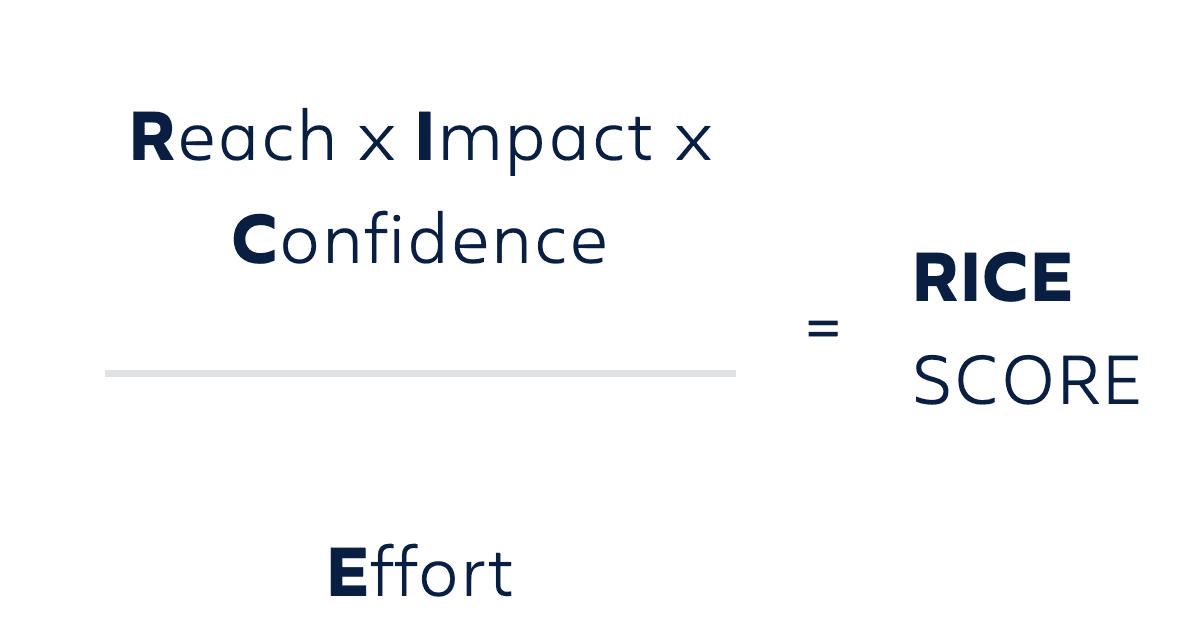
RICE is the clearest fit when a team can estimate reach, impact, confidence, and effort with some credibility. It helps engineering and product leaders compare features that may all sound urgent, but do not carry the same return per unit of work.

The catch is that RICE only works when the inputs are honest. If reach is guessed, impact is inflated, or effort is hand-waved, the score becomes a way to decorate a bias instead of challenging it. In a company like monday.com, where a single product line can scale across thousands of customers and many use cases, that kind of fake precision can be more dangerous than no score at all.
MoSCoW is useful when alignment matters more than precision
MoSCoW, with its must-have, should-have, could-have, and won’t-have buckets, is better when the real problem is stakeholder alignment. It is less about math and more about creating a common language across teams that may not agree on the same deadline or the same definition of urgency.
That matters in monday.com’s environment because product, sales, and leadership can all optimize for different outcomes. Sales may want a feature that helps close a quarter. Product may want the change that improves adoption across the platform. Executives may care most about the product that protects growth and ARR. MoSCoW can surface those disagreements early, but it can also become a bargaining table if every request gets promoted to “must-have.”
Value versus effort keeps the team honest about capacity
Value versus effort is the simplest framework, and sometimes the most useful one. It helps teams ask a blunt question: does this item create enough user or business value to justify the engineering cost?
That is a strong fit for teams that need to move quickly without pretending every idea deserves the same investment. It also helps product managers defend the roadmap when a flashy request would consume a large amount of capacity for little payoff. At monday.com, where the platform spans work management, CRM, software development, and services, value versus effort can keep each product line from overclaiming the same resources.
Opportunity scoring and Kano are better when the user story is the real signal
Opportunity scoring is useful when teams want to understand where customer pain is highest and where an unmet need could open a meaningful gap. It works best when the product team has enough customer feedback to compare demand against satisfaction.
Kano becomes valuable when the question is not just what customers ask for, but what they will notice as a basic expectation versus a real delight. That distinction matters in mature SaaS products, where many features no longer differentiate the company, but missing table-stakes functionality can still trigger churn or slow adoption.
Cost of delay is the best framework when timing changes the outcome
Cost of delay is the most direct way to think about urgency. It asks what the business loses by waiting, which makes it especially useful when timing affects revenue, customer trust, or a competitive deal.
For monday.com, that lens fits a company whose recent growth has been tied to monetizing new products and expanding existing ones. In Q2 2025, revenue reached $299.0 million, and monday CRM hit $100 million in ARR. In Q3 2025, revenue rose to $316.9 million, and new products accounted for more than 10% of total ARR. By full-year 2025, revenue reached $1.232 billion, up 27% year over year. When that much growth is riding on product momentum, delay is not abstract. It can show up in ARR, pipeline, and customer confidence.
Where frameworks break down
Frameworks fail when teams use them as a substitute for judgment. RICE breaks down when estimates are speculative. MoSCoW breaks down when politics turns every request into a must-have. Value versus effort can undervalue strategic bets that are expensive now but essential later. Cost of delay can overfavor the near-term customer or the loudest sales request if leadership does not also protect platform health.

That tension is especially relevant at monday.com because the company now runs four end-to-end products: work management, CRM, software development, and services. According to its investor materials, all of those products run on the same AI layer. That kind of shared foundation creates leverage, but it also creates competition for the same engineering talent, design attention, and go-to-market focus. Without a framework, the roadmap can fragment fast.
What prioritization looks like in a multi-product company
The bigger monday.com gets, the more important it is to decide whether a request is a one-off fix, a platform improvement, or the next growth engine. The fact that new products already make up more than 10% of ARR in Q3 2025 shows why this is not just a maintenance exercise. It is how the company decides where to place bets while protecting the products that already work.
That is also why the speed of product monetization matters. monday CRM reaching $100 million in ARR and monday vibe becoming the fastest product to pass $1 million in ARR are not just growth milestones. They are signals that prioritization has to make room for both established revenue and emerging products without letting one crowd out the other.
The practical rule for teams under pressure
The best prioritization framework is the one that makes the tradeoff visible before the work starts. If the decision is about measurable upside, use a score that forces the numbers onto the page. If the decision is about alignment, use a structure that clarifies which requests are truly non-negotiable. If timing is the real risk, measure the cost of waiting.
For monday.com, that discipline matters because every slot on the roadmap has a cost in customer value, strategic focus, engineering effort, and team capacity. The company’s scale, public-market scrutiny, and product expansion make guesswork expensive. A clear framework does not remove conflict, but it does turn conflict into a decision, and that is what keeps a growing SaaS company moving without losing its center.
Know something we missed? Have a correction or additional information?
Submit a Tip