Monday.com teams use customer health scores to spot churn and expansion risk
Health scores are only useful when they drive action, and monday.com’s own retention numbers show why expansion signals matter as much as churn warnings.

Why customer health scores matter now
Customer health scores are at their best when they stop acting like a vanity dashboard and start functioning like an operating system for retention. At monday.com, that matters because the company is no longer juggling a handful of accounts and a simple login metric. It serves about 245,000 customers across more than 200 industries and in over 200 countries and territories, which means the real question is not just who is active, but who is expanding, stalling, or drifting toward renewal risk.

A good health score turns scattered signals into one view of the account. HubSpot describes it as a composite metric that can blend product usage, engagement, support activity, renewal behavior, upgrades, and other lifecycle data. For a platform like monday.com, that approach is more useful than waiting for a cancellation email to reveal that an account had gone cold. The point is earlier intervention: catch the account before the renewal becomes a rescue mission.
The signals that actually deserve weight
The biggest mistake teams make is treating every signal as equal. A customer who logs in often but never broadens adoption is not the same as a customer whose usage is spreading across teams, admins, and higher-value workflows. In a company with monday.com’s mix of self-serve users and enterprise accounts, the score has to reflect what success looks like in each segment, not some generic “active or inactive” label.
The signals that deserve the most weight are the ones tied to business outcomes:
- Usage depth: repeated logins matter less than whether people are building real workflows, automations, and shared boards.
- Stakeholder breadth: one power user is fragile; broader admin and team adoption usually means the account is embedded.
- Support patterns: a rising volume of unresolved issues can warn that adoption is getting messy before churn shows up.
- Renewal timing: accounts should be scored differently as a renewal approaches, because urgency changes.
- Outcome attainment: if the customer is hitting the job they bought the platform to do, that is more meaningful than raw activity.
That is where vanity models fall apart. A score that looks mathematically clean but ignores expansion behavior can miss the very accounts that deserve a sales call or a success intervention. monday.com’s scale makes that especially important, because a healthy enterprise account can look quiet in one dimension and still be highly valuable if seats are spreading and usage is deepening.
monday.com’s own numbers make the case
The company’s financial disclosures show why this is more than a theoretical CS exercise. In its 2024 annual report filed in March 2025, monday.com said it had reached $1 billion in annual recurring revenue in August 2024, about a decade after launching its Work OS and eight years after reaching $1 million in ARR. By the time it reported fourth-quarter 2024 results, it said net dollar retention had climbed to 112%, alongside fourth-quarter revenue of $268.0 million, up 32% year over year.
That retention story gets even clearer in the third quarter of 2024. monday.com said net dollar retention was 111% overall, 115% for customers with more than 10 users, 116% for customers with more than $50,000 in ARR, and 117% for customers with more than $100,000 in ARR. Those are exactly the kinds of numbers that tell a customer-success team where the expansion engine is strongest and where the risks may be hiding beneath the average.
The deal sizes tell the same story. In the second quarter of 2024, monday.com said it closed an 80,000-seat agreement, which it described as the largest deal in company history. In the third quarter, it said the second-largest customer had more than doubled its seat count to 60,000. Those are not the metrics of a company where “healthy” means someone is simply logging in. They point to a business where seat growth, cross-team adoption, and enterprise entrenchment are central to retention.
How monday.com should use health scores across teams
For customer success, the best health score is one that triggers a workflow, not one that sits in a report. If an enterprise account’s score drops because admin activity falls, support tickets spike, and no new teams have adopted the platform, that should automatically route the account to the right owner. If the score rises because more seats are added, feature adoption widens, and renewal conversations start early, that should trigger expansion attention before the account becomes a passive renewal.
That same picture matters for sales and product analytics. Sales needs to know which accounts are quietly becoming expansion-ready, not just which ones are active. Product teams need to know which behaviors correlate with retention so they can prioritize features that deepen usage rather than simply increasing logins. In a company like monday.com, where monday CRM and the broader Work OS are designed to connect workflows across departments, the health score becomes a shared language between post-sale teams and product decision-makers.
monday.com’s own customer-success content now treats health scoring as part of the post-sale operating model, alongside cleaner handoffs from sales to customer success and tighter renewal workflows. That is the right direction. A health score is only useful if it is connected to the operational machinery that can respond to it.
Why AI changes the retention playbook
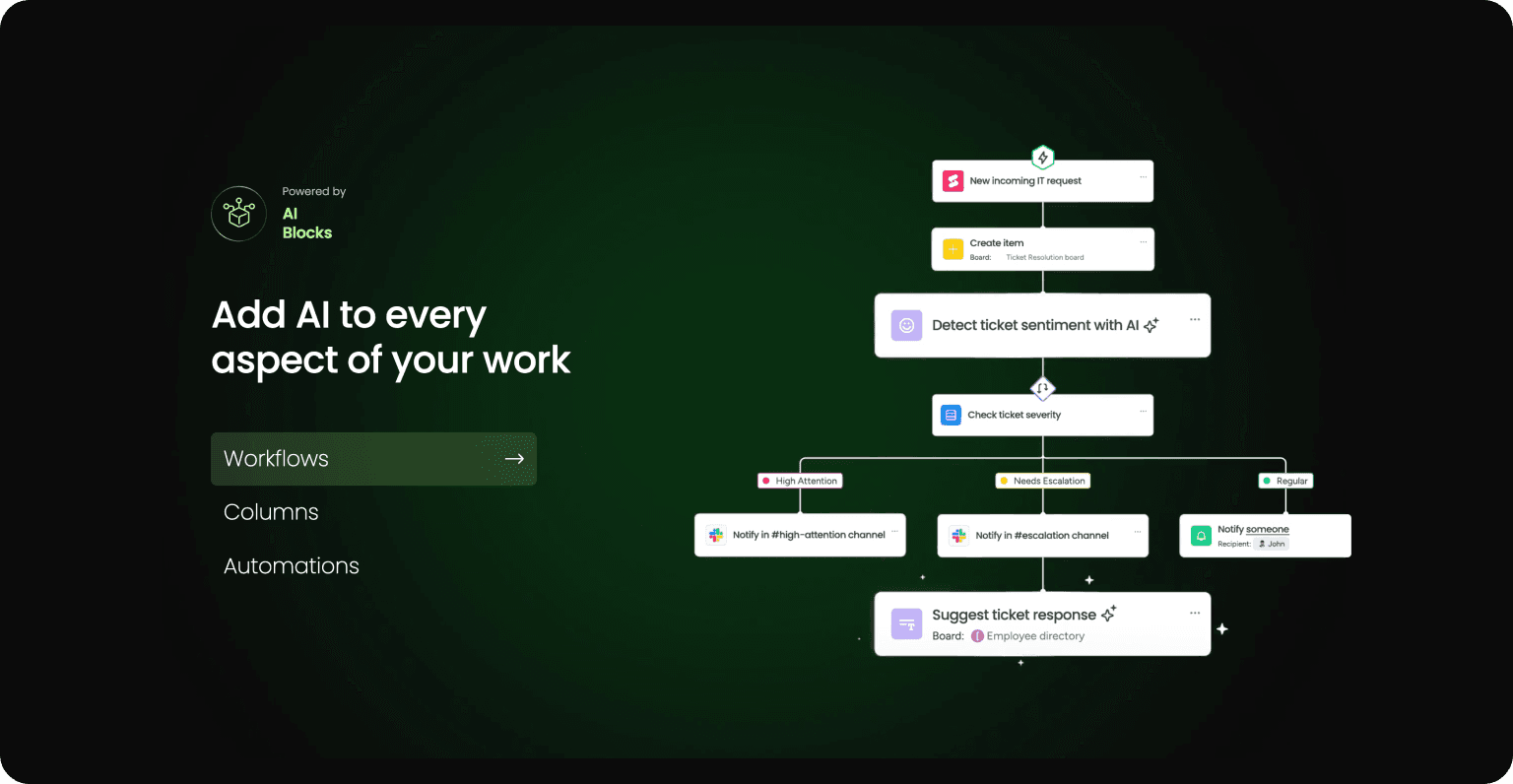
monday.com is also signaling where this work is headed next. In its customer-success content on AI, the company says AI can automatically log interactions, update health scores, and sync data across systems. That matters because health scoring has historically been limited less by theory than by manual work. Teams often know which signals matter, but the data lives in too many places for anyone to keep the score current enough to act on.
Automation can help make the score less stale and more operational. If customer interactions, support patterns, and product usage can be updated without waiting on manual entry, the health score becomes closer to a live instrument panel. For a company that sells itself as a Work OS, that is a meaningful fit: the platform is not just helping customers manage work, it is also modeling how retention work should be managed internally.
The larger lesson is that monday.com’s retention strategy is now inseparable from how well it reads its own customer behavior. With 245,000 customers, more than $1 billion in ARR, and net dollar retention above 110%, the company has moved past the stage where growth alone tells the story. The real edge will come from spotting churn risk early, recognizing expansion before it shows up in the quarter, and using health scores as the operating system that keeps both in view.
Know something we missed? Have a correction or additional information?
Submit a Tip